
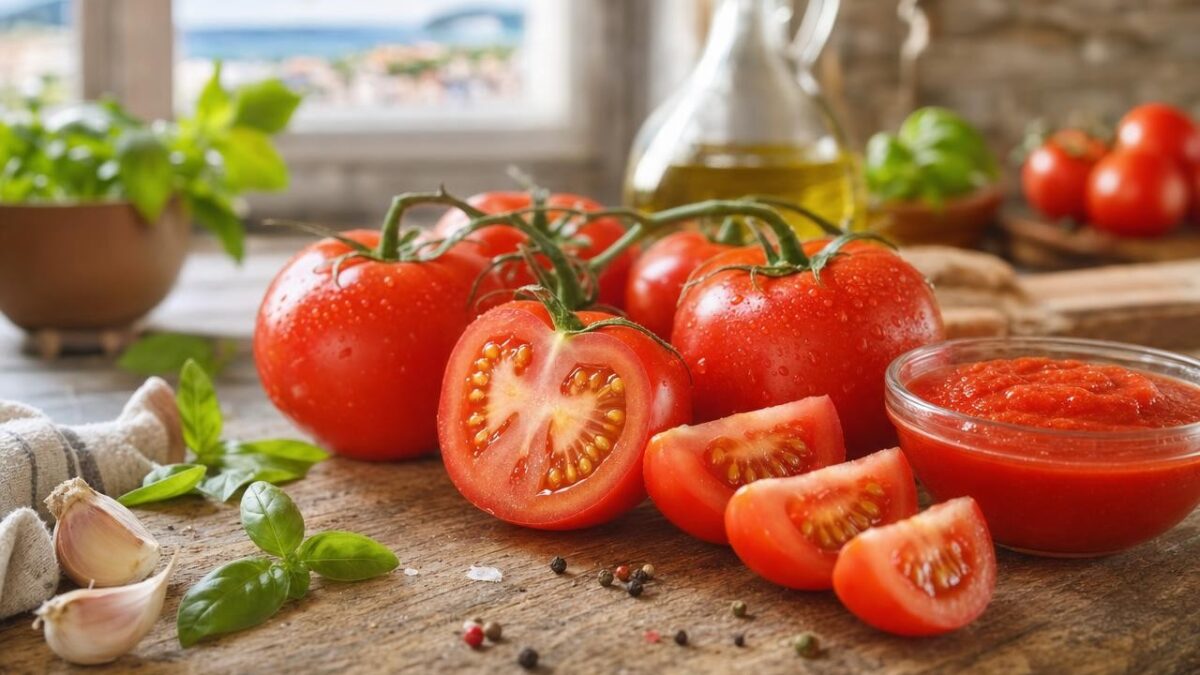
Published on July 30, 2026 in Nutrientsthe POMOSANO study compared two groups of patients suffering from “fatty liver disease” for six weeks. Some consumed 200 g of raw tomatoes and 50 g of tomato sauce every day, the others followed a tomato-free diet. Their liver fat levels decreased more in the first group.
A liver that is too fatty, sometimes without the slightest symptom
Metabolic fatty liver disease, or MASLDcan evolve silently. The liver gradually accumulates fat, particularly in connection with insulin resistance, overweight, obesity or other metabolic risk factors. In certain patients, this accumulation can then be accompanied by inflammation and progress towards fibrosis or even cirrhosis.
Food therefore plays a central role in its care. But one question intrigues researchers: could certain foods act on liver fat independently of weight loss?
This is what a team from the National Institute of Gastroenterology “Saverio de Bellis” in Italy wanted to explore.
The POMOSANO randomized trial included 79 adults aged 18 to 65suffering from MASLD and having a BMI less than or equal to 30 kg/m². They were divided into two groups: 42 in the tomato group and 37 in the control group.
For six weeks, the first had to consume every day 200 g raw tomatoes and 50 g tomato sauce. The others followed a tomato-free diet. Everyone was invited to maintain their lifestyle habits.
To measure liver fat, researchers used the
CAP (Controlled Attenuation Parameter)an indicator obtained with the FibroScan, which makes it possible to estimate the quantity of fat accumulated in the liver.
After six weeks, the difference appears on the FibroScan
The result is quite clear. The CAP score decreased in both groups, but more among participants consuming tomatoes.
The median decline reached 35 dB/m in the tomato group, compared to 18 dB/m in the control group. The statistical analysis confirms a significant difference between the two groups, with an adjusted difference of −26.63 dB/m.
And above all, this development does not seem linked to significant weight loss. Weight, BMI, waist circumference, fat mass and visceral adiposity remained generally stable. The researchers also found no significant differences in blood sugar, blood lipids, inflammatory markers, or liver enzymes.
The authors write that ““Tomato consumption can reduce hepatic fat accumulation independent of major changes in body weight, total and abdominal adiposity.”
But be careful: a reduction in CAP does not automatically mean that the disease is stopped or that the risk of cirrhosis decreases.
Lycopene at the heart of suspicion
Why might tomatoes have an effect on the liver? Researchers are particularly interested in
lycopenea carotenoid responsible for its red color and with antioxidant properties.
Other plant compounds present in tomatoes could also act on oxidative stress, inflammation and hepatic fat metabolism.
Nadege Gunn, hepatologist cited by Preventionexplain : “Research suggests that lycopene may work through several complementary pathways to support liver function by making less new fat, breaking down existing fat more effectively, and pulling less fat from the bloodstream.”.
The form in which the tomato is consumed could also matter. Cooking notably facilitates the absorption of lycopene, while raw tomatoes help preserve certain nutrients sensitive to heat. The protocol therefore combined the two. However, this biological hypothesis remains to be confirmed.
Tomato can help the diet, but does not cure alone
This is the main limitation to keep in mind. The study does not show that eating a tomato a day cures MASLD.
The researchers worked on a small group of participants, for only six weeks and in a single center. Liver fat was assessed indirectly by CAP. No significant benefit was observed on liver stiffness or score FIB-4which makes it possible in particular to estimate the risk of fibrosis.
Randa Abdelmasih, endocrinologist cited by Medical News Todayis therefore cautious: “We cannot conclude that tomato consumption significantly alters disease progression or improves clinically relevant outcomes.”.
Another important point: the participants had a BMI less than or equal to 30. The results cannot therefore be generalized directly to patients suffering from obesity or type 2 diabetes, profiles common among people with MASLD.
However, tomatoes can fit perfectly into a Mediterranean-style diet, rich in vegetables, fiber and nuts and low in added sugars. A portion close to that tested corresponds to one large tomato per day accompanied by a few spoons of slightly sweet tomato sauce. But it must not make us forget the essentials. In people with obesity, lasting weight loss remains the intervention whose benefits on MASLD and fibrosis are best established.