
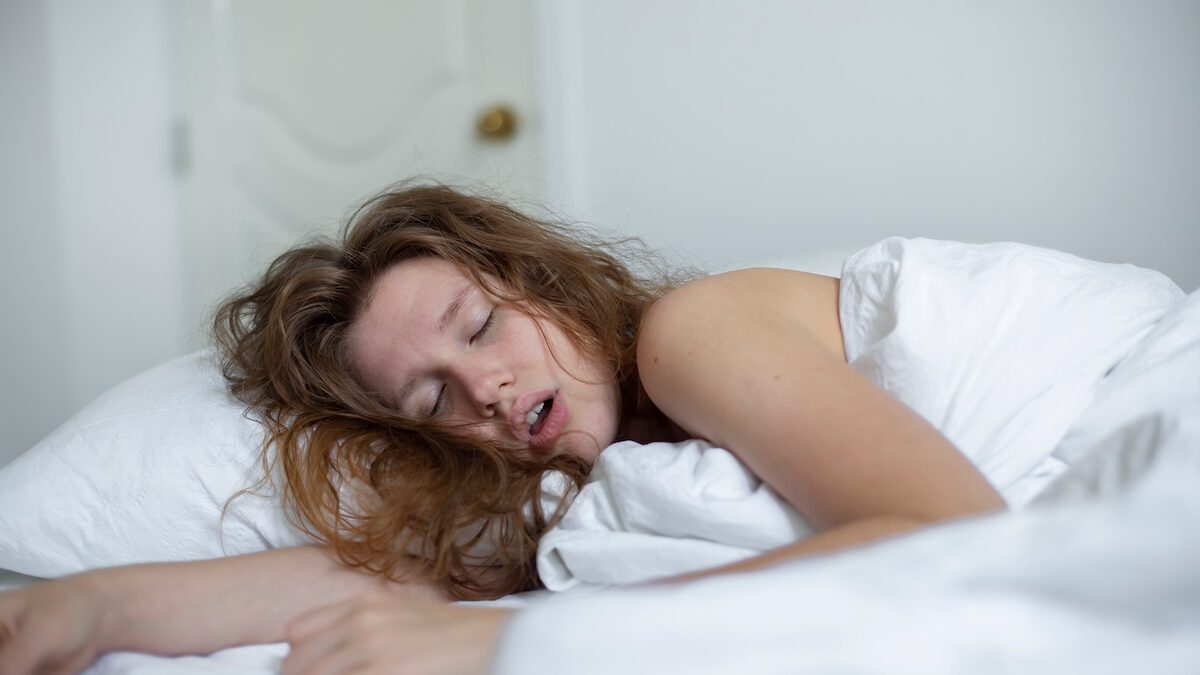
Hearing someone talking in your sleep can make you smile, worry, or wake up an entire household. According to the Sleep Foundation of America, studies indicate that up to two-thirds of the population will have experienced at least one such episode in their lifetime. This phenomenon, which doctors call
somniloquyis benign, but often raises questions: what does it say about our psyche, and when should we be concerned about it?
Somniloquy is classified among the
parasomniasthese unusual behaviors that occur during sleep. The Sleep Foundation specifies that it can appear in both paradoxical sleep (REM) and slow-wave sleep (non-REM), which distinguishes it from other disorders. But first of all, let’s reassure ourselves. for the Cleveland Clinic, “Although it may be entertaining or irritating to those who hear it, or embarrassing or disconcerting to those who speak, sleep talking is probably not a cause for concern.”.
Somniloquy: how does this sleep disorder manifest?
The Cleveland Clinic describes several forms of talking in sleep : simple whispers, sentences spoken in a normal voice, or even shouting out words or complete responses. Some people can speak coherent sentences and hold a mini-conversation, others produce a mixture of garbled words, grunts, and other noises. Most often, the episode lasts a few seconds and the person has no memory of it when they wake up.
Linguistic work cited by Infobae shows that about half of somniloquy recordings are incomprehensible, muffled by sheets or reduced to garbled sounds.
The other half follows normal grammar, with pauses worthy of a real discussion. The content is often negative, exclamatory, or crude, suggesting processing of internal conflicts during sleep.
The Sleep Foundation has also observed a higher frequency among people with post-traumatic stress disorder.
What does somniloquy mean for psychology?
For sleep psychologists, somniloquy reflects above all the continuity of emotions between day and night. Stress, anxiety, undigested arguments or traumatic memories can fuel these nocturnal words.
The Cleveland Clinic points out, however, that these sentences should not be taken as an absolute truth or a “confession”: they reflect an emotional state, not a verdict on the relationship or personality.
Factors that disrupt sleep play a key role. Time desynchronization, sleep deprivation,sleep apneaanxiety, stress, but also alcohol or substance abuse can come into play. To limit episodes, the Sleep Foundation recommends keeping regular schedules, avoiding caffeine in the evening, reducing alcohol, preparing a relaxation ritual, exposing yourself to daylight and practicing regular physical activity.
Somniloquy: warning symptoms and when to consult
But should we be worried when the monologues happen again? Specialists invite consultation if the
somniloquy becomes very frequent, very noisy, is accompanied by significant movements or appears suddenly in adulthood. When nocturnal speech is mixed with sleepwalking, violent nightmares or physically “acting out” one’s dreams, the Sleep Foundation suggests a possible REM sleep behavior disorder, different from simple somniloquy.
Infobae also reports a possible link with sleep apnea: talking while sleeping associated with loud snoring, breathing pauses observed by the partner or significant daytime sleepiness should lead to consulting a sleep specialist. A sleep assessment, such as a polysomnography, can then be offered.
For those around you who are bothered by noise, ear taps, white noise or, in extreme cases, separate rooms remain practical solutions.