
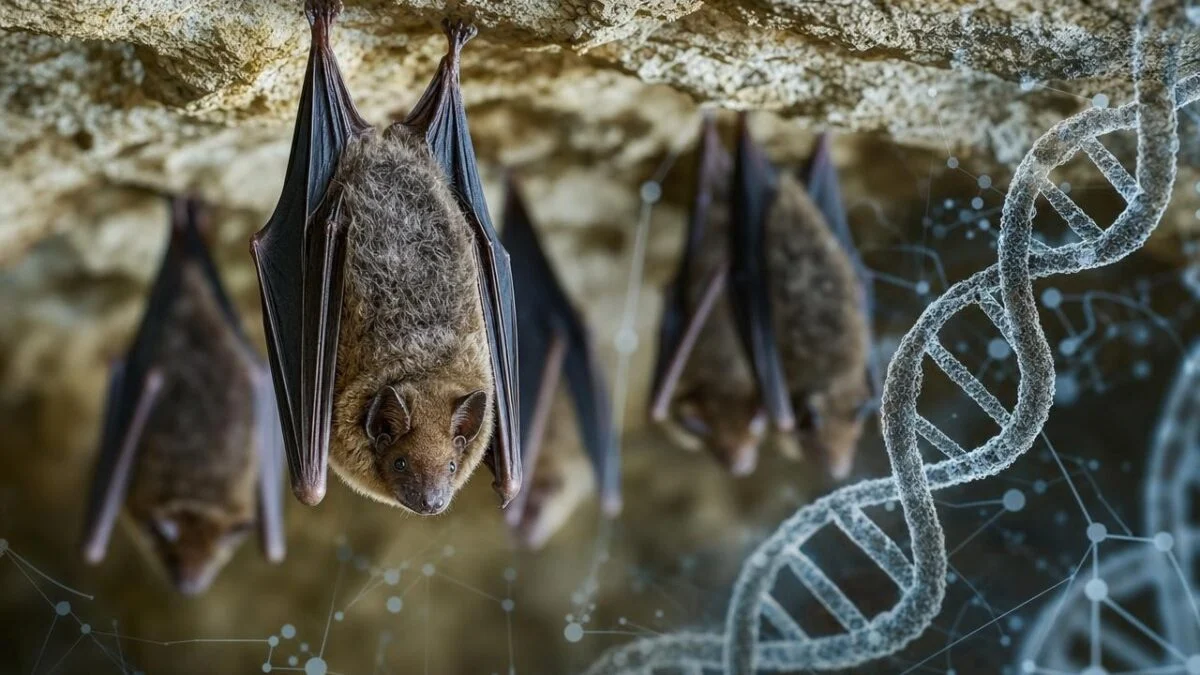
Published in Nature in 2026, this study opens a new avenue to understand why certain animals are more resistant to aging and cancer. A fascinating discovery, even if it is still far from being able to be transposed to humans.
In their DNA, a clue to understand why they age so well
In bats of the genus Myotisthe differences in longevity are spectacular. Myotis brandtii can live over 40 years oldwhile Myotis nigricansof comparable size, hardly exceeds seven years.
To understand this paradox, Juan Manuel Vazquez, now a researcher at Pennsylvania State University, and his team sequenced the genomes of eight species of
Myotis and studied their cells in the laboratory.
The finding is surprising: the genes associated with longevity largely overlap with those involved in interactions with viruses.
“There is much more overlap than would be expected by chance between genes associated with longevity and genes associated with viral interactions.”explains Juan Manuel Vazquez.
The same genetic architecture could therefore help protect the animal against infections and against certain effects of aging.
Their other weapon against cancer: eliminate cells that are too damaged
The researchers notably observed surprising behavior in the cells of Myotis lucifugusone of the longest-lived species in North America.
After artificially causing significant damage to their DNA, they found that the cells were not simply trying to repair the damage. When they seemed too damaged, they quickly activated their planned deathor apoptosis.
A strategy that could have a major advantage: preventing a cell that has become dangerous from continuing to multiply.
““We found the exact opposite of what we would expect if you treat bats with a lethal dose of this chemical.”says Juan Manuel Vazquez.
This response “better to kill the doubtful cell” is reminiscent of that observed in the elephant, another animal particularly resistant to cancer: when a cell can no longer be saved, the body seems to prefer to delete it.
Viruses, aging and cancer may be more linked than previously thought
The study also focuses on proteins capable of interacting with viruses. Among the Myotisthe genes affected by DNA virusnotably herpesviruses, show numerous signs of evolutionary adaptation.
However, some of these genes are also involved in the response to DNA damage. This proximity could explain why the pressure exerted by infections would, over the course of evolution, have contributed to shaping mechanisms that also promote longevity and resistance to cancer.
“Proteins interacting with DNA viruses were highly enriched in selection signals in bats, unlike in most other mammals.”underlines Peter Sudmant, of the University of California at Berkeley.
The bats thus seem to have found a particularly effective balance: fight infections, limit inflammatory damage and quickly eliminate excessively damaged cells.
A lesson in longevity for man, but still many questions
This discovery obviously does not mean that we will soon be able to reproduce the genetic “secret” of these animals in humans. The experiments were notably carried out on cells in culture and do not reproduce the full complexity of an organism.
But they invite us to look at aging differently. Rather than studying cancer, infections, and age-related decline separately, researchers are beginning to explore the biological mechanisms that connect them.
“If you start studying long-lived species like elephants, whales and bats, you start to find solutions that nature has already provided to many human health problems.”believes Juan Manuel Vazquez.
The next step will be to determine whether some of these mechanisms can be reproduced or stimulated in humans. For the moment, the DNA of these tiny mammals does not yet provide the recipe for a longer life. But it reveals one essential thing: To better understand aging and cancer, we may need to learn to look at the animals that have already managed to fend them off.