
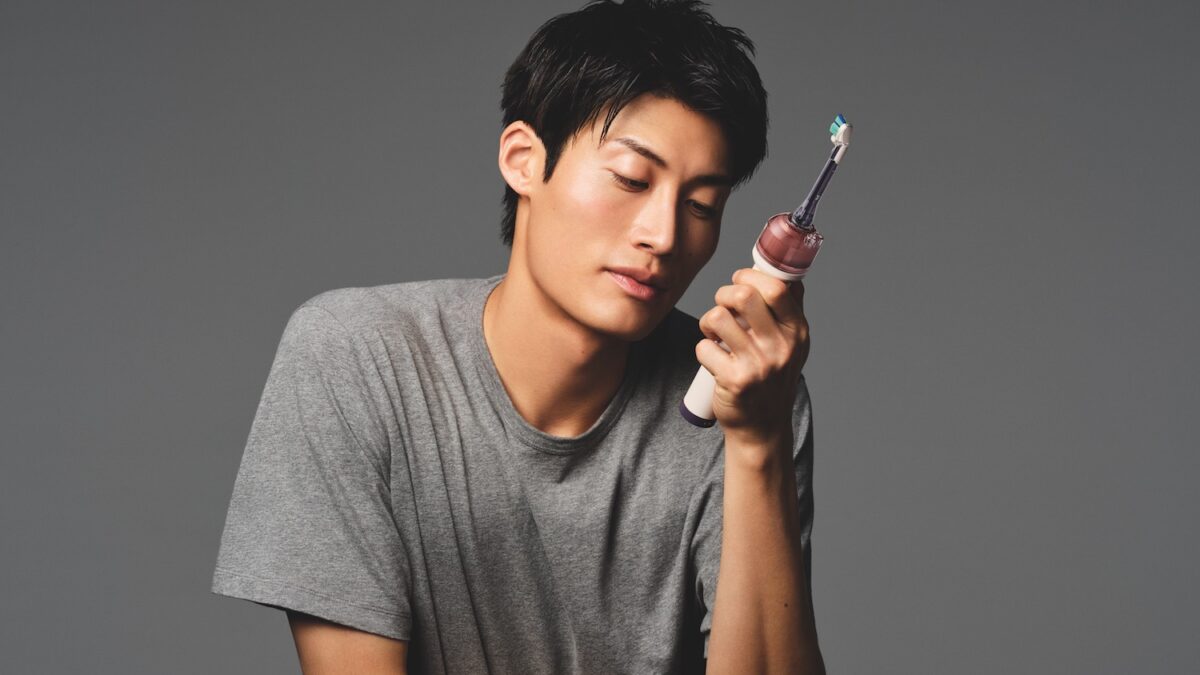
What if your toothbrush could look between your teeth to tell you where to brush? With its new CameraJet, Dyson is pushing connected oral hygiene very far. Camera, artificial intelligence, targeted jet and application: the device wants to transform daily brushing into a real precision session. But at 479 euros, to which are added proprietary consumables, the question is no longer just technological: is this riot of innovations really necessary?
A toothbrush that watches what you do
For decades, a toothbrush has remained… a toothbrush. Dyson clearly wants to change the situation.
The CameraJet combines an electric brush with a 100,000 pixel macro camera. Its artificial intelligence system analyzes
28 frames per second to identify spaces between teeth. When an area is detected, the device can automatically trigger a targeted stream of mouthwash in less than 100 milliseconds.
The idea is to tackle one of the blind spots in brushing: the spaces between your teeth. Dyson also indicates that nine out of ten people do not floss as regularly as they should and that the average time spent brushing is 45 seconds, compared to the recommended two minutes.
The MyDyson application completes the device. It allows you to view brushing live, map the areas cleaned and receive personalized advice. The camera is, however, not presented as a diagnostic tool: it allows you to see certain areas of the mouth, but obviously does not replace a dental examination.
479 euros for purchase… and 10 euros for refills
This is where technology becomes a lot less trivial.
The CameraJet is marketed 479 euroswith two brush heads, Dyson toothpaste, mouthwash and a travel case. The price is explained in particular, according to Dyson, by six years of development, 661 engineers mobilized and 38 patents filed.
But the real cost is also measured over time. The toothpaste and mouthwash have been specially formulated to work with the system. They are sold separately 10 euros eachwhile Sensitive toothpaste costs 12 euros.
In other words, the price displayed on the box is only the beginning of the bill. Before falling for a toothbrush packed with technology, it is therefore better to also look at the price of the brush heads and the products necessary for its use.
Dyson announces impressive results, but with its own tests
To defend its innovation, Dyson highlights a clinical trial carried out over four weeks in Italy with 60 participants. The company indicates that the CameraJet made it possible to obtain 58% less plaque than a manual toothbrush after four weeks. It also claims improved gum health and greater effectiveness in preventing plaque buildup.
These results are interesting, but they must be read in context: this is a trial funded by Dyson and comparing its system to a manual toothbrush under the conditions described by the manufacturer. Part of the other announced performances are also based on laboratory tests or on an artificial plate developed with the National University of Singapore.
So the CameraJet isn’t just a more powerful toothbrush. It’s a complete ecosystemwhich combines equipment, application, mouthwash and toothpaste.
Do you really need artificial intelligence to brush your teeth?
This is ultimately the most interesting question.
For someone who brushes too quickly, regularly forgets certain areas or has difficulty adopting good technique, real-time guidance may be of interest. Dyson seeks precisely to transform the theoretical recommendations of the dentist into corrected daily actions.
But for someone who brushes their teeth properly twice a day and regularly uses recommended interdental cleaning products, the added value of a camera and artificial intelligence is much less obvious.
The CameraJet above all illustrates a trend: our most mundane health actions are gradually becoming grounds for technological experimentation. After watches capable of monitoring the heart or sleep, here is the toothbrush that observes our teeth.
It remains to be seen whether this sophistication will really change habits… or if it will simply transform a two-minute gesture into a new technological object at 479 euros.