
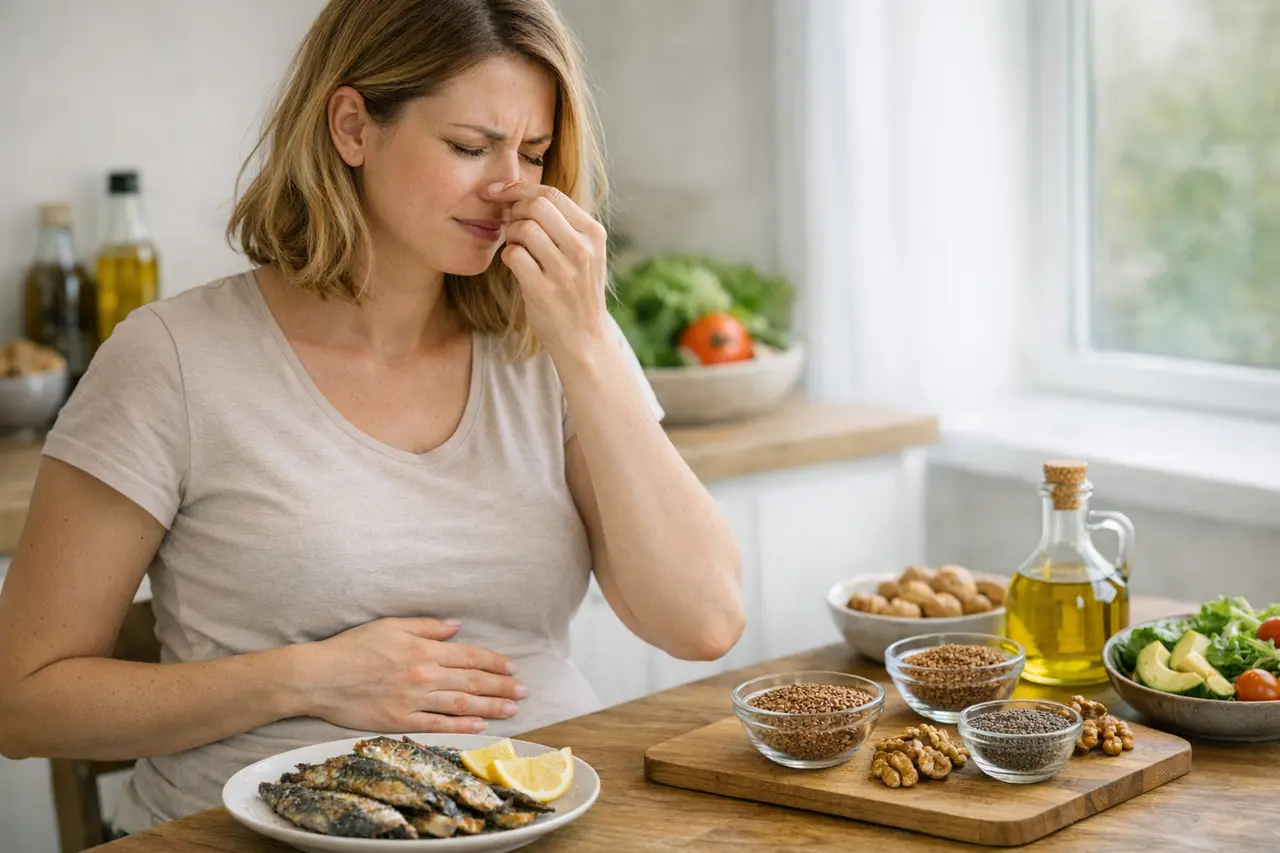
In the 1st trimester, if fatty fish disgusts you, the objective is not to force yourself: stick to well-cooked fish when possible, also rely on useful plant sources, and talk about possible supplementation in consultation. This is the practical message of a video published on Instagram by Dr Laure Einaudi, aka @la.gyneco.
Not all omega-3s are equal during pregnancy
Dr Laure Einaudi, aka @la.gyneco, recalls a point that is often less visible than iron or vitamin B9: omega-3, and in particular DHA. The important nuance is this: DHA contributes to the normal development of the fetal brain and eyes. It’s not a guarantee of “better health” on its own, but it is definitely a key nutrient during pregnancy.
Another useful clarification: we often speak of “omega-3” as a single block, whereas we must distinguish the forms. EPA and DHA are long-chain omega-3sdirectly present in particular in certain fatty fish. Besides, plant sources mainly provide ALA, a precursor.
Rapeseed oil, walnut oil, flax or chia seeds can therefore have their place on the plate. But, as the text accompanying the video also points out, plant-based ALA is not equivalent to a direct intake of DHA/EPAbecause its conversion by the body into DHA is limited and varies depending on the person. In practice, these foods supplement the diet, but do not necessarily replace direct sources of DHA/EPA.
When the fish does not pass, the right marks to keep
The nausea, poorly tolerated odors and food aversions of the 1st trimester can make fish impossible to consider.
According to French guidelines, during pregnancy, it is recommended to consume fish twice a week, including fatty fish oncevarying the species and places of supply. Examples cited in the recommendations include sardines, mackerel, herring or salmon. To go further, you can find the fish to favor and avoid during pregnancy.
Safety also matters: pregnant, the fish must be well cooked. We avoid raw, lightly cooked or smoked fish due to the risk of infection. And the idea of varying species allows you to benefit from nutritional benefits while limiting repeated exposure to the same contaminants.
To simplify without feeling guilty, remember these options:
- When fish is tolerated : favor well-cooked fatty fish, such as sardines, mackerel, herring or salmon, varying the choices;
- When only small amounts pass : small fatty fish, mentioned in the video, can constitute an interesting base, without seeking perfection at each meal;
- Vegetable side : use rapeseed or walnut oil, flax or chia seeds, keeping in mind that they mainly provide ALA;
- When fish is really impossible : discuss the question of DHA/EPA intake with the person following the pregnancy.
You can also consult our article dedicated to the benefits of omega-3 during pregnancy, to replace these benchmarks in the overall diet.
Complementation: an option to discuss, not an automatic reflex
The text of the publication presents supplementation as a possible solution when the plate is not enough or the fish is too poorly tolerated. This is a useful point, provided you remain careful: you should not start a supplement during pregnancy without talking to a healthcare professionalespecially if you are already taking other products or if the follow-up has particularities.
The point of this discussion is to get out of the vagueness. Should we aim for DHA, EPA, both? What dose is appropriate? Is the product compatible with pregnancy? These questions cannot be resolved with an Instagram video, even a useful one, nor with a quickly read label.
The good reflex is therefore to concretely explain the situation in consultation: fish absent for several weeks, significant nausea, vegetarian diet or simple temporary disgust. The professional who monitors the pregnancy will be able to evaluate the entire diet and, if necessary, direct towards targeted supplementation. To understand this framework more broadly, our file on food supplements during pregnancy can help ask the right questions.
The take-home message is simple: in the 1st trimester, not being able to tolerate fish is not a failure. We keep the benchmarks safe, we distinguish plant sources from direct intakes of DHA/EPA, and we ask for a personalized opinion if the intakes seem insufficient.
Too much fish consumption can be harmful – ANSES recommendations
Fish can be exposed to environmental pollutants such as dioxins, PCBs or methylmercury, which can harm health with excessive exposure. PCBs and dioxins are often present in fatty fish such as eels, as well as in certain fish that accumulate these substances, such as barbel, bream, carp or catfish. As for methylmercury, it is generally found in wild predatory fish such as tuna, monkfish or sea bream. For pregnant and breastfeeding women and young children (under 3 years), the Agency recommends taking special precautions:
- Limit the consumption of wild predatory fish, likely to be highly contaminated: tuna, bonito, skate, sea bream, sea bass, monkfish, emperor, halibut grenadier, sabrefish, pike, etc.
- Avoid consuming the most contaminated “large predatory” fish: sharks, lampreys, swordfish, marlins (close to swordfish) and sikis (a variety of shark).