
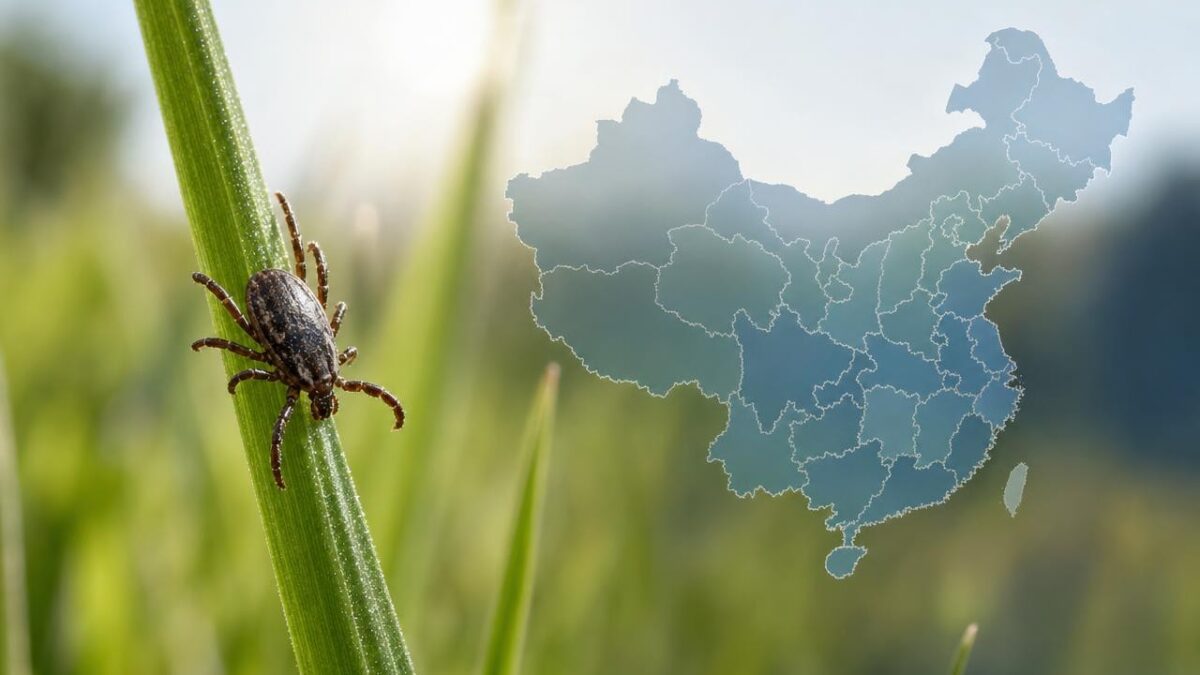
Called ALTNV, this new virus seems to cause a rather moderate infection when present alone. But associated with Dabie bandavirus, it could make the disease much more severe.
A known disease… but a test that doesn’t work
It all starts with a situation that intrigues Chinese doctors: patients bitten by ticks develop fever, fatigue and digestive problems, with a picture that resembles
severe fever with thrombocytopenia syndrome (SFTS).
This disease, caused in particular by the Dabie bandavirus (DBV), can be serious and has a mortality rate of
10 to 30%. But in some patients, the analyzes do not find the virus.
To solve this enigma, a team from State Key Laboratory of Pathogen and Biosecurityin Beijing, led by Xiao-Ai Zhang, studied 3,163 people with fever
treated in sentinel hospitals after a tick bite.
Result : 10.4% were infected with a previously unknown virus. In DBV negative patients, this proportion even reached 15.1%.
The researchers named it Asian longhorned tick nairovirus (ALTNV), which could be translated as Asian longhorned tick nairovirus.
In the ticks too, the virus was there
Genetic analyzes show that ALTNV belongs to the orthonairoviruses, in the Nairoviridae family. It is different enough from already known species to be considered a distinct emerging virus.
The researchers then analyzed 47,428 ticks from 15 Chinese provinces. ALTNV RNA was found in 1.29% of them, and up to
1.75% at Haemaphysalis longicornis.
Experiments have also shown that this species can transmit the virus to mice.
The discovery is therefore not based solely on human samples: ALTNV does indeed seem to circulate in ticks and be able to be transmitted through them.
An essential question then remains: what does this new virus really cause in humans?
Alone, ALTNV seems rather moderate. With DBV, the danger increases
Among the 56 patients infected only with ALTNVthe most common symptoms were fatigue (84%) and gastrointestinal disorders (80%). Thrombocytopenia was observed in 38% of them and an increase in aminotransferases, which could indicate tissue damage, in 36%.
But one element is rather reassuring: all recovered completelyaccording to the study published on September 2, 2026 in the New England Journal of Medicine.
The scenario is different when both viruses are present simultaneously. The researchers identified 38 patients co-infected with ALTNV and DBV.
Among them, respiratory symptoms affected 61% of patients, compared to 38% with DBV alone. Renal damage affected 84% of co-infected patients, compared to 66% in those infected only with DBV.
And above all, seven of the 38 co-infected patients died, or 18.4%.
These results do not allow us to assert that ALTNV is directly responsible for the worsening. But they constitute a signal that deserves close monitoring.
Behind the virus discovered, a very concrete issue
DBV is already a known threat in several parts of Asia. But so far, more than 30% of patients presenting a typical picture of SFTS could remain negative in tests looking for this virus.
ALTNV could explain some of these situations.
“The cocirculation of ALTNV and DBV in the same areas, associated with their common vector, highlights the need to improve the differential diagnosis between these infections in regions where SFTS is endemic.”write the authors in the New England Journal of Medicine.
The challenge now is to understand how far ALTNV circulates, what is its real capacity to cause serious forms and what happens when two viruses simultaneously infect the same person.
The discovery does not mean that a new global threat has emerged. However, she reminds us that diseases transmitted by ticks are a constantly evolving world. And that a negative test for a disease that seems familiar does not always mean that there is no virus:
sometimes medicine just didn’t know which one to look for yet.