
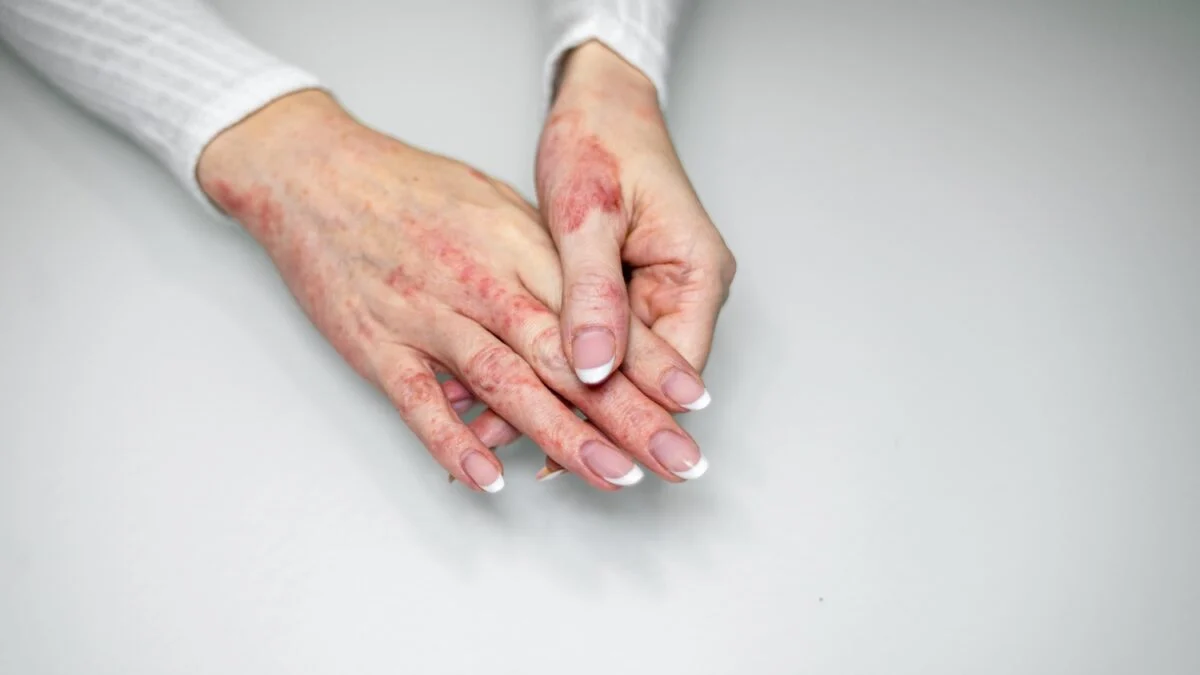
In France, almost 2.7 million adults
would be affected by chronic hand eczema. For moderate to severe forms, its cost is estimated at 7.6 billion euros per year72% of which are linked to the professional consequences of the disease.
Painful hands that complicate everyday actions
Chronic hand eczema is an inflammatory disease that affects the hands and sometimes the wrists. It becomes chronic when the lesions persist for more than three months or reappear at least twice a year.
Redness, itching, blisters, cracks, thickening of the skin and pain can accompany flare-ups. And these are often unpredictable. Washing your hands, cooking, writing or simply holding your children can then become difficult. Sleep disorders linked to itching, but also discomfort linked to the appearance of the hands, can further make daily life more difficult.
When work maintains illness
The problem is particularly marked in the professional world. 80 to 90% of occupational dermatoses affect the handsparticularly in professions exposed to water, detergents, solvents or prolonged wearing of gloves.
Hairdressers, bakers, maintenance workers, nurses and even certain industrial workers are particularly exposed. The disease can create a real vicious circle: working conditions maintain the injuries, while the injuries can in turn prevent you from working.
For dermatologist Bruno Halioua, the problem remains too often trivialized:
“Hand eczema is still too often considered a temporary problem. It is a chronic and painful illness, which affects a limb with which we work, we cook, we write, we hold our children. Making a precise diagnosis and looking for causes, particularly professional ones, should be a reflex: this is what allows action to be taken before a patient is forced to give up their profession.”.
Next to 20% of those affected should have already changed profession because of their hand eczema, while 12.5% reportedly encountered difficulty finding employment.
7.6 billion euros: most of the cost comes from labor
According to the study carried out by Asteresthe annual cost of moderate to severe forms of chronic hand eczema reaches 7.6 billion euros. But the most striking figure is found elsewhere: 5.5 billion euros, or 72% of the total, correspond to the socio-economic consequencesmainly work stoppages and loss of activity. Medical expenses represent 2.1 billion euros.
Absenteeism alone represents 4.6 billion euroswith approximately 26 days of absence per patient per year. Added to this are the consequences of exclusion from the labor market: 42,000 people of working age would be affected, at an estimated cost of 818 million euros per year.
For economist Nicolas Bouzou, this distribution strongly distinguishes chronic hand eczema from the other diseases studied:
“In most chronic diseases, healthcare expenditure constitutes the first cost item. Here, the relationship is reversed: almost three quarters of the burden occurs outside the health system, in work stoppages and job exits.“.
The study also specifies that its estimate remains conservative: certain costs, such as presenteeism, expenses directly borne by patients or the consequences for caregivers, have not been quantified.
Consult before illness disrupts work
To limit this burden, the authors identify several levers: diagnose earlierinvestigate the causes, particularly professional or allergic, and adapt working conditions when possible.
Early treatment can in particular make it possible to better protect the hands, replace certain products or adapt professional actions. The objective is to prevent lesions initially considered as simple dry skin from ending up lastingly compromising professional life.
As Stéphanie Merhand, founder of the French Eczema Association, recalls:
“Behind these more than 7 billion euros, there are people: a patient who has given up consulting, an employee on leave, an abandoned career..
Hands that itch, crack or cause lasting pain are therefore not necessarily a sign of simple dry skin. Appropriate diagnosis and treatment can also help prevent the disease from becoming an obstacle to work and daily life.