
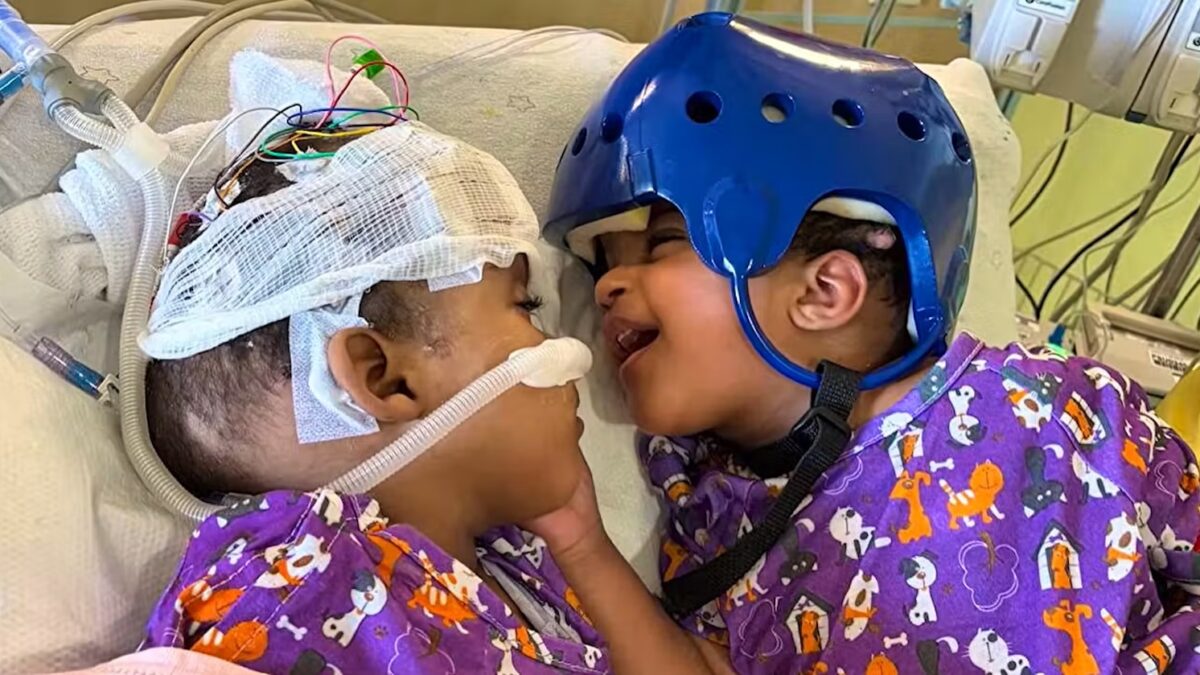
Arriving from Ethiopia in 2025, the two girls required more than 300 hours of preparation and the mobilization of dozens of specialists. But their separation is only a stage: they must now learn to live with their new body.
Two little girls, one skull
Hiyab and Wuhbto are 2 years old. Born in Ethiopia, these so-called twins
craniopages were connected by the skull. Their anatomy was particularly complex, including shared vascular structures.
In March 2025, shortly before their first birthday, they arrived in St. Louis, Missouri, to be cared for at SSM Health Cardinal Glennon Children’s Hospital. Their journey mobilized an international network bringing together doctors, caregivers, associations and reception structures.
Even before the operation, more than 300 hours of preparation were necessary. The teams notably used three-dimensional anatomical models to anticipate each stage of the intervention.
An operation lasting more than 24 hours where every gesture counted
On February 24, 2026, the two girls entered the operating room. The procedure continued without interruption until the next morning.
The separation itself was carried out at 2:31 a.m., February 25after hours of work. In total, more than 24 hours passed between the start of the intervention and the return of the two children to intensive care, each in their own bed.
“Successful surgical separation of craniopagus twins requires sublime precision, meticulous attention to detail, and highly complex coordination across many specialties and with our partner institutions.”says Dr. Andrew J. White, medical director of SSM Health Cardinal Glennon.
The challenge was considerable: surgeons had to simultaneously protect the brains, blood vessels and facial structures of both children.
A situation so rare that every case counts
Conjoined twins are already exceptional. The craniopagus forms are even more so. According to the National Library of Medicine, twins joined at the head occur in approximately
one in 2.5 million live births and represent less than 6% of conjoined twins. A medical journal also listed 69 well-documented cases of craniopagus twins and 62 attempts at separation in the world.
The difficulty, however, varies considerably from one case to another. Some pairs share skull structures, others vessels or brain tissue. It is this anatomy which determines whether a separation can be considered and at what cost.
For Hiyab and Wuhbto, successful surgery does not mean that the medical journey is over.
Now learn to live apart
After their separation, the two girls joined the Ranken Jordan Pediatric Bridge Hospital for a long rehabilitation.
They must now learn gestures that other children acquire naturally: sit, eat, talk, play, interact with others and gradually move to standing and walking.
“They can now participate in individualized therapy to perform activities of daily living that they could not do when connected, such as sitting up straight, and they will eventually be able to learn to stand and walk.”explains Dr. Nick Holekamp.
A new intervention is also necessary for each.
Wuhbto has already benefited from cranioplastyintended to reconstruct his skull. Hiyab is scheduled to undergo a similar procedure in the fall.
The road remains long and doctors cannot yet know how far each person will be able to progress. But a step unimaginable just a few months ago has now been reached:
Hiyab and Wuhbto can grow with their own bodies, learn to move independently and gradually build their own autonomy.
Their story also shows that, behind such a spectacular surgical feat, the real issue is much simpler: allowing two little girls to be able, finally,
grow up like two children.