
We come back from the races with a beautiful yellow cluster, and three days later the bananas are already tiger-colored, or even completely black. This scenario comes up often, because this very fragile fruit ripens and spoils quickly, especially in a heated and humid kitchen. To limit waste, Marmiton points out that a few targeted actions are enough to keep bananas presentable for several more days.
Here’s how to apply them on a daily basis.
Rule #1: the right temperature to store bananas without them turning black
Marmiton recommends keeping bananas in a cool, dry place, around 12°C, away from the sun. In most homes, this corresponds to a room at 15–20°C, away from the oven and radiators. Top Santé reports that work cited from the University of California at Davis suggests “cold lesions” below 12°C, which damage the texture. A refrigerator set at around 8°C causes precisely this “cold snap”: the skin becomes gray or very dark and the fruit appears less attractive.
“Refrigeration alters the ripening of bananas, which will blacken just like that of other exotic fruits.” confirms Alexandra Murcier, nutritionist. They are therefore stored at room temperature, in a dry place and away from direct sunlight.
The fridge remains useful at the right time. Marmiton explains that, once the bananas are ripe, placing them in the refrigerator saves one to two days of consumption. The skin turns black, but the flesh remains intact. To avoid waste, simply open the fruit: as long as the flesh has no liquid areas, suspicious odors or mold, the banana is still edible.
Rule #2: wrap the peduncle and keep climacteric fruits away
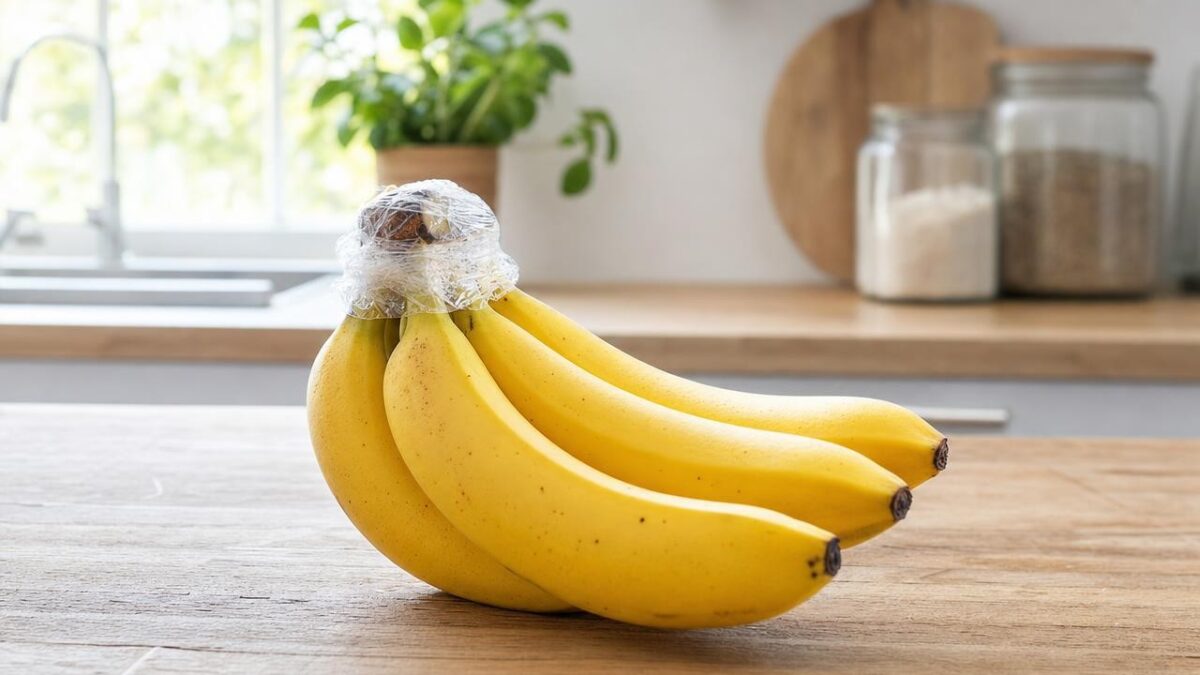
The Marmiton article recommends wrapping only the banana stems in cling film or aluminum foil. This area, called the peduncle or crown, emits a lot of ethylene, the natural gas that accelerates the ripening of climacteric fruits like bananas. By isolating the stalk, we slow down the diffusion of this gas and prolong freshness. Top Santé reports that this gesture, combined with a good temperature, would save between 2 and 5 days.
It is also advisable to keep bananas away from apples, pears, kiwis or avocados, which are also large producers of ethylene. Santé Magazine reminds us that deliberately bringing a banana closer to one of these fruits causes everything to ripen in 24 to 48 hours. Useful if you want a smoothie tomorrow, but avoid if the goal is to keep the bananas longer.
Rule n°3: hang the bananas and limit shocks during races
Bananas placed on a work surface or packed in a bowl experience pressure which creates dark spots and accelerates deterioration. Hanging them on a hook or on a banana holder prevents these bruises and ensures better air circulation, which carries away some of the ethylene. Marmiton specifies that a plastic bag or a closed container, on the contrary, promotes humidity and early rot.
The Interprofessional Banana Association, via the LaBanane.info website, also emphasizes the sensitivity of this fruit to shocks upon purchase. It’s best not to slide the bananas into the bottom of the shopping cart under the bottles, or trap them under a heavy bag. Once at home, letting them breathe, hanging, in a cool, dry place, remains one of the simplest ways to preserve bananas without them turning black too quickly.