
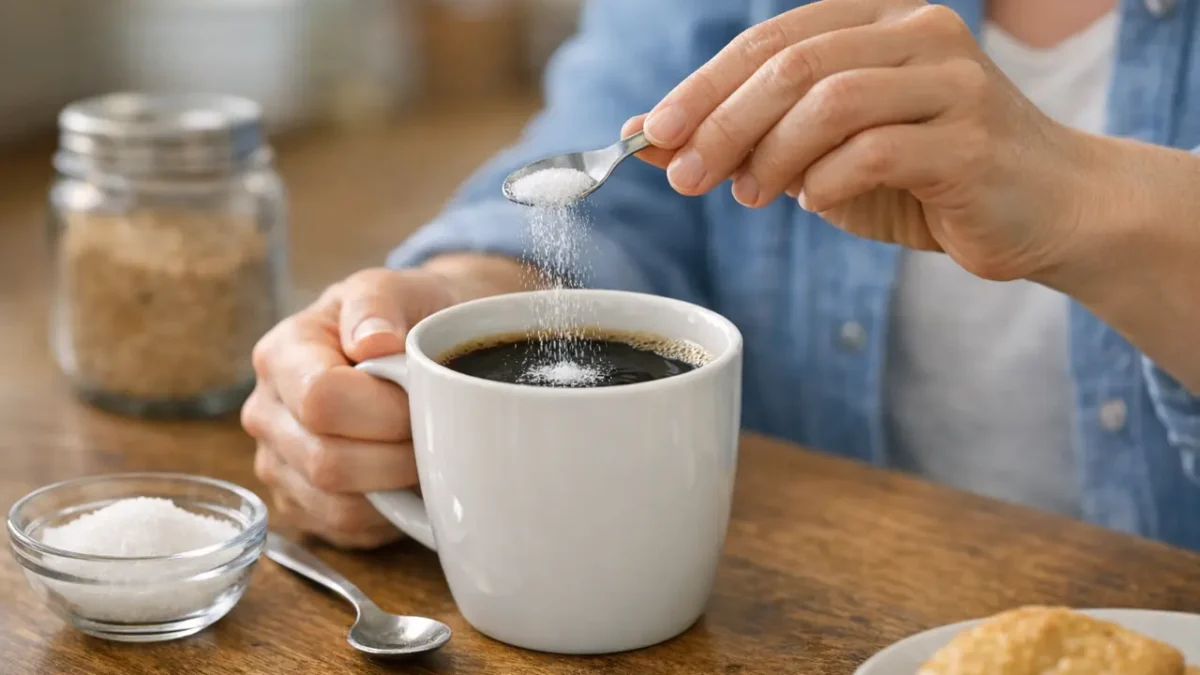
Are you replacing the sugar in your coffee with xylitol to make it “healthier”? In “Advice from Doctor Kierzek” on HERE, the emergency doctor and medical director of True Medical, urges caution: it is better to gradually reduce the sweet taste than to look for a miracle substitute.
Xylitol is not just a “healthier” sugar
In the column, Dr Gérald Kierzek starts from a very common gesture: sweetening your coffee because coffee without sugar seems “less interesting”. He recalls that xylitol is a polyol, also called sugar alcoholused as a sweetener to replace sugar.
It is found in particular in certain “sugar-free” products, such as chewing gum or confectionery. The doctor also mentions toothpaste, while emphasizing that xylitol is popular because its taste is similar to that of sugar. To understand where it is located among the different types of sweeteners, it is important to remember that it is not to be confused with all the so-called “unsweetened” sweeteners.
On the labels, xylitol may appear under the code E967as confirmed by the EFSA page dedicated to sweeteners authorized in the European Union. This statement should not lead to considering all “sugar-free” products as dangerous, nor automatically better: their benefit depends on the product, the quantity consumed and the health context.
The cardiovascular signal calls for caution, not to conclude too quickly
The point which motivates the doctor’s alert concerns an analysis presented at the congress of the European Society of Cardiology. According to the press release from the European Society of Cardiology of August 26, 2026, it concerns 17,710 participants from two prospective observational cohortsCLSA and EPIC-Norfolk.
Dr. Kierzek reports a higher risk of cardiovascular events among xylitol users: +57% over 6 years in one cohort, and +18% over 30 years in the other. An essential nuance: this is not a trial simply comparing people who “take” xylitol to others who do not. The results compared participants with the highest blood levels of xylitol to those with the lowest levels, with more major cardiovascular events, defined as death, myocardial infarction or stroke.
The doctor also mentions a possible mechanism: xylitol could make platelets more reactive and promote the formation of clots. But the reservation he makes is central:
“This is not proof of cause and effect, but it calls for caution.”
In other words, these data show an association, not proof that xylitol causes heart attacks, strokes or death. However, they are enough to avoid presenting this sweetener as a harmless solution to automatically add to your coffee.
In coffee, the advice is to reduce rather than replace
Dr. Kierzek then broadens the topic to sweeteners. He recalls that the World Health Organization recommends, in a conditional recommendation, against the use of sugar-free sweeteners to control weight or reduce the risk of chronic diseases. This position is detailed in the WHO recommendation published in 2023 on sugar-free sweeteners, and extended in our article on WHO recommendations on sweeteners.
This recommendation, however, has important limitations:
it does not concern people with pre-existing diabetes and does not target polyols like xylitol, because they provide calories. It should therefore not be used to modify medical or nutritional care alone.
In the cafe, the doctor’s practical advice is simple:
“The best thing about your coffee is to add nothing.”
To achieve this without brutality, he proposes a logic of taste education, close to the idea of gradually reducing sugar consumption:
- Choose a coffee whose taste you really like;
- Go from one sugar to half a sugar, then reduce again;
- Locate xylitol on labels, particularly under the code E967.
The goal is not to make people feel guilty about occasional use of a sweetenerbut to avoid systematically maintaining the need for sweet taste in coffee. For people who are diabetic, followed for a chronic illness or have specific dietary constraints, this type of change is discussed as part of the usual follow-up.