
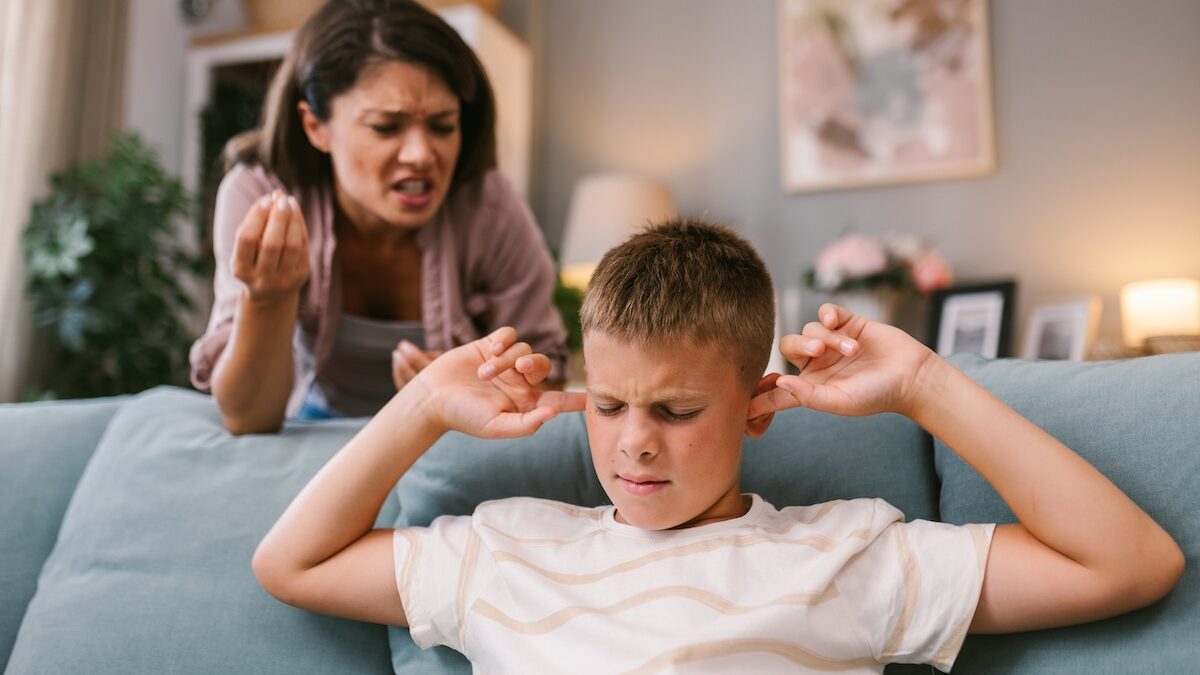
In class, with grandparents, with friends… Your child only receives compliments on his behavior. However, at home, it’s something else. Once alone with you, the angel turns into a little demon, criticizes, rebels, provokes you… A sometimes exhausting stage which also leaves you with some questions: is there something you missed?
At school, your child must constantly adapt
Before worrying, you should know that this shift in behavior is very common. “It’s something banal and quite normal.”explains clinical psychologist Aline Nativel Id Hammou, author of Parental mental health: the essential guide to the psychological well-being of parents.
This phenomenon can concern young children, particularly between 3 and 5 years old, but also children aged 6 to 10 and adolescents. Several factors can come into play: the child’s age, personality, relationship with his parents, but also his status as a student.
Because being a school or college student requires a lot of effort.
“We will ask him to be in this posture of sharing, attention, concentration, respect for the rules, instructions, exercises, but also to manage his frustrations”explains the specialist.
During the day, the child must therefore adapt to a collective setting, listen, concentrate, respect rules and deal with others. An adaptation that can require a lot of energy, especially when relationships with peers are complicated or the child feels social pressure.
“There is also this whole composition around the peer group, succeeding in making friends, the social image“, underlines Aline Nativel Id Hammou. In other words, behind a child who is perfectly well behaved in class can hide a child who has made a lot of effort to control his emotions and adapt to his environment.
At home, he feels safe enough to release the pressure
So why does all this explode once you walk through the door? For the psychologist, the notion of emotional security is central.
Parents are the child’s main attachment figures. With them, the emotional bond is not the same as with a teacher: “The child needs to feel and experience it, that these attachment figures have unconditional love.”
The house thus constitutes a space in which the child can further release the pressure accumulated during the day. “The return home becomes a form of decompression”explains the specialist.
Anger, tears, agitation, opposition or on the contrary overwhelming excitement: this discharge is not necessarily linked to a bad day. A child may also come home excited because he had a great time at school.
In both cases, the parent represents a secure anchor point. “The child allows himself to unload, to explode, to project onto the parent, since he is convinced that the parent will stay and will continue to love him,” explains Aline Nativel Id Hammou.
This obviously does not mean that all reactions are acceptable. But behind these behaviors may lie a need for co-regulation: the child still needs the adult to put words to what he feels and gradually learn to regulate his emotions.
“We don’t necessarily have to try to stop everything”
Faced with a child who comes home from school angry, the first instinct may be to want to stop the behavior immediately. However, the psychologist instead invites parents to be patient, attentive and available.
“I always encourage parents to be patient, to listen, to be available, to accept that their child can unload, project”she advises.
The idea is not to let all behaviors pass, but to allow the child to have a real airlock between his school day and evening obligations.
A snack, a few minutes of rest, a moment of play, a discussion, a hug or even physical activity can help make this transition. “It could be going to the park 30 minutes before going home, coming home and allowing yourself to lie on the ground, do a dance.” suggests the specialist.
These little rituals are to be adapted to the personality and age of each child. For some, it will be a quiet time; for others, on the contrary, it will be necessary to move, run or play before being able to regain a certain availability.
A moment of listening not to be skipped
The objective is also to avoid immediately linking school, homework, meals, shower and bedtime without giving the child time to breathe. “We can also allow our child to have this decompression chamber, to put away the problems of the day”explains Aline Nativel Id Hammou.
This moment can also be an opportunity to review with him what he has experienced: an argument in the yard, a difficulty with a teacher, a problem with a classmate or simply a particularly tiring day.
The parent can then help them put their emotions into words, without necessarily approving the excessive behaviors that result. “The goal is to validate your emotions,”
specifies the psychologist, and to gradually offer him tools to learn how to manage them.
This can involve very concrete solutions: thinking together about what they could do during a conflict at recess, asking them if they would like their parent to talk to the teacher or even offering to invite a friend home when a relationship difficulty arises.
What if your child was just happy to see you again?
Finally, we should not underestimate the importance of reunions. After a day at school, the child may need to reunite with their parents before they can get back into the rhythm of family obligations.
The specialist speaks of “exclusive and secure connections”: privileged times of affection and presence which allow the child’s emotional reservoir to be refilled. And that we sometimes forget, caught up in a busy and structured schedule.
A few minutes of discussion, a game or simply a moment spent together can therefore be important. “These famous times of affectivity” can then facilitate the transition to homework, hygiene care, meals and other evening obligations.
So, if your child is a real little angel at school but transforms at home, there is no need to immediately conclude that you have “missed” something in his education. This contrast can also reflect the adaptation efforts he makes during the day and the security he finds with his parents. It then remains to support him so that this decompression can gradually be done in a more appropriate way.