
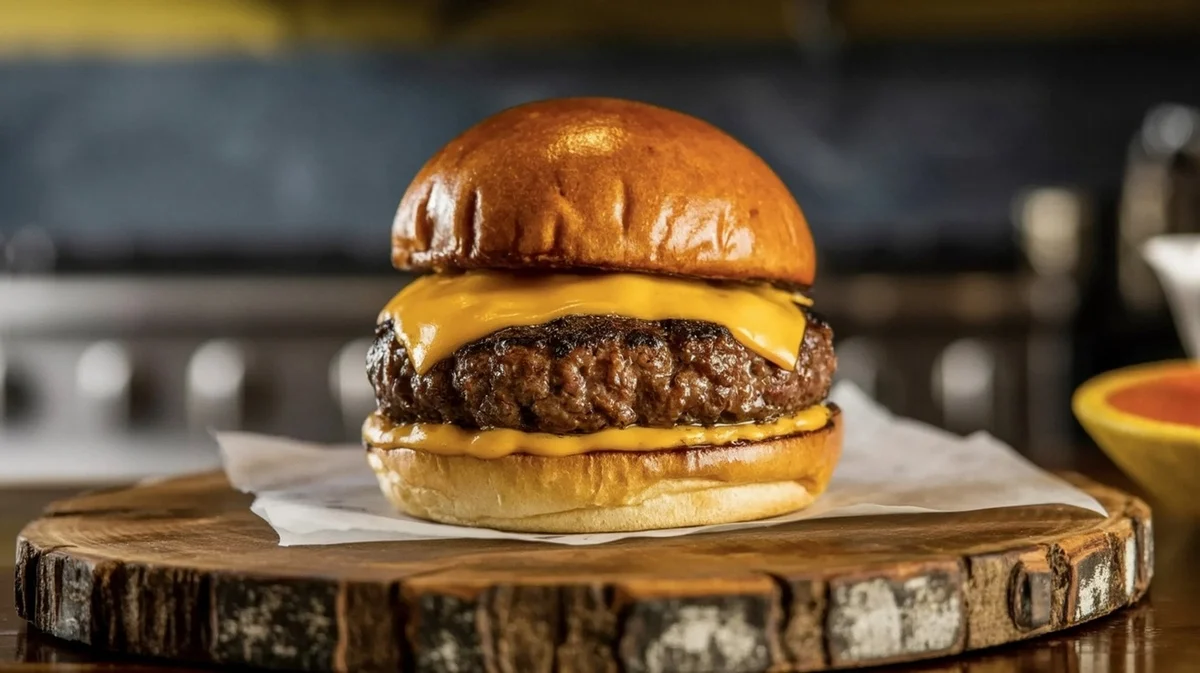
A little ketchup and salad, a slice of cheese that melts on the still hot meat… and your burger is ready. But when you’re filling your basket, have you ever looked at what’s hidden behind those little orange slices? Not all of them have the same composition, and some are more harmful than others for your health.
Cheese, processed cheese or specialty cheese: what are the differences?
At first glance, the packaging of all these cheeses looks similar. However, in reality, not all burger slices come from a wheel of Gruyère or Mimolette cheese.
“The first thing to know is that not all burger slices are real slices of cheese. Some are simply cheese cut into portions. Others are processed cheeses, made from one or more cheeses to which melting salts are added to obtain a homogeneous and melting texture. Finally, cheese specialties can contain different dairy ingredients and, depending on the recipe, various fats“, recalls the dietician-nutritionist.
In other words, a slice that looks like cheese is not necessarily cut directly from a wheel: it can turn out to be much more transformed. And it is moreover this chemical transformation which often makes it possible to obtain a very supple texture – melting on the meat.
From one slice to another, the protein, calcium and salt content may change
Then, once the nature of the product has been identified (cheese, processed cheese or specialty cheese), it is still necessary to compare the labels. Because all these specialties do not have the same nutrient intake. “These products provide protein and calcium, but the quantities vary from one reference to another,” confirms Julie Boët.
And while some are good for your health, others, like fats and saturated fatty acids, deserve to be monitored more closely.
“They can increase LDL cholesterol when you consume too much, which increases cardiovascular risk. If your cholesterol level is already high, it is better to take the time to compare labels,” advises the specialist.
Another ingredient that can prove problematic: salt. On a daily basis, we quickly exceed the recommended sodium intake. The right reflex then? Compare, once again, the salt content per 100 g of each product.
And cast iron salts, should we be wary of them?
Not necessarily. They are mainly used to obtain a very melting texture and to stabilize the cheese. “But their presence does not automatically mean that the product is bad for your health“, recalls Julie Boët.
Fat, in small doses, can be accepted
Finally, any cheese containing fat should not scare you.
“The idea is not to remove all fat from your diet, but to limit saturated fats and favor good fats, present in olive oil, nuts and fatty fish.“, explains the dietician.
How do you ultimately choose your cheese slices on the shelves?
To make the right choice, start by checking the name of the product and its list of ingredients. Then take a look at the nutritional table per 100g, comparing fat, saturated fatty acids, salt and protein.
“Also think about the portion you are actually going to eat: a 20 g slice obviously does not provide as much saturated fat as 100 g of product,” recalls the dietician-nutritionist.
Then, if possible, choose an organic and French product.
Another point to keep in mind: cheese is only one element of the burger. “Bread, meat, sauces and sides count too. Adding some raw vegetables, choosing a suitable source of protein and varying the accompaniments allows you to further balance the meal without sacrificing pleasure.“, underlines Julie Boët.
Finally, to vary the pleasures, nothing prevents you from varying. A slice of raclette one day, a slice of melted cheese the following week…
“The main thing is to know what you are buying, to compare the compositions and to take into account your entire diet, rather than demonizing a single product.”
concludes Julie Boët.