
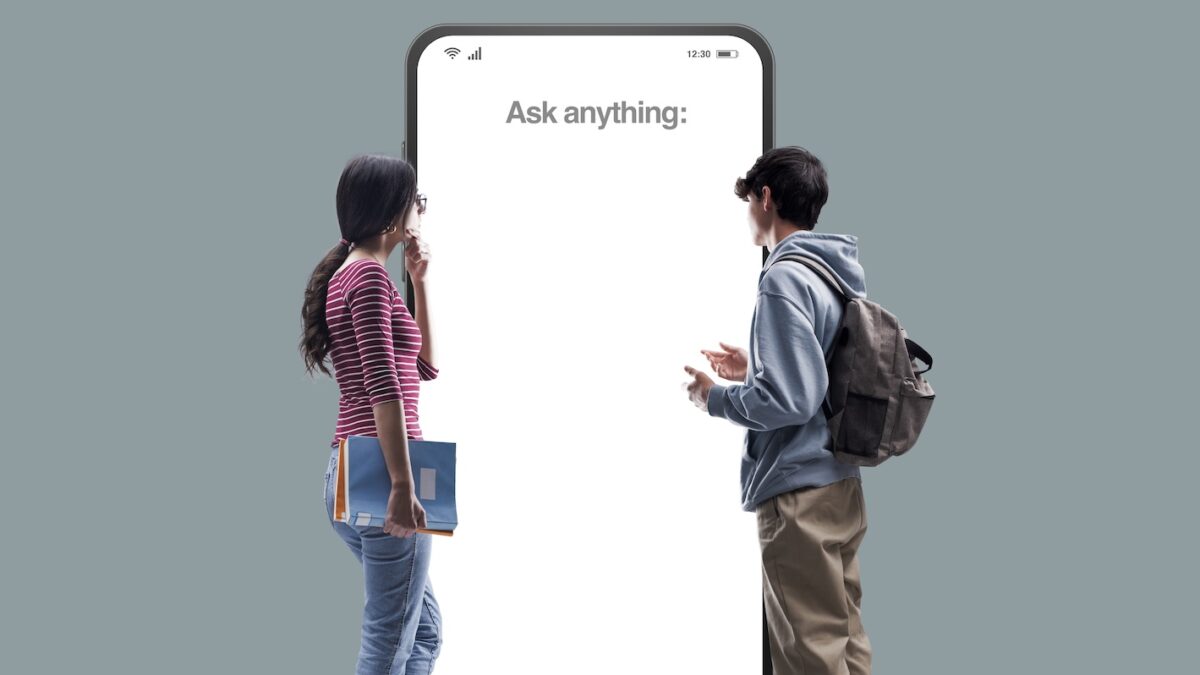
Permanent availability, apparent absence of judgment, personalized responses: AI is installed in our privacy. For psychoanalyst Christian Richomme, this development raises an essential question: by favoring exchanges without frustration, are we risking making our human relationships more difficult to live with?
Why is it sometimes easier to trust an AI?
She is available at all hours, does not sigh, does not seem to judge and does not risk telling our secrets to a mutual friend. When faced with artificial intelligence, it is sometimes easier to talk about your fears, your failures or your emotional difficulties.
With a loved one, confidence always involves an element of risk: being misunderstood, worrying the other person, disappointing them or changing the way they view us. With AI, this fear seems to disappear. We don’t have to deal with his emotions, or wonder if our story is weighing on him.
“We don’t just trust AI because it responds. We confide in her because we are not afraid of disappointing her.”analyzes Christian Richomme, psychoanalyst and author.
This asymmetry is at the heart of the phenomenon. AI offers a form of intimacy without reciprocity: it listens to us, reformulates our words and produces personalized responses, without expressing our own needs.
But this availability also has its downside. Feeling listened to by a machine is not necessarily the same as being understood by another human being.
Nearly one in two young people talk to AI about their personal problems
The phenomenon is no longer anecdotal. According to an Ipsos BVA survey carried out for the VYV Group and the CNIL among 3,800 young people aged 11 to 25 in France, Germany, Sweden and Ireland, 48% of young people surveyed in France use AI to talk about personal or intimate subjects. A third, or 33%, sometimes consider her a “psychiatrist”.
This proportion reached 46% among young people surveyed suffering from anxiety. Furthermore, 69% believe that an AI can give reliable advice.
Another figure is striking: if 56% think that AI can keep their exchanges secret, only 32% say they know what really happens to the data they entrust to it.
The emotional trust placed in these tools is therefore not always accompanied by precise knowledge of their functioning or their limits.
Another American study, published in September 2026 among 3,597 respondents, also notes differences in use according to age, with particularly high use among those under 18.
This data does not mean that talking to an AI is systematically problematic. For a person who is isolated or who struggles to express their emotions, this conversation can be a first space to put their discomfort into words.
The question becomes more delicate when this tool ceases to be a complement and begins to replace exchanges with loved ones or professionals.
Can we become attached to a machine as to a human being?
An AI does not get tired of our questions. She can rephrase her answer ten times, be reassuring and stay focused on our concerns. Conversely, a human relationship involves disagreements, silences, unavailability and needs that are not always ours.
Research published in September 2026 in JAMA Pediatrics suggest that adolescents sometimes evaluate very positively AIs adopting a warm and validating relational style. In certain experimental comparisons, this type of interlocutor was even preferred to a parent. This preference was associated with lower family support, as well as more anxiety and stress.
Be careful, however: these associations do not demonstrate that AI causes these difficulties. Young people who are already vulnerable may also be more attracted to this type of support.
Attachment can nevertheless have very real psychological consequences. A study published on September 3, 2026 in Natural Human Behavior examined reactions to significant changes to AI companions and models. Based on two natural experiments, the analysis of 54,861 publications and seven surveys with 1,452 participants, the researchers observed reactions of loss and distress when personality or certain abilities of these tools changed.
Knowing that an AI is not human therefore does not necessarily prevent one from becoming attached to it. What we feel can be real, even when the relationship is based on technology.
The risk: that AI will gradually replace human relationships
It would be excessive to systematically oppose artificial intelligence to human relationships. It can help to formulate a difficulty, to take a step back or to prepare for a delicate conversation. But it does not replace either the presence of a loved one or the support of a health professional when this is necessary.
The real warning sign appears when talking to a machine becomes systematically easier than confiding in your partner, a friend, a parent or a psychologist.
Because human relationships confront us with otherness: the other has their own emotions, their limits and their point of view. It can contradict us, surprise us or force us to reconsider our way of seeing things.
An AI designed to adapt to our expectations can, conversely, make exchanges more comfortable. But this comfort should not be confused with a therapeutic relationship, nor with the richness of a human bond.
For Christian Richomme, the challenge in the coming years will therefore be less to prohibit these conversations than to preserve our capacity to maintain reciprocal relations.
“AI can become the ideal confidant precisely because it asks nothing of us in return. But can a relationship without reciprocity really teach us how to live with others?
The question deserves to be asked without feeling guilty about those who find in these tools a listening experience that they sometimes struggle to find elsewhere. The challenge will be to take advantage of what AI can bring without giving up what makes human relationships rich, but also difficult: being two people, with emotions, needs and limits that do not always coincide.