
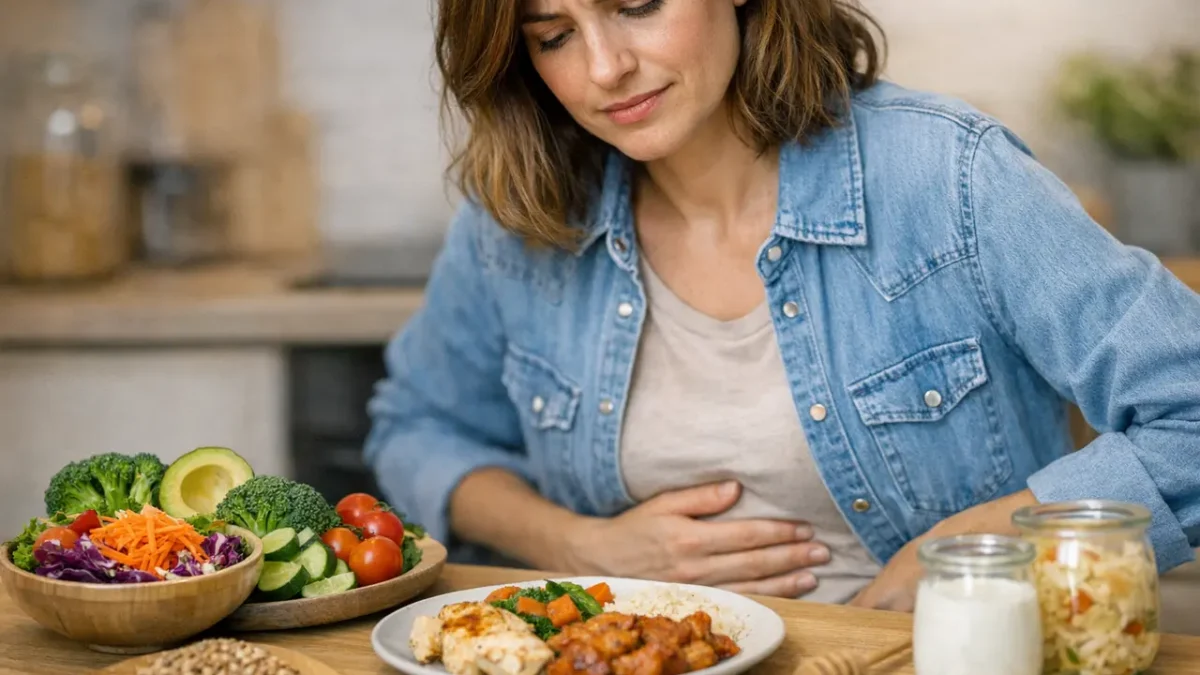
In the supplement section, the promise is attractive: one capsule, and the intestine would be “rebalanced”. On the side, raw salads and green juices sometimes give the impression that you should review everything on your plate. To take care of your intestinal microbiota, the starting point is simpler:
focus first on varied plant foods, rich in fiberwithout switching to all-raw or automatically taking probiotics.
The intestinal microbiota refers to all the bacteria, yeasts and other microorganisms that live in the digestive tract, particularly in the small intestine and the colon. Some bacteria use fiber that we do not digest ourselves. In other words, our food also nourishes our microbiota.
Where to start on the plate?
The most useful reflex is to vary the sources of fiber. It is found in many plant foods: vegetables, fruits, whole grains, oatmeal, whole grain bread, but also dried vegetables. Lentils, chickpeas, beans… these foods have their place in a diet favorable to intestinal health.
French recommendations encourage eating dried vegetables at least twice a week. The idea is not to turn your kitchen upside down overnight. A few chickpeas in a salad, lentils in a soup, red beans in a stew: these are already very concrete ways to start.
What matters is consistency. Finding THE superfood for the microbiota is less relevant than alternating food families throughout meals. A microbiota is worked more through repeated habits than through an isolated product.
Should you eat everything raw to preserve your microbiota?
It is not necessary to convert your entire diet to raw food. Cooked vegetables and legumes remain nutritionally valuable, particularly because they remain sources of fiber. Vegetable soup, cooked lentils or chickpeas added to a dish can therefore contribute to your intake.
Cooking can modify certain nutrients and certain fiber fractions depending on the foods and preparation methods. But that’s not enough to make it a must. For many people, cooked vegetables are also easier to integrate into their daily lives, sometimes better tolerated, and allow them to eat more variety.
On the other hand, if you consume little fiber today, it is better to avoid the big leap. Gradually increase the quantities : a portion of legumes from time to time, then more regularly, more vegetables in meals, a gradual transition towards more complete cereals. This progression can limit digestive discomfort, because a sudden intake of fiber can cause gas or bloating in some people.
Also remember to drink enough water, especially when increasing your fiber intake. It’s a simple, but useful gesture to support this dietary change.
Are probiotics a must?
Probiotics are live microorganisms. They are found in certain products or supplements, but their interest depends on the strain used, the dose, the situation and the desired objective. A strain studied in a specific context therefore does not allow us to conclude that all probiotics will have the same effect for everyone.
This is the essential reserve to keep in mind: a capsule does not guarantee “rebalancing” the intestine. Supplements presented as intended for the microbiota can have variable effects depending on the person, and their effectiveness should not be generalized to all situations.
This is not to say that probiotics are never useful. But they should not become an automatic reflex as soon as we want to “take care” of our microbiota. In the event of digestive disorders, illness, current treatment or doubt, seek advice from a health professional before taking it for therapeutic purposes.
The most solid benchmark therefore remains very concrete: a varied diet, richer in fiber according to your tolerancewith dried vegetables several times a week and a variety of plant foods. No need to eat everything raw, or hope for a cure capable of resetting the body.