

Increased nocturnal heart rate, less restorative sleep, fluctuating weight: these physiological variations can help understand certain symptoms of the menstrual cycle. But what exactly does this data reveal, and what are its limitations?
Before your period, sleep becomes less restorative
For some women, the week before their period results in more restless nights and persistent fatigue upon waking up. These difficulties are not necessarily due to stress or lifestyle habits: the menstrual cycle could also play a role.
An analysis published on October 15, 2026 by Withings, a specialist in connected health objects, examined 469,000 menstrual cycles in approximately 69,000 women aged 18 to 50in 11 Western countries, including more than 11,000 French women. The data, collected between September 2025 and September 2026, concerns women not using hormonal contraception.
The observation is clear: 76% of participants saw their sleep score decrease during the week before their periodby 3.4 points on average compared to the days following menstruation. At the same time, nighttime heart rate increases in nine out of ten women, by 2.8 beats per minute on average.
“Of the 469,000 cycles analyzed, the same pattern repeats itself: in the days before menstruation, the nighttime heart rate increases and sleep becomes lighter. Women whose heart rate increases the most are also those whose sleep quality decreases the most. These variations are modest, but remarkably consistent across countries. Knowing that they are normal and predictable can help women understand a restless night or a higher weight on the scale when they wake up, rather than worry about it.”explains Livia Robic, women’s health expert at Withings.
The phenomenon is therefore widely shared. But it does not necessarily result in much shorter nights: it is mainly their quality which seems to be affected.
French women lose more in deep sleep
During the week before their period, women sleep about 5 minutes less. On the other hand, the proportion of deep sleep decreases by 1.8 percentage pointsor around 5% of its usual level. Light sleep increases by 2 points. Heart rate variability, an indicator used in particular to assess the body’s recovery, drops by 3 milliseconds.
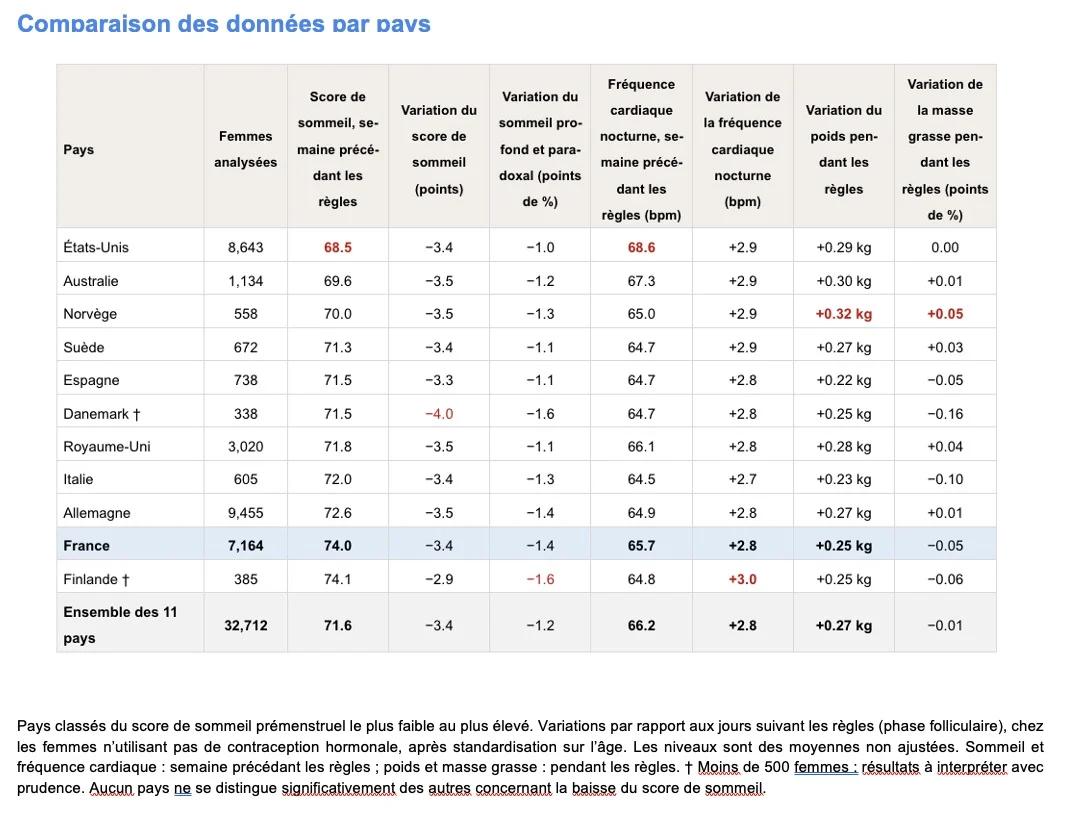
French women particularly illustrate this evolution. Their sleep score fell by 3.4 points, to 74.0, but remains the second best among the 11 countries studied.
 © Withings
The paradox lies in the distribution of sleep phases: among them, the cumulative share of deep and paradoxical sleep decreases by 1.4 points, a significantly greater drop than in other countries. Light sleep increases at the same time by 1.9 points.
Should we conclude that French women are the most penalized by their cycle? Not quite. The overall drop in sleep score varies from 2.9 to 4 points depending on the country, with no statistically significant difference between them.
Why does the heart race before menstruation?
These changes could in particular be explained by hormonal fluctuations in the cycle. After ovulation, the body produces progesterone, a hormone that helps increase core body temperature and accompanies physiological changes that can influence sleep.
Nocturnal heart rate can then increase, while its variability decreases. These phenomena could contribute to a less favorable recovery.
A systematic review conducted by researchers from the Hôtel-Dieu Sleep Center, AP-HP, and Inserm also highlights that sleep varies depending on the phases of the menstrual cycle and that levels of reproductive hormones are associated with its duration and quality.
Be careful, however: Withings’ analysis is observational. It highlights concomitant variations, but does not demonstrate that hormones alone explain all sleep disturbances.
During menstruation, weight increases mainly because of water
Sleep is not the only parameter to fluctuate. The feeling of swelling and the rising number on the scale can also weigh on morale.
According to Withings data, 72% of French women studied gain weight during their periods. Their body water quantity increases on average by 0.18 kg. Around 70% of the increase observed on the scale would therefore be linked to water rather than fat.
Internationally, after adjusting for longer-term weight trends, the average increase during the week of menstruation is estimated to be around 0.15 kg.
These temporary fluctuations should therefore not be automatically interpreted as fat gain. They remind us that weight also varies with the movement of water in the body.
The analysis finally shows that the variations are less marked among women using hormonal contraception. In a separate analysis of 3,362 women, sleep score decreased by 1.4 points before menstruation, compared to 3.4 points among those with natural cycles. Nighttime heart rate increases by 1 beat per minute.
Normal variations, but not symptoms to trivialize
These findings can help women better understand the changes that occur throughout the cycle. They must nevertheless be interpreted with caution: the data comes from users of connected devices who enter their period dates themselves. They therefore do not necessarily represent the entire female population, and the phases of the cycle were estimated from these dates.
A falling sleep score does not constitute a diagnosis, any more than a one-off variation in weight allows us to conclude that there has been a change in fat mass. Connected objects can spot trends, but their measurements do not replace medical advice.
Finally, knowing that certain changes are common does not mean that we should put up with distressing symptoms without talking about them. When sleep problems become persistent, fatigue disrupts daily life or menstrual symptoms are particularly difficult to live with, a health professional can help find the causes.
Better understanding your cycle doesn’t make all the difficult nights disappear. But this allows you to take a less guilty look at your body and remind you that hormonal variations deserve to be taken into account in women’s health.