
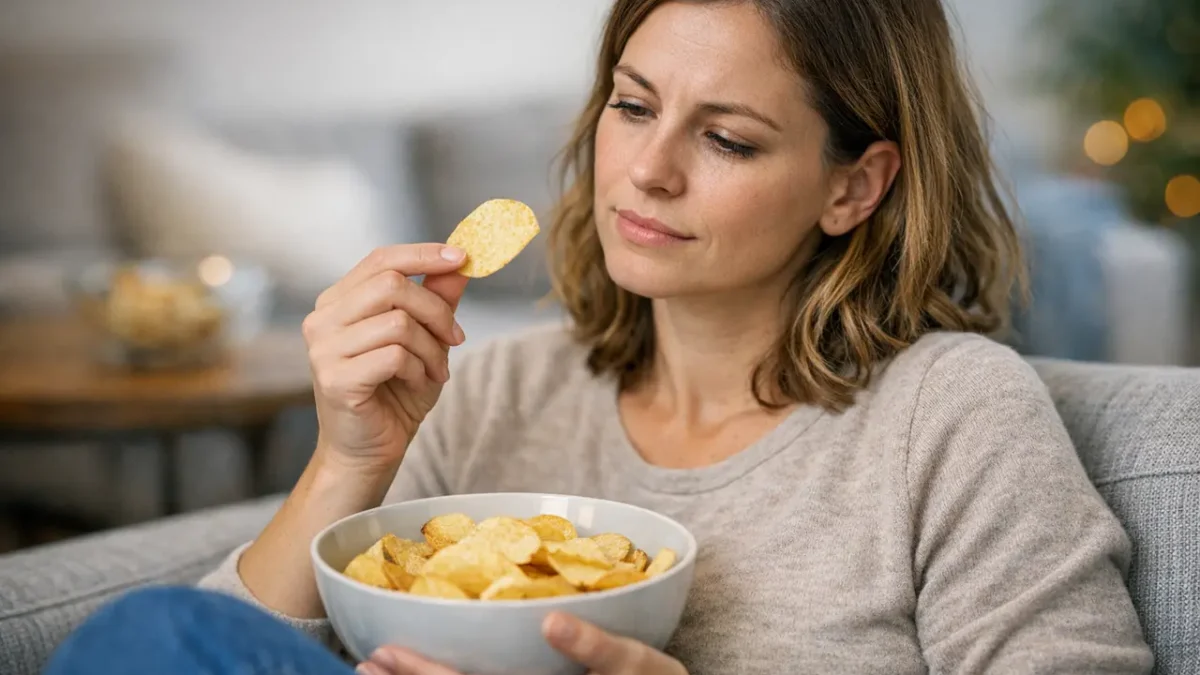
Why does a bag of chips so easily call for a second handful? On her Instagram account @thebraingutscientist, Émilie Steinbach, doctor of science specializing in the intestinal microbiota and holder of a master’s degree in neuroscience, responds clearly:
It’s not just a matter of will.
The brain doesn’t just respond to taste
In the video, Émilie Steinbach takes the very concrete example of chips: the sound of the packet, the smell when opening, the crunch, the salt, the fat, then the immediate sensation of pleasure in the mouth. In other words, the desire to continue does not arise only after the first bite: it can start before, with sensory signals.
Chips and many industrial snacks often fall into the category of ultra-processed foodsfrequently defined as industrial formulations containing in particular flavorings, additives or ingredients little used in domestic cooking. Not all are equal, but many are designed to be very practical, very available and very pleasant to consume.
This is where the reward system comes into play. Foods that are very palatable — that is, particularly pleasant to taste, smell and texture — can activate reward circuits. The brain then associates the food with a positive sensation, which can encourage the desire to eat more, even when hunger is no longer the main driving force.
The expert also evokes the idea of an “obesogenic” environment. The formula is useful if it is understood without feeling guilty: it designates a context where fatty, salty, sweet or very palatable products are everywhere, available in large portions, easy to eat quickly and often promoted. To better understand this mechanism, we can also talk about the bliss point of industrial foods, this sensory balance which makes certain products particularly attractive.
However, work on food reward shows that
difficulty stopping is multifactorial. Taste matters, but so do habit, emotional state, pack size, speed of ingestion, availability at home or at work, and eating without paying attention.
Strong desire does not mean automatic addiction
Important point: saying that a food makes you want to return to it
is not synonymous with medical addiction. According to the specialist, we cannot say that sugar is a drug “like cocaine” in humans. This nuance is essential, because studies carried out in animals do not directly translate to our eating behaviors.
Likewise, research on food addiction exists, but the concept remains debated. We must not confuse an intense desire, consumption beyond one’s hunger, repeated snacking and an addiction in the medical sense. The nuance is all the more important because talking about addiction too quickly can give the impression that everything is a foregone conclusion, whereas the environment and habits can be changed.
A short-term randomized controlled trial showed that a diet of ultra-processed foods could lead to eating more and gaining weight compared to an unprocessed diet. This study supports the idea that the effects of ultra-processed foods on the brain and food intake deserve to be taken seriously, without oversimplification.
Concretely, the objective is not to prohibit or make people feel guilty. It is rather a matter of reduce exposure to situations that make overconsumption more likely:
- Avoid eating directly from the large package, when possible, because the portion becomes difficult to perceive;
- Identify the signals that trigger the desire – smell, opened package, habit in front of a screen – so as not to experience them automatically;
- Alternate with less processed foods on a daily basis, without turning every craving for chips into a personal failure.
This approach helps get out of the false debate between “will” and “lack of control”. The correct answer is more nuanced: certain foods are particularly attractive to our brain, but this does not make sugar comparable to cocaine and does not make every desire an illness. To go further on this point, the notion of sugar addiction in humans must also be handled with caution.