
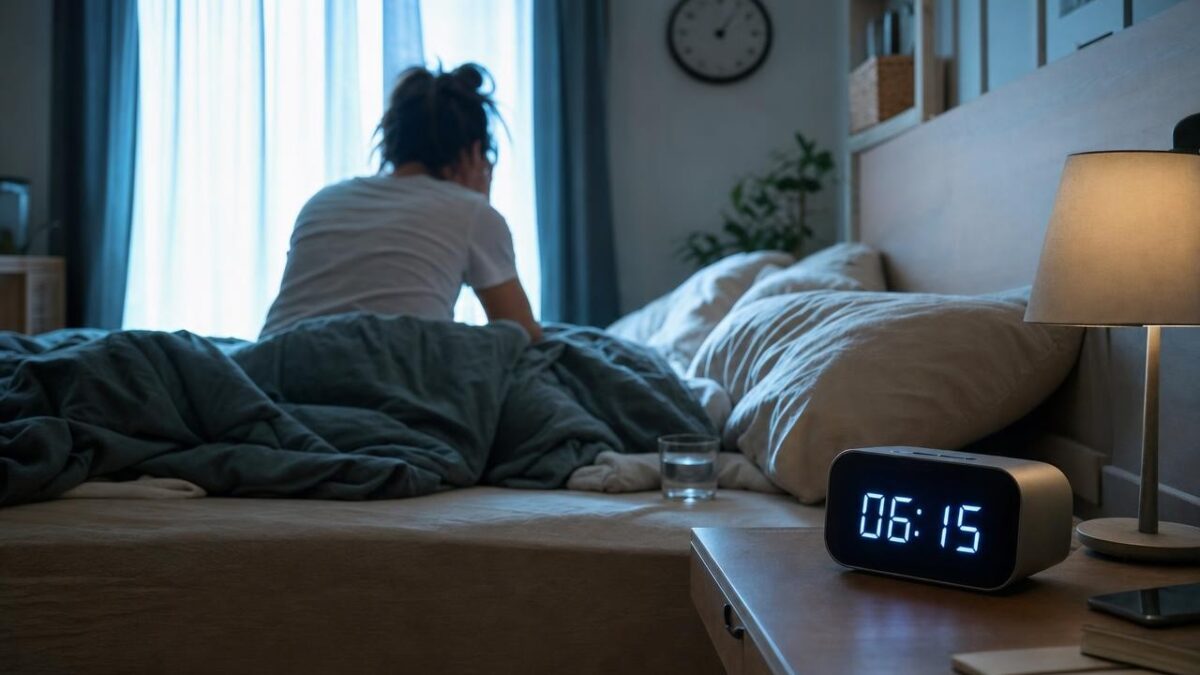
Called “circadian depression”, this form represents 23% of the cases studied. Associated with more complex symptoms and a less favorable response to traditional antidepressants, it could justify treatment targeting the sleep-wake rhythm more closely.
When sleep is no longer enough to recover
Going to bed very late, sleeping a long time and yet waking up exhausted. In some people with depression, sleep seems to have lost its restorative function. These difficulties could reveal a particular form of the disease:
circadian depression.
Researchers at the University of Sydney, Australia, identified this subtype using clinical and genetic data from 11,380 people suffering primarily from severe, recurrent or persistent depression. Published in the British Journal of Psychiatry on October 21, 2026, their results show that 2,604 participants, or around 23%, had this profile.
“Our research identified circadian depression as a new subtype, affecting around a quarter of people in our study with severe, recurrent or persistent depression.”explains Emiliana Tonini, first author of the study.
She recalls that “Depression is not a uniform illness and understanding the characteristics of different subtypes allows us to offer people earlier access to the treatments most effective for them“.
The stakes are high for people who struggle to get better despite their medical follow-up. But what distinguishes this form of depression?
A biological clock that could change everything
Our body has an internal clock of approximately 24 hours, which regulates the alternation between wakefulness and sleep. When this rhythm becomes disrupted, it can contribute to disrupting psychological balance.
Researchers used six characteristics to define circadian depression. Participants had to present at least three: seasonal depressive episodes, going to bed very late, prolonged sleep during depressive phases, an evening chronotype, intense fatigue upon waking up or a significant gap between sleep schedules during the week and the weekend.
This last phenomenon, sometimes called “social jet lag”, reflects the difficulty in reconciling one’s natural rhythm with professional or social constraints.
But it’s not just about sleeping poorly. “This is important because it indicates that circadian depression is not just depression with poor sleep, but that there is actually an underlying biology that is quite distinct from other forms of depression.”underlines Emiliana Tonini.
The study also reveals a more complex clinical picture: in those affected, depression began earlier, episodes were more numerous and suicidal thoughts more frequent. Some participants also had more manic or psychotic symptoms.
Genetic analyzes have also highlighted associations with an increased risk of ADHD, anxiety disorders, bipolar disorder, mood disorders and certain metabolic and inflammatory problems, including insulin resistance or a higher body mass index.
These results do not demonstrate that these factors cause circadian depression. They nevertheless suggest that this form of the disease could be based on partly distinct biological mechanisms.
Why traditional antidepressants might work less well
Antidepressants such as SSRIs and SNRIs are among the treatments commonly offered as first-line treatment for depression. However, in this study, people with a circadian profile reported less effectiveness of these medications and more side effects.
“What is crucial about this circadian type is its poor response to standard treatments, those that are generally recommended in guidelines.”explains Ian Hickie, psychiatrist and co-director of the Brain and Mind Center at the University of Sydney.
This reduced response does not mean that antidepressants are ineffective in all these patients. However, she underlines the interest in better identifying their needs, particularly among young people, in order to avoid repeated therapeutic failures.
Researchers particularly mention treatments targeting the biological clock: light therapy, melatonin and certain antidepressants acting on the mechanisms linked to this hormone. Regularity of sleep schedules, exposure to daylight in the morning, and activity during the day could also play a role.
“Since circadian depression is linked to an individual’s internal biological clock, treatments targeting the circadian rhythm, such as light therapy and melatonin, may be much more relevant, and clinicians should use them much earlier in people with this clinical picture.”estimates Jacob Crouse, co-author of the study.
Ian Hickie emphasizes the importance of early treatment: “Most young people will be offered SSRIs first, but for at least a quarter, there are better circadian-focused medical and behavioral options.”.
However, these approaches do not constitute a universal solution. Their benefit must be assessed on a case-by-case basis, with a healthcare professional.
A promising avenue, but still to be confirmed
Staying up late, sleeping more during depression, and waking up exhausted are not enough to make a diagnosis. At this stage, there is no simple test to confirm circadian depression: the proposed criteria still need to be validated by other research.
The authors highlight several limitations, including the use of declarative questionnaires and the relatively homogeneous genetic composition of the sample, mainly of European ancestry. The results therefore need to be replicated in more diverse populations.
Psychiatrist Jayashri Kulkarni, who did not participate in the study, praises the work as “really well done”, particularly for its genetic analysis. Other questions remain open, such as the role of menopausal hormonal changes in sleep disruption.
In The GuardianAndrew Coogan, specialist in behavioral neuroscience at the University of Maynooth, in Ireland, recalls that the links between depression and the biological clock have been known for a long time. He considers these results to be interesting first observations that require further research.
For patients, the message is therefore measured, but important: if sleep problems accompany depression, it may be useful to talk to your doctor or psychiatrist, especially when treatments provide insufficient relief. This does not allow self-diagnosis, but can help re-evaluate treatment options.
Better understanding the different forms of depression could thus make it possible to move away from a uniform approach and to offer care more adapted to each patient. A particularly valuable perspective for those who are still waiting to find a treatment that truly relieves them.