
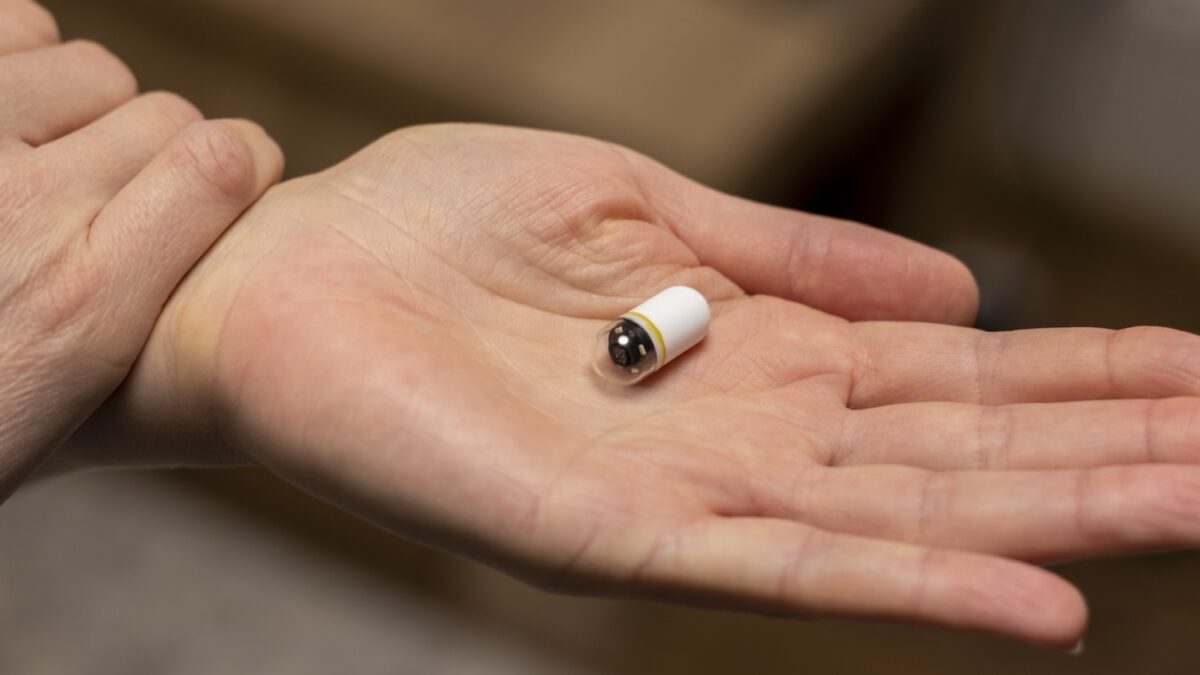
Swallowing a small camera rather than undergoing a colonoscopy: the image is reassuring. In the United Kingdom, the Medway NHS Foundation Trust highlighted the local launch of a colonic capsule service at Medway Maritime Hospital, with the testimony of Mark Freeman, 65, the first patient cited by the hospital.
This technology already exists in France in certain situations. But can she really avoid a colonoscopy ? Sometimes it can offer a diagnostic alternative. However, it does not replace the traditional examination when it is necessary to take tissue, remove a polyp or treat an abnormality identified.
What does this camera capsule really see?
The colonic capsule is a form of digestive or intestinal video capsule intended to explore the colon. It contains a miniature camera. Once swallowed, it progresses naturally through the digestive tract and collects images, then transmitted or recorded, then analyzed by health professionals.
To understand the principle of the digestive video capsule, we must remember a simple idea: the examination is filmed, but it is not carried out like a classic endoscopy. Health Insurance describes the intestinal video capsule as a tablet-sized, single-use capsule intended to collect images of the intestine.
Its less impressive appearance should not make us forget a very concrete point: colon preparation remains essential. For the images to be usable, the colon must be properly cleaned. According to Health Insurance, this preparation is similar to that necessary before a colonoscopy. In practice, it depends on the protocol given by the medical team: you should therefore not improvise or modify the instructions.
Why does colonoscopy keep a special place?
The great limitation of the capsule can be summed up in one sentence: it watches, but it does not intervene. It can show an anomaly, but it does not allow sampling or removal of a polyp.
Colonoscopy is used to observe the inside of the rectum and colon, but also to take samples from a suspicious area and to remove certain polyps. These polyps are small growths of the intestinal lining. Many are benign, but some can progress over time. This is why their detection and analysis are important in the diagnosis of colon cancer.
Direct consequence: if the capsule identifies a polyp or a suspicious lesion, a colonoscopy may still be necessary to remove the polyp, perform a biopsy or complete the exploration. The capsule can therefore avoid an immediate colonoscopy in certain courses, but it can also lead to a secondary colonoscopy if an abnormality is detected.
This is what prevents it from being presented as a pure and simple replacement. It adds a diagnostic tool, without making the examination useless, which also allows action.
In what cases can it be discussed in France?
In France, the High Authority of Health recognizes a place for the colonic capsule in adults, outside the context of chronic inflammatory intestinal disease, in particular to search for polyps and cancers after certain optical colonoscopies remain incomplete. Precision is important: these are incomplete colonoscopies for a reason that is not a lack of colon preparation or digestive stenosis.
HAS also insists on the need for a shared medical decision. The choice between colon capsule and virtual colonoscopy is a shared medical decision, depending on the patient’s situation, contraindications and precautions for use. The goal is for the patient to understand the strengths, limitations and uncertainties of each option.
This position of the HAS is more restrictive than the general presentation of alternatives by Health Insurance. For its part, Health Insurance points out that alternative examinations such as the video capsule have a diagnostic objective. They can be discussed when colonoscopy is incomplete, impossible, contraindicated or refused, but this does not mean that they are suitable for all cases.
Certain signs should lead you to consult without waiting to choose a test yourself: red or black blood in the stools, recent transit disorders, abdominal pain, or anemia due to iron deficiency linked to sometimes invisible digestive bleeding. These symptoms do not necessarily mean cancer or polyp, but they warrant medical advice.
If you have been prescribed a colonoscopy, do not cancel it because a capsule exists. The most useful thing is to talk about it with the gastroenterologist: he will be able to explain the preparation and procedure for a colonoscopy, say whether an alternative is possible and specify what each examination can really bring to your situation.
The camera capsule is a useful advance for some patients, particularly because it can make exploration more acceptable. Its interest, however, depends on the medical question asked: seeing the colon is not always enough, especially when you have to remove or analyze what you have found.