

Published in 2013 in the New England Journal of Medicinethis clinical case reminds us that certain complementary practices can leave lasting traces in the body, sometimes with unexpected complications.
Persistent pain that pushes her to look for another solution
At 65, this South Korean woman suffers from osteoarthritis of the knees. This chronic disease, which causes progressive degradation of cartilage, can transform ordinary actions into challenges: walking, getting up or climbing stairs.
She has already tried several treatments: painkillers, non-steroidal anti-inflammatory drugs and corticosteroid injections directly into the knees. But the pain persists. Even more difficult, the medications cause significant abdominal pain. She ends up stopping them.
In search of relief, she turned to acupuncture. Initially weekly, the sessions become more frequent when his pain intensifies, up to several times a week.
But his condition is not improving sufficiently. She finally goes to the hospital. An x-ray of the left knee will reveal a totally unexpected detail.
Hundreds of gold threads appear on the x-ray
The photo shows signs of advanced osteoarthritis: the tibia, in the internal part of the joint, appears thickened and hardened. Doctors also see bony growths, called osteophytes, on the tibia and femur. But above all, it is multiple small shiny elements that attract their attention. Distributed around the joint, they appear as fine radiopaque lines, in other words structures that block X-rays.
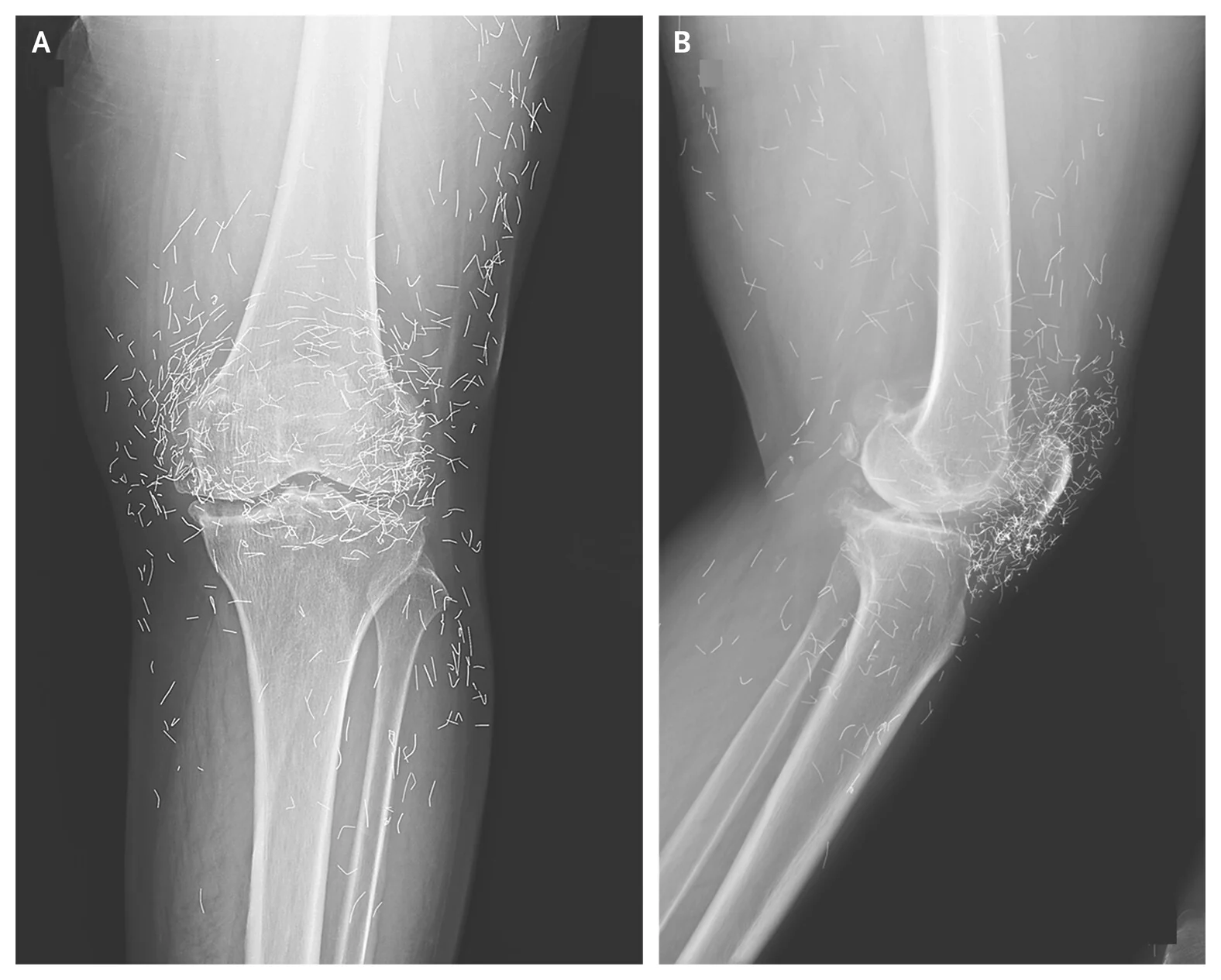 © N Engl J Med 2013;369:e37 DOI: 10.1056/NEJMicm1202540
The explanation lies in the patient’s medical history: it involves gold threads implanted in the tissues during acupuncture sessions.
Unlike conventional needles, these very fine and sterile threads are deliberately left in the body in order to prolong the stimulation of the points concerned.
The case was published on December 26, 2013 in the New England Journal of Medicinerecalls in particular that these implants can complicate the interpretation of x-rays.
A technique with no demonstrated effectiveness, but with risks
Gold wire implantation is practiced in some Asian countries to try to relieve osteoarthritis or rheumatoid arthritis. However, it should not be confused with classic acupuncture, which uses temporary needles removed after each session.
Above all, no solid scientific evidence demonstrates the effectiveness of these implants against osteoarthritis. Their use can even become problematic when it delays the implementation of appropriate medical treatment.
The risks are not only linked to a possible delay in support. Complications have also been reported: formation of epidermal cysts, migration of threads in the body or damage to neighboring tissues.
A particularly striking case concerns a 75-year-old woman. Ten years after implantation of gold wires in the back, certain fragments had migrated to his right leg, causing infectious cellulitis, a deep infection of the skin and subcutaneous tissues.
The presence of these metallic elements also requires precautions before certain imaging examinations, notably MRI. Their location and nature must be reported to the medical team so that they can assess the risks.
In the case of the 65-year-old patient, doctors did not specify whether the wires were removed or left in place.
This story finally reminds us of an essential reflex: any previous therapeutic gesture, including a complementary practice, must be reported to the doctor. Pain that persists or interferes with walking also merits medical advice. Because behind an x-ray, there is not only a joint to examine, but also an entire medical history. And sometimes, attempts at relief whose consequences are discovered many years later.