
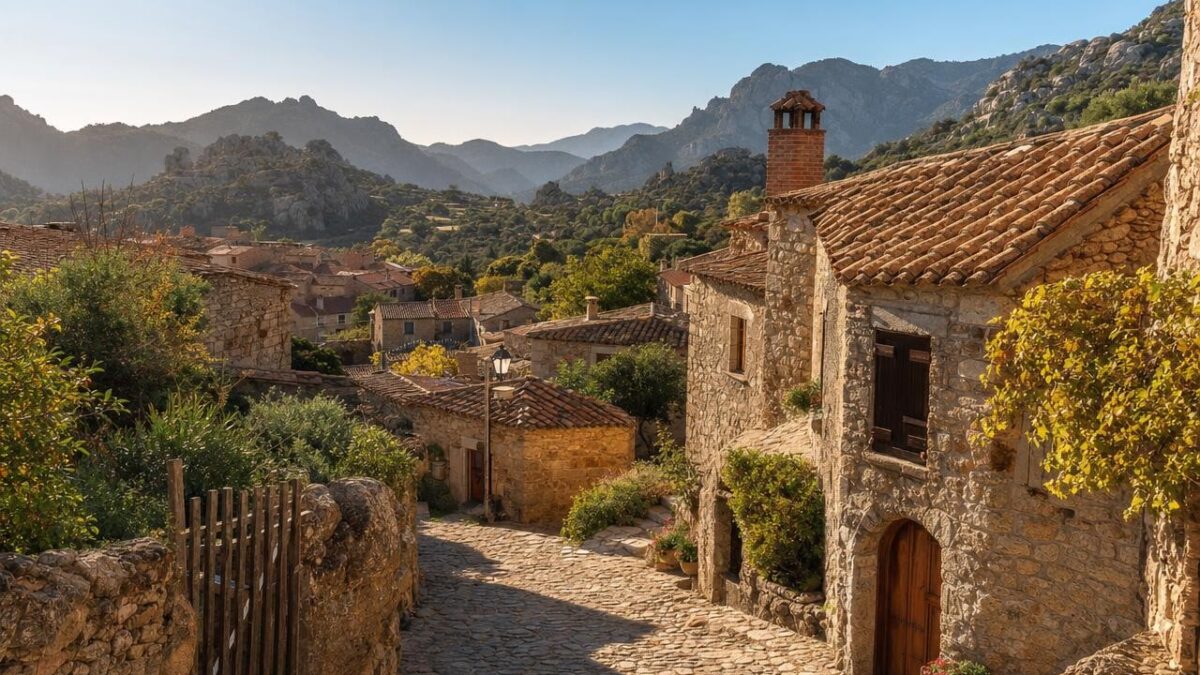
In a small mountain village in Sardinia, the survival statistics for seniors are out of the ordinary: among 70-year-old women, nearly one in seven would reach 100, according to a demographic study published on October 5, 2026 in the journal
Frontiers in Aging. For researchers, this village could join the famous “blue zones”, these territories where the longevity
clearly exceeds the average, as Okinawa or the peninsula of Nicoya. But here, the phenomenon is recent and especially female.
This village is Bolotana2,300 inhabitants, terracotta roofs and sloping streets in the heart of Sardinia. The team led by Giovanni Mario Pes and S. Jay Olshansky estimates that 13.8% of women who reach 70 will live there to be 100, compared to around 3.5% in Italy and 3.6% in the United States. The authors write that “Bolotana has an exceptional, predominantly female, late survival profile and can be considered a candidate longevity blue zone“. It remains to be understood what this means in concrete terms.
Bolotana, a “hotspot” where 70-year-old women aim to be 100
Between 2021 and 2025, the team reconstructed life tables from municipal and parish registers. Among women, life expectancy at age 70 has reached 20.85 years on average: in other words, a 70-year-old Bolotanian woman can expect to live until around 91 years old. The probability of going from 70 to 100 years increases to 13.8%more than three times the level observed among American women of the same age. Among the long-lived countries studied, only women of Hong Kong do better.
The men of Bolotana also live a little longer than the Italian average: 16.02 years of life expectancy at 70 and a 4.92% chance of reaching 100. But the real singularity is this feminine leap. In 2024, six centenarians lived in the village, a prevalence about 11 times higher than in the United States, according to the team’s estimates.
Why Bolotana intrigues “blue zone” researchers
S. Jay Olshansky, professor emeritus at the University of Illinois Chicago, emphasizes data quality: “What makes Bolotana extraordinary is that it has an incredible history that allows us to definitively assess ages at birth and death“. He adds: “Every person who has passed 100 years old, we can validate them“. Civil registers, baptism certificates, parish archives: this careful cross-referencing responds to critics who accuse certain blue zones of exaggerating ages.
Another intriguing element: Sardinia is already home to a
blue zone historical, best known for its male longevity. In Bolotana, the pattern is reversed. According to Olshansky, “women almost always live longer than men everywhere in the world, but in Sardinia this was not the case. This is one of the things that made the island so unusual“. The fact that Bolotana now displays a marked female advantage makes it a valuable counterexample for demographers.
A living laboratory, but a “blue zone” yet to be confirmed
Why this village in particular? The study remains cautious. The authors evoke paths already observed elsewhere: a very walkable village with steep streets, travel mainly on foot, local food rich in olive oil, families living close to each other. “You have this close-knit community where people take care of each other“, describes Olshansky; “travel is largely done on foot, not by car“. But the data does not allow us to say whether these factors directly cause longevity.
The researchers also point out that the observed advantage varies depending on the period studied, and that the population remains small, and therefore statistically fragile. An analysis over 2015-2019 gave a less spectacular profile. For the moment, Bolotana is therefore an open-air “laboratory”: a serious candidate for the category of blue zones, which will have to be monitored in the long term to know if this mecca of longevity is sustainable or only emerging.