
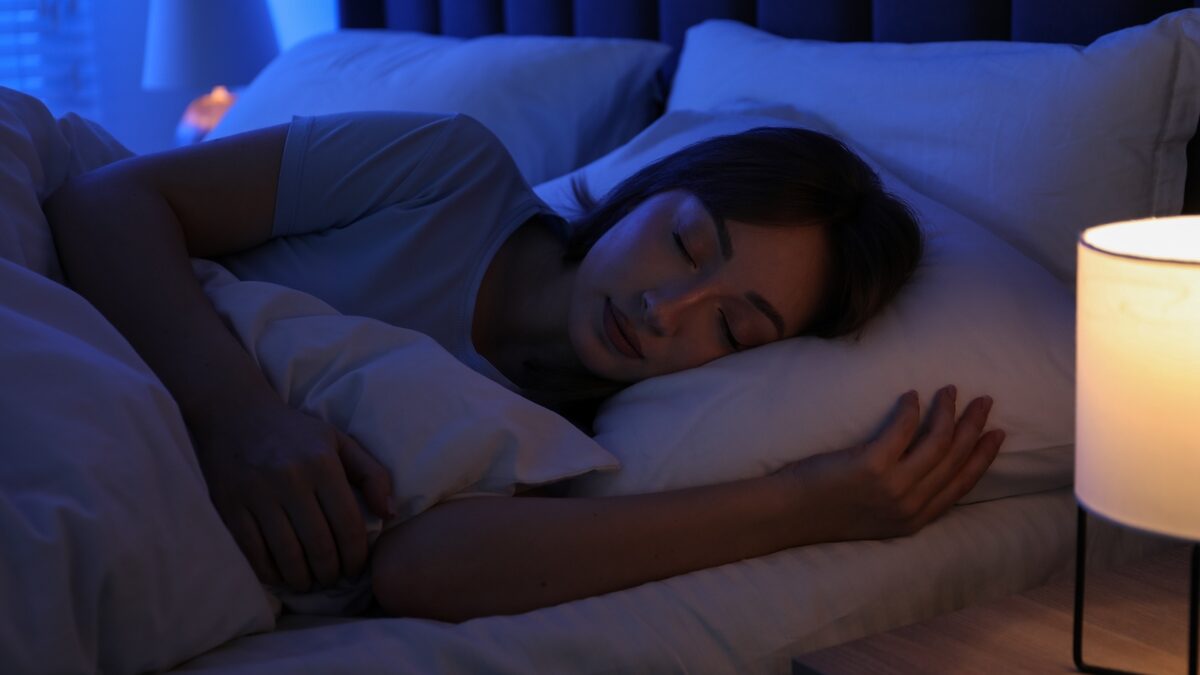
A room that’s too hot, a neighbor that’s too noisy, a light alarm that flashes in the night… What if your environment prevents you from really sleeping well? A study carried out among young adults shows that these disturbances can degrade the quality of your nights.
Sleep quality depends on many factors
Contrary to popular belief, sleeping “enough” is not enough to have a restful night, according to researchers. To reach this conclusion, they followed 372 young adults, aged 22 on average. Every morning for two weeks, they had to write down in a small notebook the conditions in which they had slept (room too hot, too cold, too bright or too noisy). A sensor worn on the wrist also made it possible to track their sleep night after night.
Result ? Too much heat, light or noise was associated with poorer sleep quality.
- In detail, young adults who most often slept in an environment considered too bright had a 90% lower chance of reporting good sleep quality. They also tended to fall asleep and wake up later;
- Heat especially seems to disrupt sleep once you fall asleep. On nights that were too hot, participants stayed awake almost 10 minutes longer after falling asleep. Their sleep was also less restorative;
- Finally, when they slept in an interior that was too noisy, their sleep was less “effective”, by around 3%. They also spent almost four extra minutes awake after falling asleep.
Results which remind us that a good night’s sleep is not just about the number of hours spent in bed.
For Dr Jonathan Taïeb, sleep specialist, you also need to look at the regularity (of your bedtime/wake-up times) and your feeling when you wake up:
“We have long summarized the quality of sleep by the number of hours slept, whereas sleep health is multidimensional. Rather than asking the French how long they sleep, we should instead ask them: do you have regular waking hours? And when you sleep, do you have the impression of having restful sleep?” underlines the specialist.
Heat, light and noise can fragment your nights
If all these elements do not disrupt sleep in the same way (too much light can delay falling asleep and waking up, heat and interior noise seem to fragment the night more…), Dr Jonathan Taïeb agrees with the researchers’ conclusions.
“We know that light blocks the secretion of melatonin, so it will hinder and disrupt it. As for noise, it can cause micro-awakenings and physiological activations which will fragment sleep. The number of decibels is therefore not, in itself, responsible for a bad night: just one small noise can be enough to put your brain on alert.” underlines the doctor.
Temperature also plays a key role in falling asleep.
“If it is too high, the body can have difficulty lowering its internal temperature, which makes it difficult to fall asleep. After a lot of sport, you also need to give it time to cool down,” specifies the medical expert.
Other elements must also be taken into account
Unsurprisingly, the time we go to bed and get up also matters.
“The quality of sleep does not only depend on the environment, but also on the time when we sleep. It is often said, for example, that the hours before midnight count double. This is false. It is the regularity that counts, and in particular the regularity of the time of getting up and going to bed”, recalls Dr Jonathan Taïeb.
Finally, “social jet lag” must be taken seriously. “This is a real problem in our society.Young people go to bed late, get up at 10 or 11 a.m. on weekends to compensate and make up for this sleep debt, then get up very early during the week. It’s like they changed time zones.” affirms the practitioner.
The quality of sleep therefore does not only depend on the number of hours spent in bed. A room that is too hot, too bright or too noisy can also affect your nights. Fortunately, a few simple actions can already make a difference, according to researchers. Such as using a blackout curtain or sleep mask, earplugs or an air conditioner. Your body will thank you!