

Behind neurodegenerative diseases, there is often the same silent tragedy: when the first symptoms appear, years of brain destruction have already taken place. It is precisely this lost time that German scientists are today trying to regain. Their challenge: to read in the blood the very first molecular anomalies announcing Alzheimer’s or Parkinson’s, thanks to infrared spectroscopy technology that is as discreet as it is ambitious.
Published in April 2026 in the Journal of Physical Chemistry and put on the cover of the magazine, their work is based on a tool called immuno-infrared sensor (iRS). Developed at Ruhr University Bochum by the team of Professor Klaus Gerwert, this sensor could transform neurological prevention by allowing ultra-early detection via a simple blood test.
Detect disease before it is seen
The principle of the test is based on a dizzying idea: detecting diseases even before the brain shows visible lesions or patients feel the slightest symptom. To achieve this, the sensor tracks proteins known to play a key role in neurodegenerative diseases: amyloid beta, involved in Alzheimer’s, and alpha-synuclein, associated with Parkinson’s. When these proteins fold abnormally, they become toxic and begin a slow process of brain degeneration.
The iRS acts as a molecular fisherman. Antibodies attached to a crystal capture these proteins directly in the blood. Once isolated, their structure is analyzed using a quantum cascade laser and infrared spectroscopy, capable of detecting minute changes in conformation.
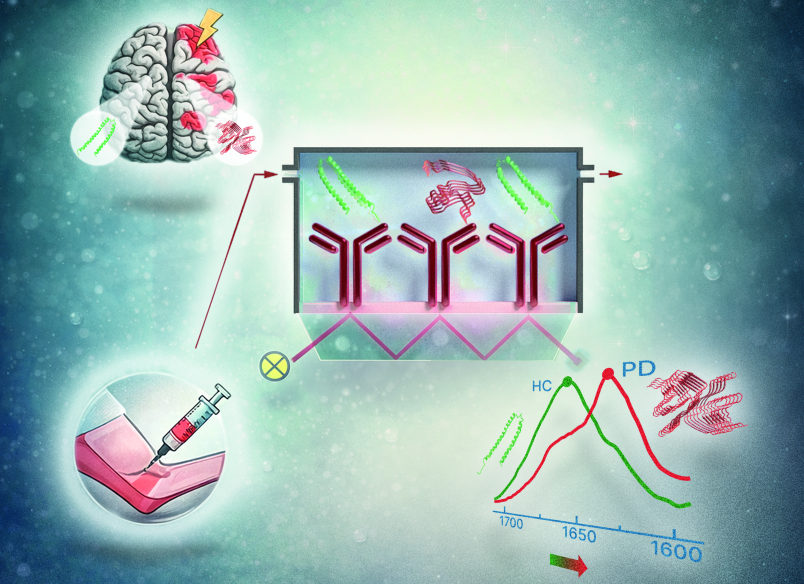 © Hartmann/betaSENSE, https://pubs.acs.org/cms/10.1021/jpcbfk.2026.130.issue-18/asset/jpcbfk.2026.130.issue-18.xlargecover-2.jpg
Abnormal folding of α-synuclein (α-syn), which accumulates in Lewy bodies of the brain, is a hallmark of Parkinson’s disease.
In a communication published by Ruhr University Bochum, Grischa Gerwert explains: “The combination of molecular biology, biophysics and laser spectroscopy makes it possible to carry out these unique measurements“. He adds: “One of the main advantages of quantum cascade laser technology lies in its high adaptability thanks to parallel measurements”.
In other words, this technology could one day enable rapid, large-scale analyzes as part of population screening.
This perspective profoundly changes the way we look at these diseases. Until now, diagnosis most often occurs late, when cognitive or motor disorders become visible. However, at this stage, the brain is already, in the words of the German university, “massively and irreversibly damaged“.
Gain precious years from Alzheimer’s and Parkinson’s
For neurologists, the real challenge is there: to intervene before the collapse.
Recently approved treatments for Alzheimer’s show their best results at the earliest stages. The study published in the Journal of Physical Chemistry
recalls: “Clinical studies show that earlier intervention offers a much more favorable therapeutic window. DAdditionally, lifestyle changes can slow the progression of the disease by several years. Prevention, from the absence of symptoms or in the event of subjective cognitive decline, seems essential in the fight against Alzheimer’s disease.. Also in the early stages, recently approved therapeutic drugs for Alzheimer’s appear to work better. If biological anomalies are detected early enough, it becomes possible to act before memory loss, before difficulty walking, before everyday actions which gradually disappear.
The idea of early detection is becoming more and more evident in the scientific community.
“There is therefore broad consensus within the scientific community on the need for much earlier therapeutic interventions even before the formation of the characteristic insoluble protein deposits in the brain – amyloid plaques in Alzheimer’s disease or Lewy bodies in Parkinson’s disease.underlines Klaus Gerwert.
Concretely, such a test could make it possible to direct people at risk more quickly towards specialized consultations, prevention programs or clinical trials targeting the so-called “silent” phases of diseases.
It could also profoundly change the daily lives of patients and their loved ones. Receiving a diagnosis before symptoms remains a delicate question, both ethical and medical. But for many families facing Alzheimer’s or Parkinson’s, understanding early what is coming could allow them to anticipate, adapt their lifestyle and, perhaps, slow the progression of the disease.
Between scientific promise and medical caution
The enthusiasm around this innovation, however, remains accompanied by numerous precautions. The test is not yet available to the general public and must still pass several regulatory steps before possible routine use in Europe.
The technology has already left university laboratories alone. A company resulting from the work of the Bochum team, BetaSENSE, is now using iRS in clinical studies carried out with the pharmaceutical industry, in particular around an experimental vaccine against Parkinson’s disease.
“At BetaSENSE, we are actively working to accelerate the approval process and make the test available to the general public as soon as possible”says Grischa Gerwert.
Before that, the device must obtain certification in accordance with the European IVDR regulation on in vitro diagnostics. A heavy, costly and particularly demanding step in terms of clinical reliability. Because the whole difficulty now lies in large-scale validation. The test must demonstrate that it can detect diseases with sufficient precision, without increasing false positives or creating unnecessary anxiety in people who are still perfectly healthy.
Caution therefore remains in order. But for researchers and for the families concerned, this advance perhaps marks the beginning of a profound change: that of a medicine that no longer waits for symptoms to act. In the field of neurodegenerative diseases, where each year gained can turn a life upside down, this perspective is not trivial.