

For decades, scientists have observed amyloid plaques that gradually invade the brains of people with Alzheimer’s. But one question remained unanswered: what actually triggers this chain reaction? A team from the National Center of Neurology and Psychiatry in Tokyo believes they have found an answer with a very particular form of amyloid beta protein, called Peak 1 amyloid beta.
For twenty years, the disease progresses in silence: researchers finally go back to its starting point
Alzheimer’s disease does not begin when the first memory lapses appear. By the time symptoms become noticeable, the brain has already been engaged in a slow process of degeneration for many years.
Researchers estimate that the first biological changes can begin almost twenty years before the first clinical signs. During this long silent period, plaques made of beta amyloid gradually accumulate between neurons, disrupting their communication and then causing their disappearance.
But a mystery persisted: what gives the starting signal? It is precisely this question that a team from the Tokyo National Center of Neurology and Psychiatrywhose work was published in July 2026 in the journal Brain Communications. Scientists believe they have identified a particular form of beta amyloid capable of acting as a true “seed” triggering the formation of plaques.
Baptized Peak 1 amyloid betathis protein is in the form of large soluble clusters of more than 150 kilodaltons, very different from other forms already known.
A careful experiment which made it possible to isolate the real “trigger”
To achieve this discovery, the researchers first analyzed the brains of mice genetically modified to reproduce Alzheimer’s disease.
Using a technique called size exclusion chromatography, they separated the different soluble forms of amyloid beta into three groups: Peak 1, Peak 2 and Peak 3.
Each fraction was then injected, in identical quantity, into the hippocampus of young mice.
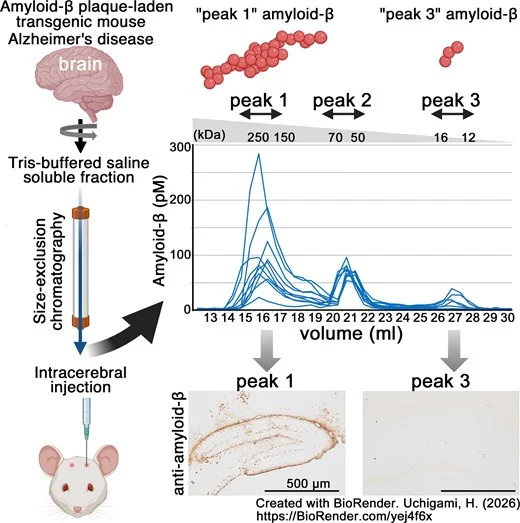 © Brain Communications
The result surprised the researchers: four months later,
only the Peak 1 fraction caused the formation of new amyloid deposits. The other two forms of the protein did not trigger this phenomenon.
The team then wanted to check if this observation was found in humans.
Frozen brain tissue from deceased people with Alzheimer’s disease was analyzed and compared to that of people without the disease. The researchers found the Peak 1 amyloid beta protein in all brains affected by Alzheimer’s, and more rarely in an elderly person without a diagnosis of dementia. When injected into mice, these human fractions in turn triggered an accumulation of amyloid, with varying intensity depending on the donor.
To confirm that this protein was indeed responsible for the phenomenon, the scientists then neutralized it. Once free of beta amyloid or after destruction of its structure, it completely lost its ability to cause the formation of new plaques.
These results reinforce the hypothesis that Peak 1 amyloid beta acts as the first spark of a chain reaction that will lead, years later, to the characteristic lesions of the disease.
An avenue that could transform prevention… but not for several years
This discovery could profoundly change the way we consider future treatments.
Today, the newest drugs, such as
lecanemab or the donanemabauthorized in Japan in 2023 and 2024 respectively, target amyloid plaques already present in the brain. They therefore intervene once the pathological process has begun.
The identification of Peak 1 amyloid beta opens a different perspective: preventing the formation of plaques before they even take hold.
Researchers are already working on a molecule capable of destabilizing this protein “seed” so that it can no longer initiate the cascade of amyloid deposits. The first candidates could be selected within one to two years, before several years of preclinical experimentation and then, if the results are conclusive, possible trials in humans.
The objective would ultimately be to protect people who are still completely asymptomatic, well before the first memory problems appear.
Lots of hope…but still many steps before a test or treatment
However, this advance remains fundamental research. To date, Peak 1 amyloid beta can only be identified by analyzing brain tissue taken after patients have died. No examination has yet made it possible to detect it in a living person.
Asked by The Japan Timesthe researcher
Tadafumi Hashimoto explain : “In the future, we hope to develop non-invasive methods to detect Peak 1 amyloid beta in a targeted manner. In particular, he discusses the expected progress in brain imaging by PET and future blood biomarkers.
This caution is essential. The discovery does not mean that a treatment is imminent, nor that the origin of Alzheimer’s is definitively elucidated. But it brings a major piece to a puzzle that neuroscientists have been trying to put together for several decades.
If these results are confirmed by other teams, they could move the fight against Alzheimer’s to a much earlier stage of the disease: no longer repairing an already affected brain, but preventing the first lesions from occurring. For the millions of affected families around the world, it is a prospect that nourishes measured but very real hope.