

Carried out on 71 adults without apparent cognitive impairment, this research shows that simple navigation errors in a virtual environment are associated, one year later, with a more marked decline in certain brain regions and an increase in blood biomarkers characteristic of early Alzheimer’s processes.
When losing the north reveals what memory does not yet say
Alzheimer’s disease does not appear overnight. For years, sometimes decades, it progresses silently. Long before repeated forgetting or difficulty finding a familiar name, certain areas of the brain already begin to be weakened.
Among them are the hippocampus and the entorhinal cortex, two regions essential not only for memory, but also for orientation in space. It is precisely this ability to find one’s way that intrigues researchers today.
For several years, scientists have been exploring a hypothesis: what if navigation difficulties constituted one of the first signals of the disease, well before visible cognitive disorders?
To try to answer this question, Dr. Kazuya Kawabata and his team from the Department of Neurology at Fujita Health University in Japan followed 71 adults who showed no signs of cognitive decline. The results of their work were published on April 20, 2026 in the journal Alzheimer’s Research & Therapy.
The principle of the experiment is both simple and confusing.
Equipped with a virtual reality headset, the participants were immersed in a virtual circular arena 20 meters in diameter, devoid of any visual cues. After reaching two crossing points marked by flags, they suddenly disappeared. The volunteers then had to find their starting point solely using their internal sense of orientation.
The researchers measured two parameters: the trajectory error, corresponding to the distance separating the participant from their initial position, and the angular error, that is to say the direction deviation.
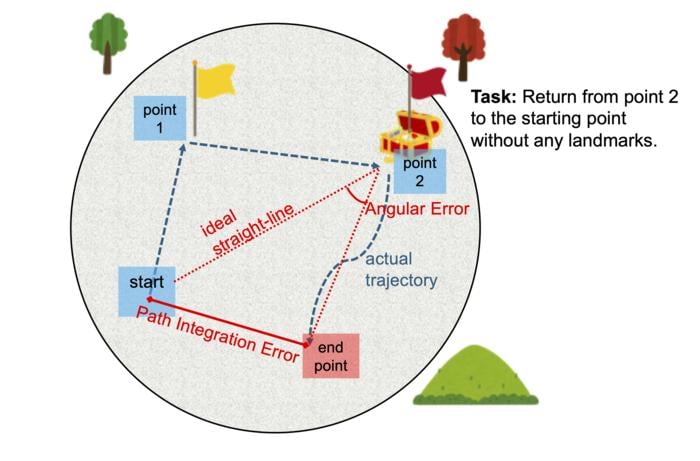 © Dr Hirohisa Watanabe, Fujita Health University, Japan.
Researchers evaluate navigation performance using an immersive 3D virtual reality headset and demonstrate that virtual reality path integration performance can help predict risk of neurodegenerative diseases
At first glance, it was just a navigation exercise. But behind these few minutes of virtual journey was perhaps hidden a glimpse of the neurological future of the participants.
What the VR headset reveals about the brain before memory
After this test, all participants received high-resolution brain MRI scans as well as blood tests aimed at measuring several biomarkers associated with Alzheimer’s disease. The researchers then followed them for about a year.
The results revealed a striking trend:
- The people who made the biggest navigation errors at baseline were also those who showed the most marked signs of cortical thinning and brain volume loss a year later. These modifications notably concerned the parahippocampal gyrus, the middle temporal gyrus, the posterior cingulate cortex and the caudal middle frontal gyrus, regions known to be vulnerable from the early stages of Alzheimer’s disease;
- Even more, these navigation errors were associated with higher concentrations of p-tau181 and GFAP in the blood, two biomarkers today considered early indicators of neurodegenerative processes linked to Alzheimer’s;
- The team also showed that the trajectory error made it possible to identify with high precision the participants whose parahippocampal region would decline the most rapidly during the follow-up.
For Dr Kawabata, these results draw a particularly interesting link between behavior, biology and brain imaging.
“Our results suggest that VR-PI test performance captures both molecular (blood biomarkers) and structural (MRI) signatures that emerge before overt clinical alteration.”he explains in a press release from Fujita Health University.
In other words, the errors observed in this virtual environment would not be simple navigation blunders. They could reflect biological transformations already at work in the brain.
Towards early detection of Alzheimer’s using virtual reality?
One of the great challenges of Alzheimer’s disease remains its late diagnosis. When the first symptoms appear, the brain damage has often been present for a long time. Hence the major interest in methods capable of identifying people at risk even before the appearance of memory problems.
For Japanese researchers, virtual reality could become one of these tools.
“Our approach could enable earlier identification of risk for neurodegenerative diseases, including Alzheimer’s disease. In the longer term, it could contribute to a move towards earlier detection, potentially allowing therapeutic interventions at the preclinical phases and slowing down the progression of the disease, while preserving cognitive functions and quality of life.says Dr. Kawabata.
The idea is attractive: a few minutes spent in a virtual environment could, tomorrow, help identify people requiring reinforced surveillance or targeted preventive interventions. But the researchers themselves urge caution.
The study only involved 71 participants, all Japanese. The virtual reality device does not fully reproduce real travel conditions since the volunteers were seated on a swivel chair. Finally, follow-up only lasted about a year, a relatively short period given the slow progression of the disease. Further work will need to confirm these observations in larger and more diverse populations.
Several teams, particularly in Europe, are already exploring similar approaches through immersive environments or navigation games on smartphones. However, this study illustrates a profound change in Alzheimer’s research. Long focused on memory, it is now interested in more discreet everyday functions.