
The paradox is striking: the “body positive” movement is gaining ground, but complexes persist. The strict diet gives way to “eating well”, sport becomes a transformation of the body, and aesthetic pressure now also affects men.
The real body versus the ideal body: a discomfort that has never been so strong
Every year, as the holidays approach, the same question comes up: will I be comfortable in a swimsuit? For many French people, summer is not only a season of freedom. It’s also a time when the body feels like it needs to take a test. Between messages of self-acceptance on social networks and the multiplication of images of perfectly sculpted silhouettes, the relationship with the body remains crossed by a permanent contradiction.
The Ifop study for Darwin Nutrition, carried out online from May 17 to 21, 2026 with a sample of 3,004 people representative of the French population aged 18 and over, provides a clear observation: never have the French found themselves “too fat”:
- Among women, 61% now say they feel too fat, compared to 41% in 2001 and 36% in 1997;
- Men are also concerned: 48% share this feeling, compared to 34% twenty-five years ago.
- Even more striking, this discomfort goes far beyond medical reality. 36% of women with a normal BMI believe they are too fat, like 18% of women considered thin.
“This growing lack of self-esteem regarding weight seems symptomatic of an inflation of the standard of thinness, fueled by digital overexposure to perfect bodies which widens, for many, the gap between the real body and the ideal body.analyzes François Kraus, division director Gender, Sexualities and Sexual Health at Ifop.
The belly becomes the new symbol of aesthetic pressure
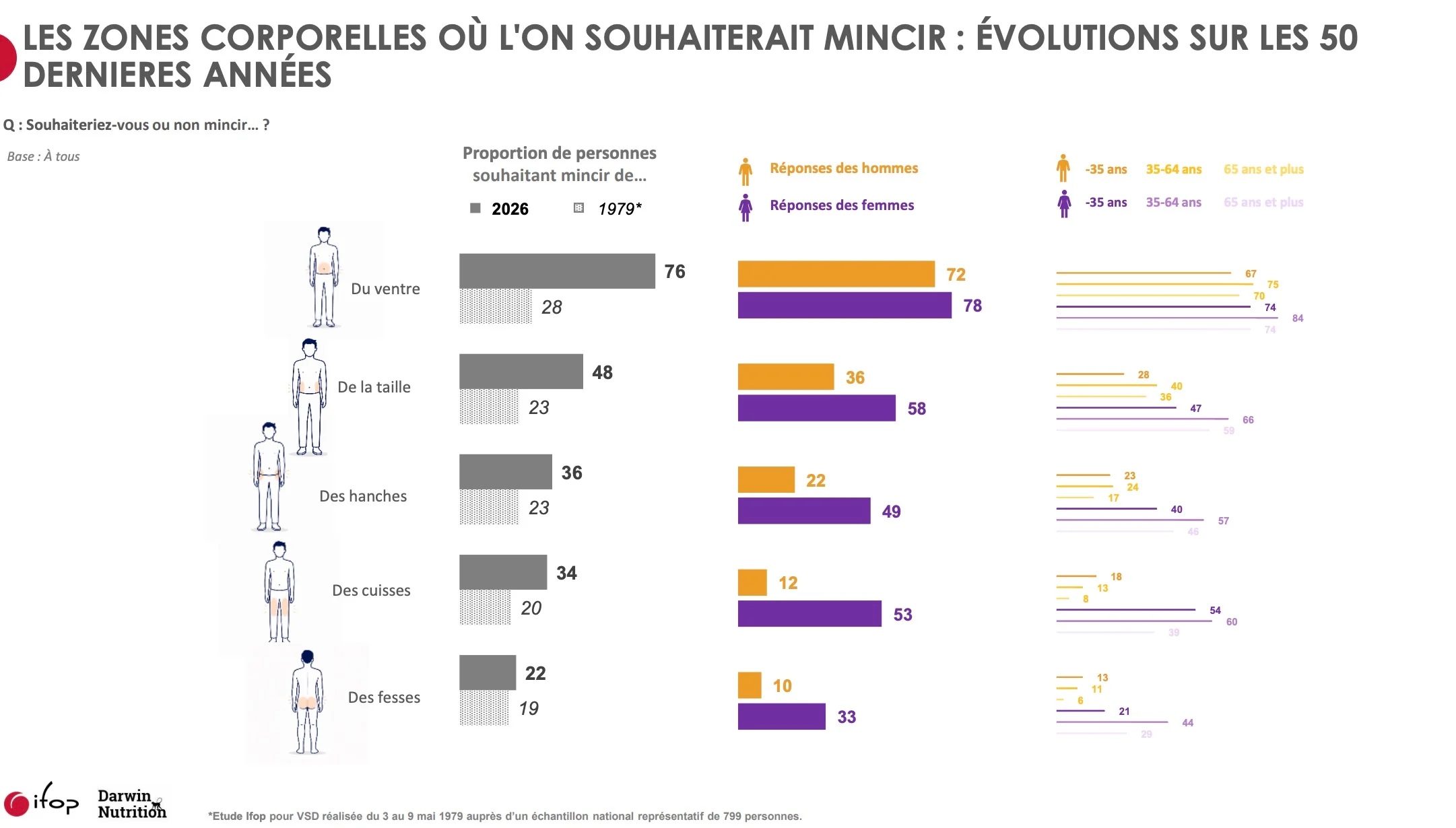
One part of the body particularly concentrates concerns: the stomach. Today, 76% of French people want to slim down this area, compared to only 28% in 1979. A spectacular development which concerns both men (72%) and women (78%).
The body complex therefore becomes masculinized. The ideal male silhouette, associated with sheathing and bodybuilding, also imposes new standards.
 © Ifop – Darwin Nutrition
“Body anxiety is masculinized, through the abdomen, this “belly” so valued by the culture of girdles, the gym and the masculine summer body.explains François Kraus.
For women, however, the injunctions remain different: the body continues to be observed “in zones”. Thus, 33% want to slim their buttocks compared to 10% of men.
Social networks amplify this pressure. Among women under 35, 66% consult beauty content, 62% follow sports or fitness influencer accounts and 51% look at images of “perfect” bodies that they would like to look like.
The swimsuit test: the “summer body” resists despite acceptance speeches
The arrival of summer acts as a trigger. Today, 40% of French people say they are on “slimming alert” before the holidays, twice as many as in 1979 (22%).
Women are particularly concerned: 47% feel this pressure, compared to 33% of men. Among 18-34 year olds, it even rises to 54% among women.
The desire to lose weight before summer is also increasing: 38% of French people say they want to lose weight before the holidays, compared to 23% at the end of the 1970s.
But this desire does not only concern overweight people. A third of women of normal weight (33%) also want to lose weight.
“Feminist criticism of the injunction to the “beach body” was not enough to defuse the mechanism of the “summer body”underlines the study.
Eat better, transform yourself, sometimes medicalize: new slimming strategies
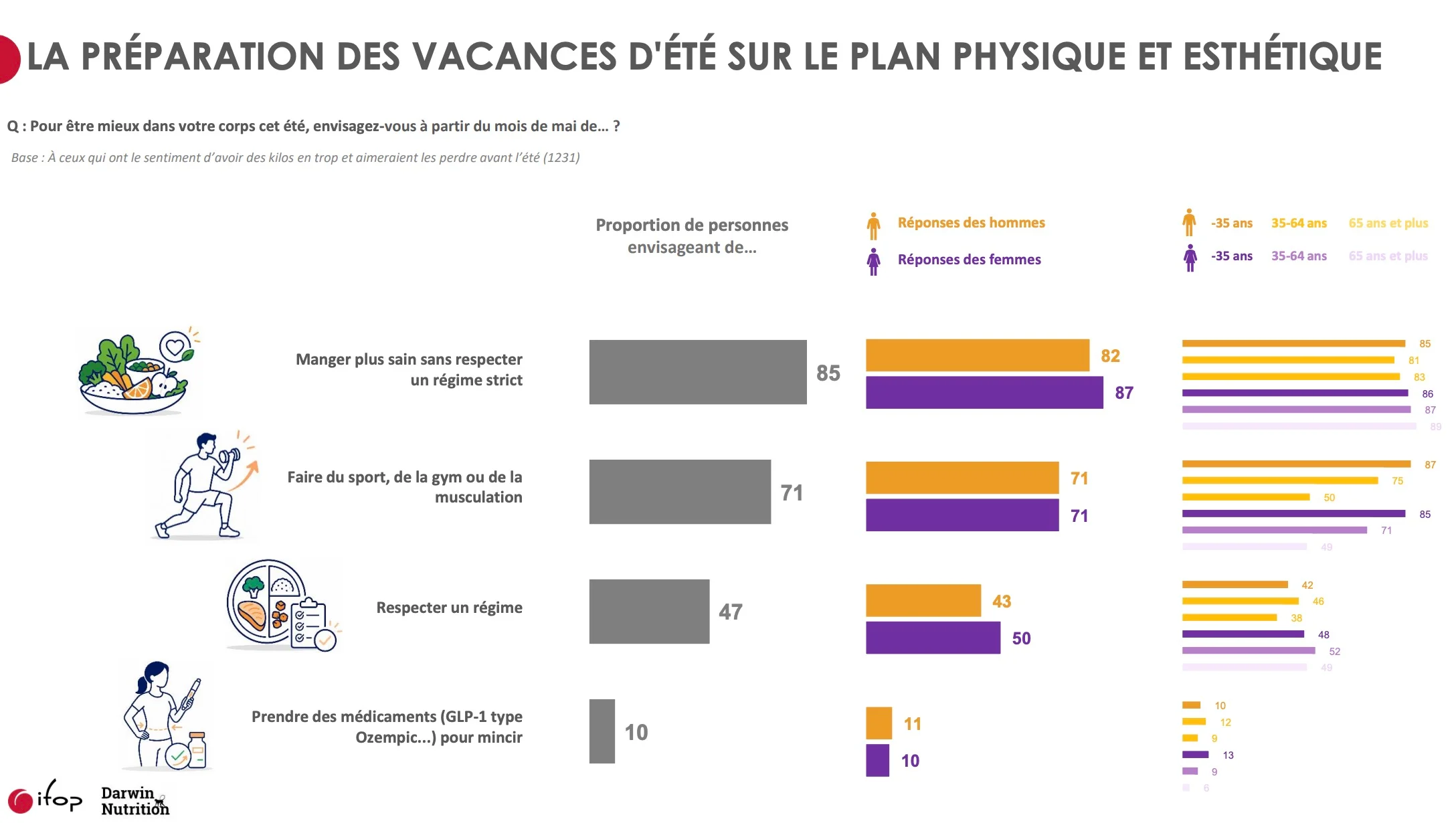
To lose weight, the French are changing their method. The strict diet is retreating behind a new promise: “eating well”. Among people wanting to lose weight before summer, 85% first consider adopting a healthier diet. The strict diet is cited by 47%.
Sport is also emerging as a major response: 71% plan to do sports, gym or bodybuilding.
“The shift from “losing” to “sculpting” says something of the times: we no longer lose weight, we “transform””observes François Kraus.
GLP-1 type drugs, like those used in certain obesity treatments, still remain in the minority: 10% of people wishing to lose weight are considering this solution.
 © Ifop – Darwin Nutrition
Body positive: a discourse adopted, but complexes still present
The great paradox of this survey is perhaps there: the French are more committed to the idea of accepting all bodies, but this is not enough to make the pressure disappear.
52% say they support the “body positive” movement, a proportion which reaches 74% among 18-34 year olds.
However, this support does not really change behavior: women who want to lose weight before summer are as numerous among the supporters of the movement (45%) as among its opponents (46%).
Even daily consumers of beauty content on social networks combine the two realities: 81% of them adhere to body positivity, while being strongly exposed to normative body models.
“Everything happens as if the acceptance of bodies had become a watchword that we willingly share… without ever ceasing to find ourselves too fat”summarizes François Kraus.
A contradiction that tells the story of our times: never have discussions on the diversity of bodies been so visible. But behind the screens, in the intimate face-to-face with one’s reflection, judgment still remains very present.