
Access to care, innovation, territorial organization: the study reveals a profound health divide, perceived by a large majority of the population, and calls for a political surge as the municipal campaign begins.
Cancer, an intimate and collective concern
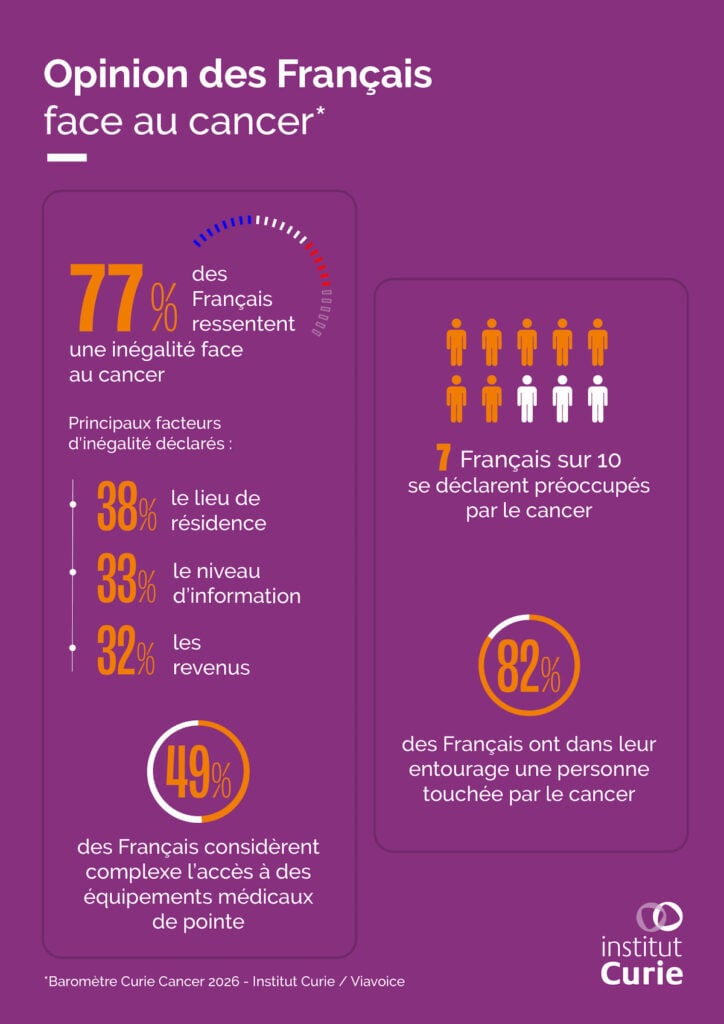
The figure is brutal, almost silent as it seems self-evident: seven out of ten French people say they are concerned about cancer. A diffuse, persistent concern, which has taken hold over the years as the disease gained visibility and proximity. Today, more than eight in ten French people know, in their immediate or extended circle, a person affected by cancer, according to the barometer Curie Cancer 2026produced by the Institut Curie with the ViaVoice institute.
This collective anxiety is not abstract. It is rooted in an experience. Nearly seven in ten people surveyed believe that the incidence of cancer has increased in recent yearsconfirming a widely shared perception: illness no longer only concerns “others”. It crosses generations, social environments, territories. In France, cancer is now the leading cause of death.
Globally, the projections reinforce this sense of urgency. Published in The Lancet in October 2025, a vast analysis anticipates a 75 to 90% increase in global cancer incidence within 25 yearseven though the number of new cases has already doubled since 1990. A dynamic which directly questions the capacity of health systems to absorb, support and treat.
But beyond the disease itself, it is the feeling of injustice which stands out as a central marker.
Support is not the same depending on where you live
77% of French people believe that there are inequalities regarding cancer. A figure that has been constantly increasing since 2019. And among the factors identified, the place of residence comes first: 38% of respondents cite the territory as the primary determinant of these inequalities, ahead of the level of information (33%) and income (32%).
Behind these percentages, a concrete reality: that of a care journey experienced as an obstacle course. Nearly half of those surveyed (49%) consider access to advanced medical equipment complex. Even more, 55% find it difficult to enter a hospital establishment, and 65% find it difficult to obtain an appointment with a specialist doctor. Essential steps, often urgent, but perceived as laborious, even discouraging.
Geography accentuates these tensions. Residents of large urban areas and Île-de-France describe smoother access, while those in rural or peripheral areas report increased constraints, longer delays, and required travel. A now structural health divide.
“This perception of a divide highlights a public health emergency that goes far beyond the strictly medical framework. It questions “Republican equity in the territory and reaffirms the need to offer everyone, regardless of where they live and their resources, effective access to prevention, screening, support and therapeutic innovations”explains Professor Alain Puisieux, Chairman of the Board of Directors of the Institut Curie.
This concentration of expertise is not theoretical. It can be read in the trajectories of patients.
“Each year, the hospital center welcomes patients from all over France, illustrating the concentration of the provision of specialized care in a few areas. In 2025, one in five patients treated at the Institut Curie is not from the Ile-de-France region. This increasing figure reflects a growing need for many French people to travel far from their place of residence.observes Professor Steven Le Gouill, director of the Institut Curie Hospital Complex.
Treating yourself then involves miles, time, energy, and sometimes renunciations. And asks a central question: how to make innovation accessible without locking it into a few centers of excellence?
Reinventing oncology: a medical, territorial and political challenge
Oncology is entering an era of profound transformation. Adaptive medicine, molecular biology, liquid biopsies, personalized treatments: these advances are redefining therapeutic strategies, promising finer, more targeted, often less toxic treatments. But they rely on heavy and expensive infrastructure, difficult to deploy without collective reflection.
However, these investments could be virtuous. By adjusting treatments as closely as possible to tumor biology, they allow “therapeutic savings” : fewer unnecessary treatments, fewer side effects, fewer avoidable hospitalizations.
“With an average cost of 40 billion euros per year in France, from screening to follow-up coupled with loss of productivity due to the disease, cancer is a determining political issue.reminds him Professor Steven Le Gouill. “This reality therefore requires collective reflection to develop these innovations: building a sustainable economic model, to deploy these tools beyond centers of excellence..
This supposes to rethinking the organization of the health systemstill largely structured around the act, to refocus it on the overall patient journey : prevention, screening, care, monitoring of relapses. But also to invest in the training of caregivers, the appropriation of new tools, and the fight against misinformation, in a context of growing mistrust of science.
As the municipal election campaign begins, the Institut Curie is calling directly on local decision-makers. Because communities play a key role: regional planning, mobility, prevention actions, information, screening.
“This is why the Institut Curie calls on future municipal teams as well as public authorities to place the fight against health inequalities and in particular cancer at the heart of their commitments.”insists Professor Alain Puisieux. “Cancer can no longer be approached as a purely medical problem; it must be considered as a social, territorial and political challenge”.
At the heart of this ambition, the Institut Curie continues to deploy a adaptive and personalized medicinebased on the “tumor tempo”, with an assumed objective: do not reserve innovation for a fewbut make it shareable, transferable, equitable.
A lucid promise, without illusion of a miracle. But with the conviction that, faced with cancer, equal access to care is also a condition of hope.
 © Institut Curie