
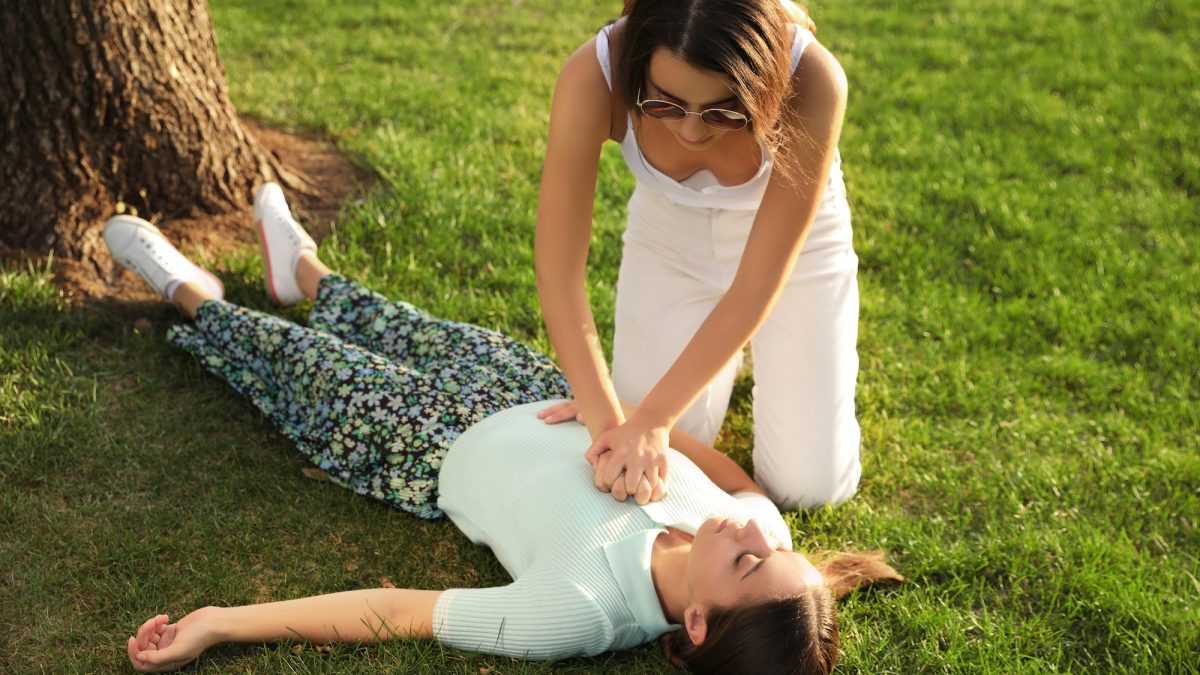
Each year, more than 350,000 cardiac arrests occur out of hospital in the United States, for a survival rate of just 9%. Until now, the “escape buoy” of witnesses remained the voice of the 911 dispatcher, responsible for guiding each chest compression in panic (equivalent to our 15 – Samu). An American study shows that a new resuscitation assistant based on artificial intelligence called ChatCPR performs better than these professionals… at least on paper.
Faced with an emergency, those seconds when everything changes
“Since only 2% of Americans are certified to perform cardiopulmonary resuscitation (CPR), when someone collapses, they call 911 and wait. ChatCPR could be a game changer and start saving lives” said Nimit Desai, BSc, research associate at the Qualcomm Institute at UC San Diego, medical student at UC San Diego School of Medicine, and lead author of the study.
The researcher believes that the adoption of new technologies could help reduce the gap between cardiac arrest and the start of cardiopulmonary resuscitation. Before creating
ChatCPRthe team tested six large AI models on simulated scenarios of cardiac arrest, drowning or collapsing while running, in children and the elderly. On average, these models validated 89.7% of the “minimal” criteria (place the hands correctly, set the right rhythm), but only 69.8% of the finer “maximum” criteria, such as letting the chest rise completely between two compressions.
“In a cardiac arrest, good is not enough”said Cameron Dezfulian, resuscitation doctor. “Missing 10-30% of steps can mean the difference between life and death“. To fill these gaps, researchers built
ChatCPR from 911 dispatcher training manuals and cardiopulmonary resuscitation (CPR) best practices. The system was designed iteratively to correct specific failure modes. In the same scenarios, ChatCPR scored 100% in simulated calls, both for basic gestures and the more advanced gestures needed to maximize a person’s chance of survival.
ChatCPR, the AI assistant tested in real emergency calls
In this feasibility study, researchers used 12 real 911 calls to compare AI-generated CPR instructions to those provided by 911 operators.
This agent, baptized ChatCPRwas developed by the University of California San Diego, the University of Pittsburgh School of Medicine and Johns Hopkins University. In the study led by Nimit Desai, he achieved 100% adherence to official CPR checklists, and when replaying 12 real 911 calls, he followed recommendations in 100% of basic steps and 98.9% of advanced steps, compared to 84.5% and 62.8%, respectively, for human dispatchers. Concretely, the agent guides the person second by second: checking consciousness, calling for help, hand placement, depth of compressions, pace to follow.
“ChatCPR Won Every Head-to-Head Comparison to Human Dispatchers” explained Noor Majhail, EMS rescuer. “ChatCPR excelled in patient assessment, instructions regarding depth and pace of chest compressions, and release guidance, areas where stressed, multitasking dispatchers most often failed” said Nimit Desai.
“It was not about style, but about strict adherence to recommendations for cardiopulmonary resuscitation, where precision is paramount.”said Dr. Davey Smith, professor at UC San Diego School of Medicine, director of the Altman Clinical and Translational Research Institute at UC San Diego and co-author of the study. “ChatCPR made it possible to correct elements that operators, under stress and faced with the complexity of real calls, sometimes overlooked, thus offering a valuable opportunity to integrate AI into everyday medical practice..
“It’s about supporting people in high-stakes situations where human judgment is essential,” explained Christopher Horvat, specialist in pediatric emergency medicine. The authors reported ChatCPR open source and demand testing and a clear legal framework.
“It is true that the procedure for sorting, sending help but also the actions to be taken is protocolled, especially in the event of cardiac arrest.” confirms Doctor Gérald Kierzek, emergency physician and medical director of True Medical. “We are even talking about reflex departures with immediate involvement of emergency services and an AI could identify, trigger the procedure and guide for cardiac massage. On the other hand, no emergency is the same and I am not sure that the AI knows how to adapt to all distress situations. There’s also a lot of psychology to be had. Humans must always be able to take control” he continues.
Open source AI between technological hope and medical caution
The idea that artificial intelligence could guide a gesture of survival arouses as much hope as caution. The researchers themselves insist: ChatCPR is not intended to replace emergency professionals.
“The goal is to raise the minimum level of performance, not to replace trained professionals.”explains Christopher Horvat.
In other words, AI could become an additional support in situations where every second lost reduces the chances of survival. But before any real large-scale use, several obstacles remain. Researchers cite the need for full-scale tests, technical safeguards, permanent human control and a clear legal framework.
Because one question remains: who would be responsible in the event of an error in an AI giving medical instructions during a vital emergency? “Today, witnesses benefit from strong legal protections when performing CPR.”recalls Mike Hogarth, professor of medicine and co-author of the study. “How these protections would apply to AI-assisted resuscitation is a challenge that still needs to be resolved.”.
It is urgent to be trained in actions that save
Beyond technology, this study tells us something else: our collective difficulty in acting in the face of an emergency. Many witnesses do not dare to intervene for fear of doing the wrong thing. However, in cardiac arrest, imperfect resuscitation is almost always better than inaction. Today, only 20% of French people have received first aid training, an insufficient figure.
Approved organizations offer training sessions throughout France. These training courses help you develop the appropriate reflexes and techniques to provide assistance.
- Awareness of life-saving actions (GQS): 2-hour training whose objective is to prevent the victim’s condition from worsening and preserve their physical integrity while waiting for help to arrive;
- Citizen first aid training (PSC): 7-hour training allowing citizens to acquire the skills necessary to provide assistance to a person in apparent serious and imminent danger by carrying out life-saving actions.