
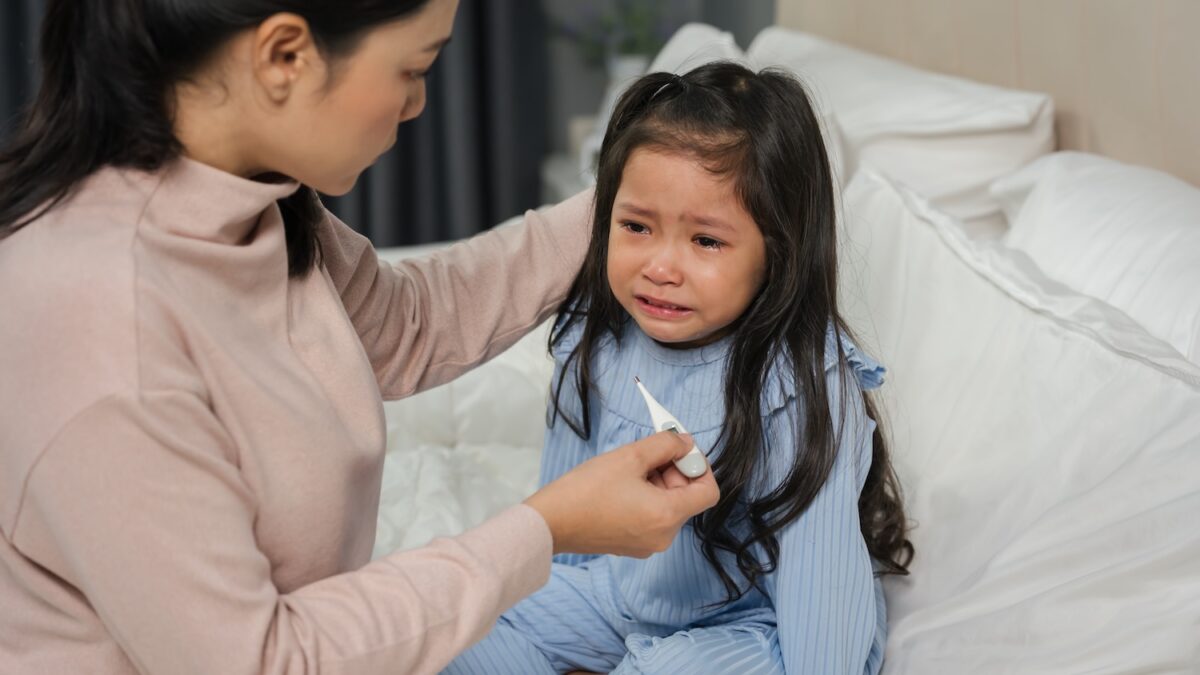
On Instagram, Dr Arnault Pfersdorff reminds parents of a useful idea: when faced with a baby’s fever, paracetamol is not an automatic reflex. The recommendations are in the same direction: we first treat discomfortnot just a number.
Paracetamol: useful if the child has difficulty coping with fever
In children, we speak of fever when the core temperature is above 38°Cunder good measurement conditions. But this threshold does not mean that the drug must automatically be taken out.
The pediatrician takes the example of a child at 38.5 or 39°C who is still gurgling, drinking, not vomiting and maintaining a good general condition: in this case, he considers that we can wait before giving paracetamol. The idea is consistent with the French recommendations, with one important nuance: this wait is only possible if the child tolerates the fever well and does not present any worrying signs.
The High Authority for Health points out that the aim of an antipyretic is not to bring the temperature back to normal at all costs, but to improve the child’s comfort. In other words, a baby or young child who is down, very embarrassed, in pain or who drinks less deserves different attention from a child who is feverish but still in good spirits. To go deeper, True Medical also details why treating fever only for the comfort of the child.
On the other hand, certain situations must lead to
seek medical advice promptlywithout just monitoring at home:
- An infant under 3 months old who has a fever;
- A temperature above 40°C;
- Unusual drowsiness or deterioration in general condition;
- Signs of dehydration;
- Breathing difficulty;
- Severe vomiting;
- A stiff neck.
If medication is needed, paracetamol remains the drug most often used as first-line treatment
in children, unless contraindicated. But it must be given with caution: the dose depends on the child’s weightthe time intervals between doses must be respected, and it must be checked that another medication given in parallel does not already contain paracetamol, in order to avoid an overdose.
Measure correctly, and avoid lukewarm bathing
Another point raised in the video: before treating, you still need to be sure that there is a fever. The account mentions practical frontal infrared thermometers and rectal measurement, which is more accurate. The recommendations confirm this nuance:
rectal measurement with a flexible electronic thermometer remains the referencewhile infrared forehead thermometers are fast but less accurate.
The video also warns against lukewarm bathing, previously recommended to lower the temperature. The practical advice is correct: this gesture no longer recommended. On the other hand, it is better to remember the reason given by the health authorities: the lukewarm or cool bath provides a modest and transitory benefit, can be unpleasant for the child and cause chills. It therefore does not replace either general health monitoring or simple comfort measures.
Nor should we believe that by mechanically lowering the temperature, we can surely prevent febrile convulsions. Antipyretics are mainly used to improve comfort; they are not a reliable way to prevent a fever-related seizure.
Finally, the video reminds us that fever is part of the immune response. This is a good way to understand why we don’t try to systematically erase it. On the other hand, it would be too general to state that taking paracetamol “reduces the immune system”: the action to take is based primarily on the age, general condition, hydration and tolerance of the child. If in doubt, especially in a toddler, it is better to refer to medical advice and the signs that should lead to emergency consultation.