
On Instagram, Dr Alexandre Mensier, visceral surgeon specializing in the digestive tract (@thefrench_chirurgien) recalls an important idea: in many cases, colorectal cancer can start from a polyp, often silent for years. Screening can spot these lesions, and a colonoscopy can help remove some before they progress.
Not all polyps become cancers
Dr Alexandre Mensier describes the mechanism visually: in the wall of the colon, the cells renew themselves regularly. It can happen that some accumulate modifications to their DNA and multiply in an abnormal way. This can form a polyp, visible during a colonoscopy.
This is the key point: in many cases, colorectal cancer begins from a polypnotably an adenoma. But nuance is essential. A polyp is most often benign and not all polyps have the same potential for development. The risk depends in particular on their type, size and number.
In other words, the transformation is not systematic. To say that a polyp necessarily “becomes” a cancer would be too simplistic. On the other hand, some can slowly develop into a cancerous lesion. This is what makes the subject both discreet and important: the process can take several years, whereas colorectal cancer can go without symptoms for a long time.
The surgeon also emphasizes another step: if the lesion progresses, it can invade more deeply the wall of the colon, then reach blood or lymphatic vessels. At this stage, care may become more cumbersome and specialized. To better understand why intestinal polyps can remain symptomless for a long time, the challenge remains to identify them before this development.
Screening is not just about colonoscopy
Colonoscopy allows you to visualize the inside of the colon and rectum. When a polyp is detected, colonoscopy can make it possible to remove some of them before possible cancerous transformation. This is why it plays an important role in the prevention of certain colorectal cancers.
But in France, for the average-risk population, organized screening does not start directly with a colonoscopy.
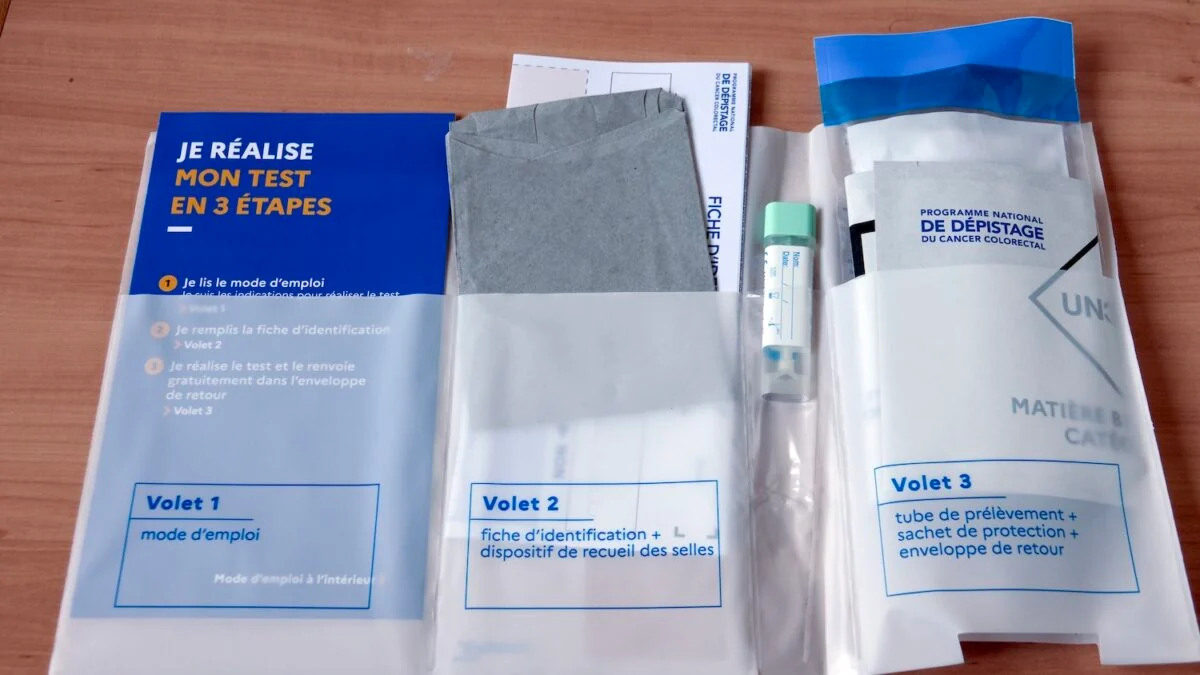
For people at average risk aged 50 to 74it is based first on an immunological test in the stool, to be carried out every two years. If this test is positive, a colonoscopy is then indicated to find the origin of the bleeding.
The situation is different for certain people at high or very high risk, for example depending on their personal or family history. In this case, the screening strategy can be adapted, often with a colonoscopy from the outset, but this must be discussed with the treating physician or a gastroenterologist.
- If you are concerned by organized screening, the immunological test is the first reflex to know;
- If the test is positive, colonoscopy can check the cause and, in some cases, remove a polyp;
- If you have a personal or family history, ask which screening is appropriate for your risk level.
We must also avoid another idea that is too radical: when a lesion is already cancerous or advanced, everything does not come down to “colonoscopy or surgery”. Management depends on the stage, location and characteristics of the lesion. Certain very early situations may require selected endoscopic treatment; others require surgery and/or other treatments.
The point of the message remains simple: screening is not only used to find cancer that is already present. In some cases, it makes it possible to identify and treat an injury before it becomes more worrying. To find out more about colonoscopy, a key examination for the prevention of colorectal cancer, it is better to rely on medical indications rather than a decision taken alone.