
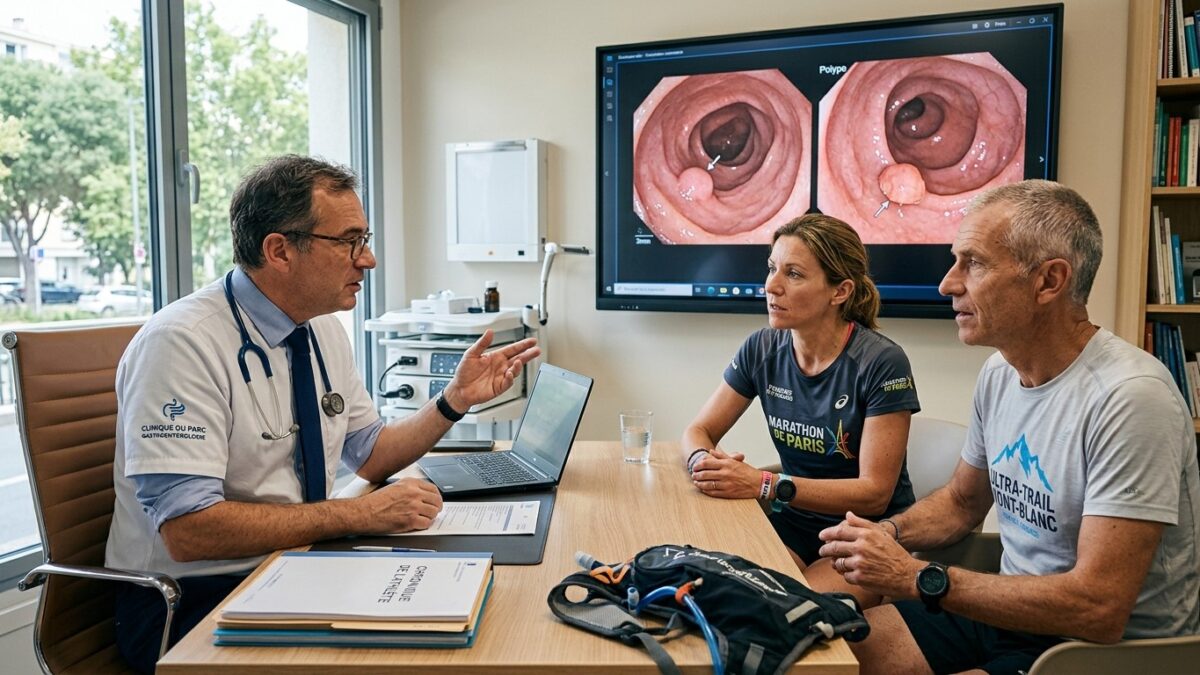
Published in Cancer Epidemiologythe study conducted by the Inova Schar Cancer Institute followed 94 marathoners and ultramarathoners. The researchers detected more advanced adenomas than is usually observed in this age group. Without calling into question the widely demonstrated benefits of physical activity, these results open a new scientific question: to what extent does extreme endurance remain protective?
The paradox of “ultra-endurance” athletes
For decades, scientific evidence has been accumulating: running reduces cardiovascular risk, improves mental health and reduces the risk of several cancers. Running has even become, for many, a symbol of prevention and longevity.
So when American doctors began observing unexpected abnormalities in experienced marathon runners, the surprise was real.
The study, entitled Advanced adenomas among young endurance runnerswas led by Dr. Timothy L. Cannon, an oncologist at the Inova Schar Cancer Institute in Virginia. The researchers followed 94 runners aged 35 to 50, all accustomed to extreme efforts: completing at least five marathons or two ultramarathons of 50 kilometers or more.
The protocol was simple but unprecedented. Each participant answered a detailed questionnaire on their sports and digestive habits before carrying out a colonoscopy.
The results intrigued the researchers.
Adenomas — polyps that are generally benign but likely to progress to colorectal cancer — were found in 41.5% of participants. Even more worrying: 15% presented so-called “advanced” adenomas, considered high-risk precancerous lesions. However, no cancer was diagnosed.
“We did not expect these rates of high-risk adenomas, which are precursor lesions to cancer, in an age group like this.”recognized gastroenterologist David Lieberman.
The contrast with the general population is striking. According to traditional data, screening programs usually find advanced polyps in only 1.2 to 6% of people in this age group.
However, these lesions are not trivial. The High Authority for Health considers polyps of at least 10 millimeters or containing very abnormal cells to be “advanced”. Some can progress to cancer in the following years if nothing is done.
A still fragile scientific alert
Should we therefore see the marathon as a danger for the colon? The researchers themselves immediately call for caution.
“These results should therefore be interpreted as signal generators and not as evidence that endurance running increases the risk of colorectal cancer at the population level.”write Timothy Cannon and his colleagues in
Cancer Epidemiology.
In other words: the study raises a question, it does not yet provide a definitive answer.
This nuance is essential. Firstly because the number remains limited: only 94 participants. Then because the profiles studied are very particular. These are not occasional joggers or Sunday sportsmen, but athletes who have sometimes accumulated several dozen kilometers every week for years.
Most ran between 32 and 64 kilometers each week, with competitions ranging from classic marathons to races of over 100 kilometers.
Specialists also point out that physical activity remains, overall, a powerful protective factor against colorectal cancer.
Amy S. Oxentenko, a gastroenterologist interviewed after the publication of the study, emphasizes this scientific caution.
“Let’s be realistic. This is a very small study, and the results are preliminary at best. Runners need not worry. There is still a lot to learn.”she says.
The fact remains that this research is part of a broader questioning of the biological effects of extreme endurance. Chronic inflammation, oxidative stress, digestive microtrauma, disruption of the intestinal microbiota: several avenues have been raised in recent years to understand what very prolonged efforts really impose on the body.
Science advances here with caution, almost groping. And this is precisely what makes these results interesting: they force us to look differently at a practice long perceived as exclusively beneficial.
What runners need to remember today
The American study does not change official colorectal cancer screening recommendations. But it brings to mind a point that is often downplayed in the world of endurance sport: certain digestive symptoms should never be trivialized.
The researchers notably observed that 57.1% of runners with an advanced adenoma reported rectal bleeding after exercise, compared to 16% in those with simple adenomas.
In the marathon world, these manifestations are sometimes considered to be simple mechanical consequences of prolonged effort. Many runners even learn to live with recurring digestive problems during competitions. However, the authors of the study now call for greater vigilance.
Blood in the stools, persistent pain, a lasting change in transit or unusual digestive symptoms should lead to consulting a doctor and, if necessary, discussing earlier screening.
This message goes far beyond just the world of sport.
Because behind this study a larger reality emerges: colorectal cancer affects more and more young people in many Western countries. A development which greatly concerns gastroenterologists and whose exact causes remain poorly understood.
For American researchers, the marathon is therefore not a designated culprit. It could be a revealer, a particular field of observation allowing us to better understand certain biological mechanisms that are still invisible. And this is perhaps the whole significance of this study: to remind us that in medicine, even the best established certainties sometimes deserve to be re-questioned. Not to worry unnecessarily, but to better protect.