
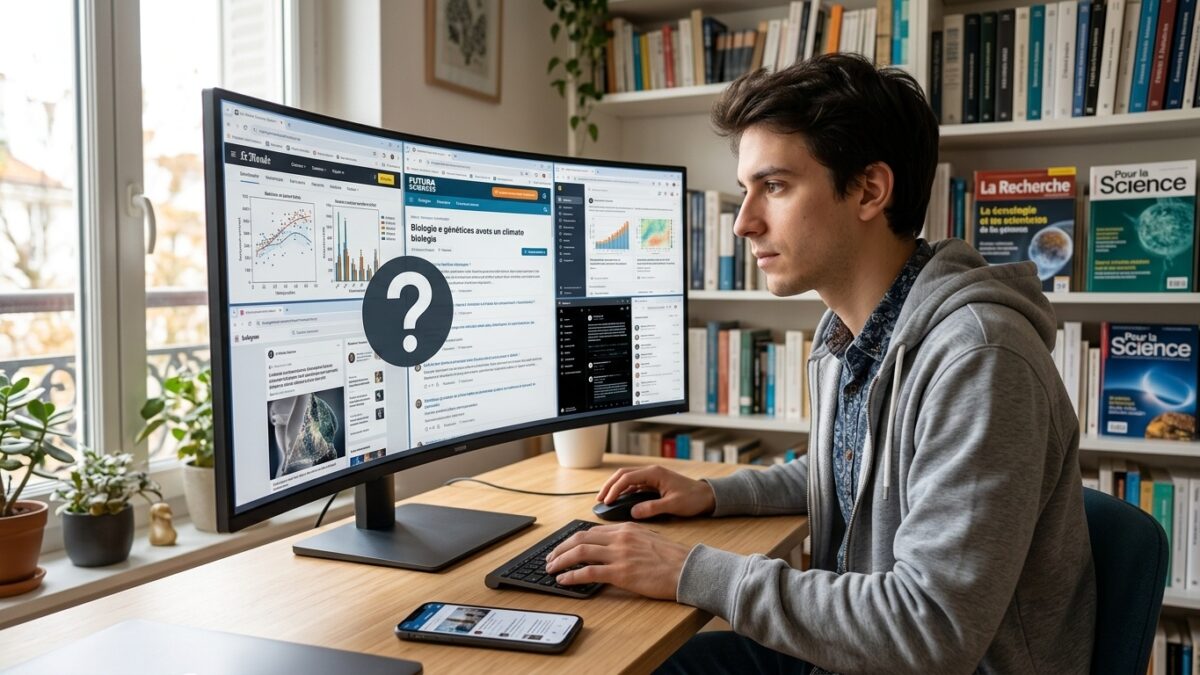
On social networks, a “shocking” study emerges, is shared millions of times, then disappears in a flood of comments accusing science of constantly being wrong. In this permanent agitation, the line between serious results, opinion dressed up as data and pure falsehood quickly becomes blurred for the general public.
The digital setting is, however, simple: infinite information, limited time, and recommendation algorithms that favor emotion rather than nuance. In this environment, most people still confuse science with certainty, and scientific thinking with accumulation of facts. This is where the misunderstandings begin.
Why scientific thinking remains the big blind spot in our digital lives
For psychologist Mona Sue Weissmark, who has taught advanced research methods and the psychology of diversity at Harvard for more than 30 years, scientific thinking is not a degree, but an attitude. It’s about formulating hypotheses, accepting uncertainty, testing your ideas and agreeing to correct them when the facts resist. Nothing to do with the image of an infallible expert.
In fact, our news feeds are structured by machines that favor clicks and reactions. These systems, whether they are social networks, search engines or generative artificial intelligence, are not neutral: they decide which topics rise, which angers amplify, which beliefs are reinforced in real filter bubbles. Most Internet users are still unaware of this mechanism, even though it already conditions their digital literacy.
Science, errors and replication: why uncertainty is part of the game
In this area, a misunderstanding dominates: if a famous study is contested, many conclude that the science is completely wrong. The psychologist recalls, in a text on the evaluation of research, that experiments like the Stanford Prison Experiment or the marshmallow test have often failed to be reproduced. For her, this replication crisis above all shows a science that verifies, corrects and refines its results, in particular thanks to meta-analyses which aggregate numerous studies.
Develop a scientific mindset in the face of algorithms and disinformation
For this teacher, scientific thinking must come out of laboratories and become a citizen skill. She emphasizes intellectual humility and remembers her mentors Brendan Maher and Robert Rosenthal, who were never afraid to say
“I don’t know”, she tells the media Psychology Today. A 2022 study indicates that people trained in critical thinking share 65% less fake news, a sign that these reflexes are really changing our online behaviors.
One question remains: who should teach these reflexes in a society saturated with information, disinformation and automatic responses generated by AI? The European Broadcasting Union believes that the ability to access the media, understand them and evaluate them with hindsight conditions democratic participation. Between school, public media and platforms, it is about learning to see how content is produced and sorted by algorithms, before clicking, commenting or sharing.