
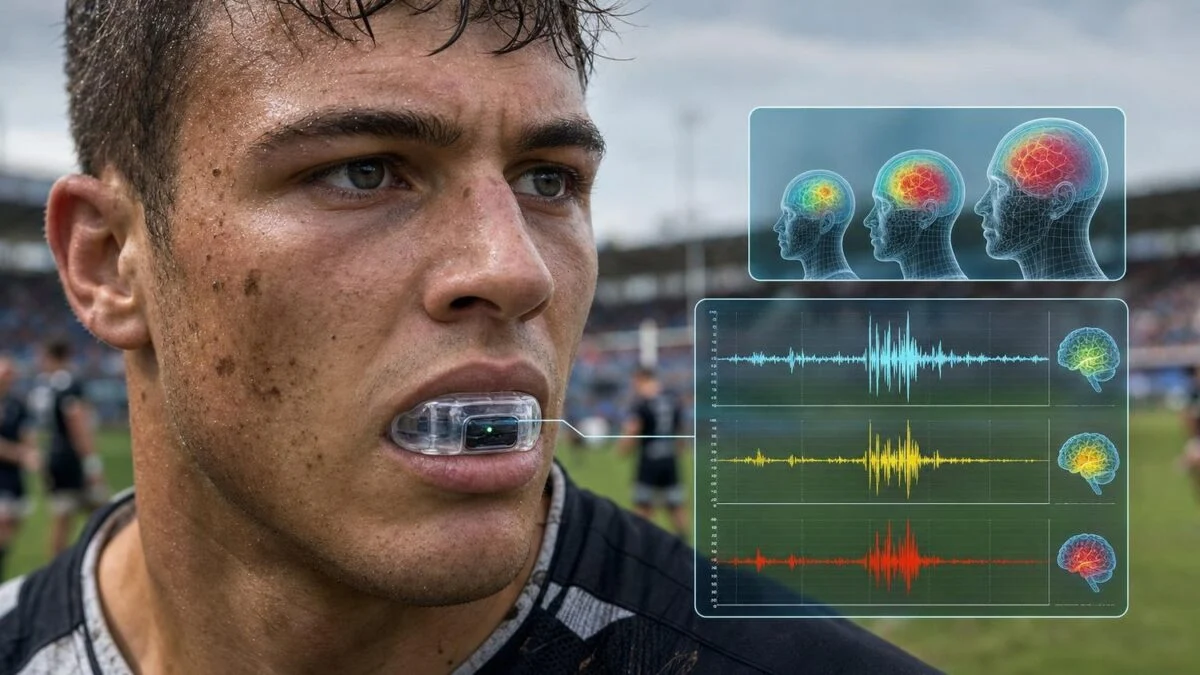
On rugby fields, smart mouthguards have become a symbol of modernity and vigilance against concussions. But a recent study reveals a silent flaw: by relying on a single male head model, these devices could underestimate certain shocks, particularly among women and young players.
The same “average skull” for a 10 year old girl or a 130kg pillar…
Smart mouthguards are supposed to alert immediately in the event of a dangerous impact to the head. Introduced in rugby since 2024, they measure skull accelerations and translate this data into risk levels used by medical teams. The international federation World Rugby already relies on these measures in the concussion protocol (Head Injury Assessment – HIA) to trigger an assessment.
©University of Otago
But behind this promise of precision lies a structural limit: the algorithms are almost all based on a single head model, that of an “average” adult man.
“The problem is that almost all trading systems use a one-size-fits-all approach, assuming that every player has the same head as a 50th percentile adult male, whether it’s a 10-year-old girl or a 300-pound premier league player.”says Professor Melanie Bussey, from the University of Otago’s School of Physical Education, Sport and Exercise Science.
Risk scores that vary by more than 50%
Out of 15,237 impacts analyzed among 572 players aged 10 to 38, researchers observed significant differences depending on the model used to interpret the data.
Among female players, simply switching from a male to a female model causes risk scores to vary by up to 54%. In some cases, shocks fall below the alert threshold without the raw data changing.
Same observation for light players: adapt the reduced model by more than 60% the estimated rotational forces. A gap that can modify the medical decision in real time.
“This also affected whether or not individual impacts were flagged as high risk.”underlines the study.
Protection to reinvent
The problem does not come from the sensors, but from the way we interpret their data. By continuing to use a single “average skull”, the systems ignore some of the real diversity of bodies.
The researchers propose a simple solution: integrate at least three head models, depending on sex and morphology, to improve the reliability of alerts.
“If we want smart mouthguards to improve safety across the entire game, then the modeling they are based on must be inclusive.”recalls Melanie Bussey.
Beyond the field, a question of fairness
This study goes beyond the sole framework of rugby. It questions the way in which medicine and sport construct their measurement tools: from which “standard” body do we decide the risk?
In a sport already faced with the issue of concussions, this invisible flaw recalls an essential reality: a technology is only protective if it truly represents those it monitors.