
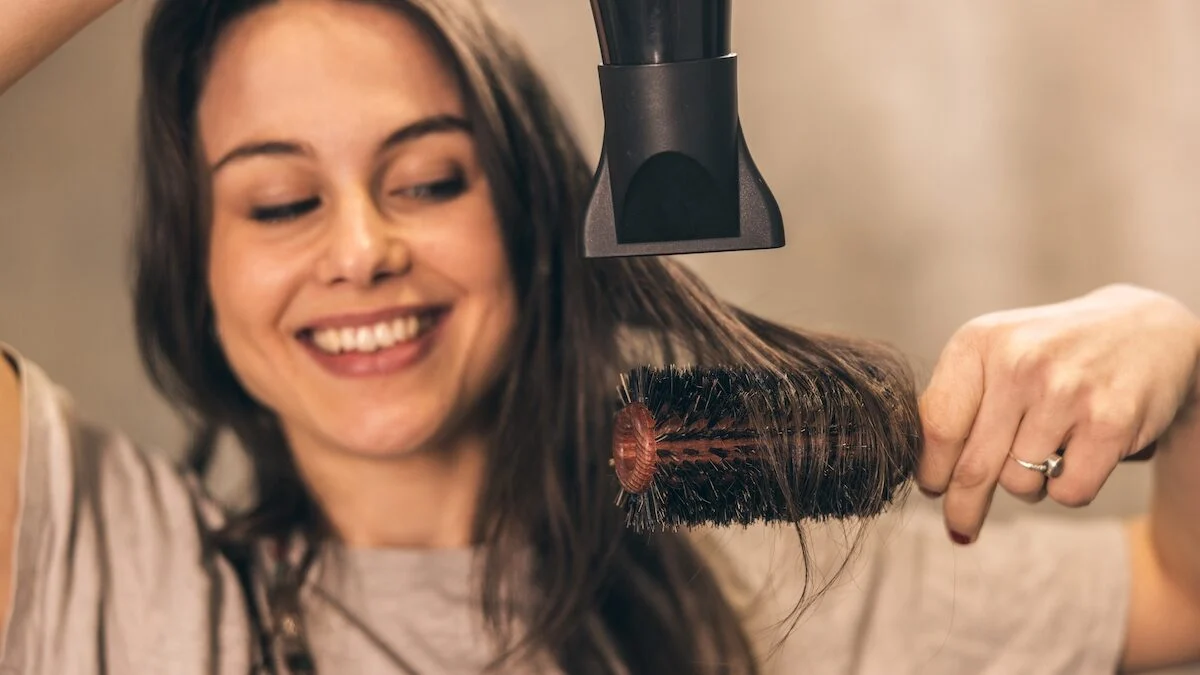
Blow-drying is coming back everywhere, from red carpets to social media, with ultra-shiny lengths and controlled volumes. However, it is one of the most difficult hairstyles to achieve at home, between unruly hair, frizz and poorly chosen tools. Many therefore end up with a swollen or flattened result, whereas with a few hairdresser tips, home blow-drying can really resemble that of a salon.
The basics of a professional blow-dry at home
To achieve a successful home blow-dry, it all starts in the shower:
- First use the Smoothing Shampoo and Conditioner Duo to soften strands and tame frizz;
- Once the hair is washed, apply an anti-frizz treatment or a smoothing oil to the lengths, then a heat-protective spray;
- Pre-dry the hair with a hairdryer to about 80% to maintain control once the brush is in hand.
In terms of equipment, a hair dryer with a concentrator tip remains the central tool, because it directs the air flow in the right direction.
A small diameter round brush gives tight curls or bombastic bangs, while a large diameter creates soft straightening with volume on medium to long hair.
A few pliers for sectioning, a comb for tracing the separations and a flat brush for finishing are more than enough.
The hairdressers’ method for a blow-dry that lasts
We start at the nape of the neck, the rest of the hair held with clips.
Work with fine strands, approximately 2 to 3 cm, to stretch them tightly on the brush without pulling. Place the brush at the root, lift to loosen the roots then slide, keeping the strand taut. The hair dryer remains 10 to 15 cm away, with the tip directed from the roots to the ends to smooth the cuticles rather than ruffle them.
At the ends, give the brush a quarter turn inwards for rounding, or roll the strand further for a wavy effect.
We repeat this pattern zone by zone, finishing each strand with a jet of cold air to fix the shape.
A well-done blow-dry generally lasts two to three days on fairly straight hair, a little less on naturally wavy or curly hair.
Adapt your blow-dry to your hair type
Adapt the temperature and drying time to the hair material:
-
Fine hair: medium heat and large brush for volume;
-
Thick hair: smaller strands and longer drying, without sticking the hair dryer.
Now, get your tools!