
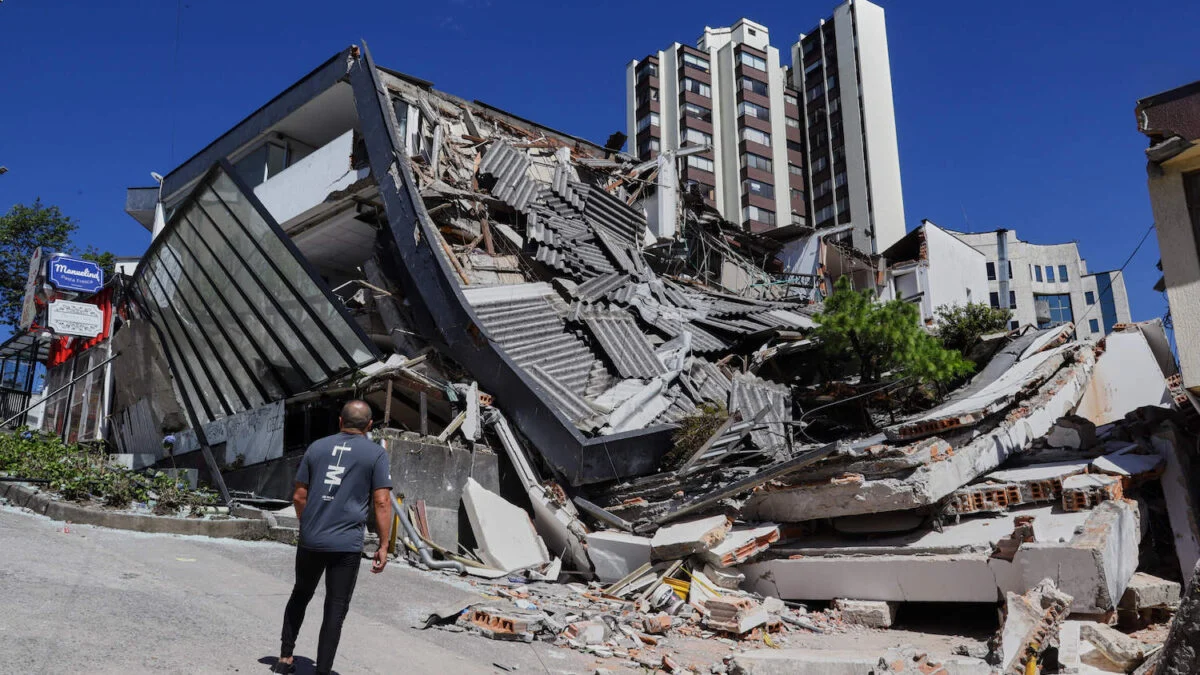
On August 10, 2026, the earth shook violently in Colombia. The earthquake, first announced with a magnitude of 6.6, was finally evaluated at 7.4. Its epicenter was located near San José del Palmar, in the Chocó department, several hundred kilometers from Bogotá. However, the tremors were felt in a large part of the country and even in neighboring countries.
In the worst affected areas, notably around Pereira, Cali and Quibdó, buildings collapsed and residents found themselves trapped under the rubble. More than 1,600 buildings were damaged and 86 completely destroyed, according to initial estimates. The toll showed at least 132 dead and 570 injured, while search operations continued.
For families still waiting for news of a loved one, every hour counts. Because under the rubble, survival depends on a multitude of factors: the severity of the injuries, the presence of an air pocket, the temperature, access to water, but also the possibility of being quickly spotted by rescuers.
The first hours are crucial
In disaster medicine, the first 24 to 48 hours are a particularly decisive period. It is during this window that the chances of finding survivors remain the greatest, even if no survival time can be fixed with certainty.
An uninjured victim can sometimes survive several hours or more if they are in an air pocket and have relatively favorable conditions. Conversely, a seriously injured person may see their condition deteriorate very quickly.
“Some people may benefit from an air pocket, which allows them to survive“, explained Dr. Gérald Kierzek, emergency physician and medical director of True Medical. “Except that not only do air pockets become smaller over time, but a person who cannot hydrate will die. The body cannot survive more than three days without water… “
This reality explains why rescue teams continue to search for possible survivors even as time passes. The silence under the rubble does not necessarily mean that there is no one left to save.
Three major threats after an earthquake
For Dr. Gérald Kierzek, several medical emergencies overlap after a disaster of this magnitude.
The first threat concerns the trauma caused by the collapse. A person may suffer internal bleeding, chest trauma, multiple fractures or even neurological damage. Some of these injuries can become fatal within hours if left untreated.
“Any respiratory, neurological or hemorrhagic distress must be treated urgently in the first hours, the risk of death is very present“, underlines the doctor.
The second threat directly concerns the people still trapped in the rubble. Even when they escape the most serious injuries, they remain vulnerable to lack of oxygen, dehydration and exhaustion. The more hours pass, the more survival conditions can deteriorate.
The third threat is less visible, but equally worrying: the interruption of medical treatments.
A natural disaster does not only affect people whose homes have collapsed. It can also endanger patients who survived the earthquake but find themselves deprived of their usual treatment.
“These are diabetic people who do not have their insulin, people with kidney failure who can no longer be dialyzed. All these people are also going to be in danger. Even if they are not direct victims, if their treatment is not accessible, they can quickly become collateral victims of this event.“, continues Dr. Kierzek.
Can we really survive several days under the rubble?
The question obsesses loved ones and rescuers alike: how long can a person last under several tons of rubble?
There is no universal deadline. The first 24 to 48 hours are particularly important, but survivors can sometimes be found several days after a disaster. Everything depends in particular on their injuries, their hydration, the temperature and the existence of a sufficiently ventilated space.
Particularly late rescues have already marked the history of natural disasters. After the earthquake and tsunami that hit Japan in 2011, an 80-year-old grandmother and her grandson were found alive nine days after the disaster. In Haiti, in 2010, a teenager was pulled from the rubble alive two weeks after the earthquake.
These situations remain exceptional. But they explain why the specialized teams continue their searches as long as security conditions allow.
Being pulled out of the rubble doesn’t mean being out of the woods
Rescue does not always constitute the end of the emergency. A person who has been trapped under rubble for a long time may develop crush syndrome.
When muscles are compressed for several hours, their destruction releases substances into the bloodstream that can severely damage the kidneys. When the victim is released, these substances can then cause a sudden deterioration in his condition, sometimes with acute renal failure and failure of several organs.
Treatment must therefore continue immediately after extraction. Victims need trauma care, but also close medical monitoring in order to prevent or treat complications linked to their prolonged immobilization.
In the hours following an earthquake, the emergency is not limited to finding buried people. We must also be able to take care of them as soon as they emerge from the rubble, then ensure continuity of care for fragile patients.
Because behind the balance sheet figures are hundreds of disrupted destinies. And as long as people remain missing, the race against time continues.
IN BRIEF
- August 10, 2026a powerful earthquake struck Colombia. Its magnitude, first estimated at 6.6, was later reassessed to 7.4.
- The results showed at least 111 dead and 87 injuredwhile emergency services continued their searches in the most affected areas.
- Under the rubble, the main threats are
severe trauma, dehydration and lack of oxygenbut also the interruption of treatments in people suffering from chronic illnesses.- Even after extraction, victims remain exposed to
crush syndromewhich can cause serious kidney complications.