

When the clock of meals dialogues with our genes
What if you advance your dinner could block obesity? This is the track explored by the study of the ones, conducted in Spain with 1,195 overweight or obesity adults. The researchers followed the participants during an intensive 16 -week program, then contacted them on average 12 years later. The objective: to understand how the meal time interacts with the genetic predisposition to obesity.
“”We have shown that meal time is relevant to maintain weight in the long term, which is notoriously difficult for most individuals “write the authors in the journal Obesity (2025).
Each offbeat meal hour increases the BMI
The researchers calculated a Polygenic score (PRS-BMI) based on more than 900,000 genetic markers in order to assess the genetic risk of obesity. They also measured the “Midpoint”, that is to say the middle hour between the first and the last daily meal.
The observation is final:
- Each meal hour offbeat later corresponds to +0.95 kg/m² of BMI at the start;
- And at +2.2 % more weight after 12 years.
But the effect explodes in people at highest genetic risk : Each late hour is equivalent to +2.2 kg/m² of BMIor more than 3 kg/m² of difference between “early eaters” and “late eaters”.
“”Our results reveal that the middle hour of meals is associated with a higher body mass index only in individuals with a strong genetic predisposition to obesity “underline the researchers.
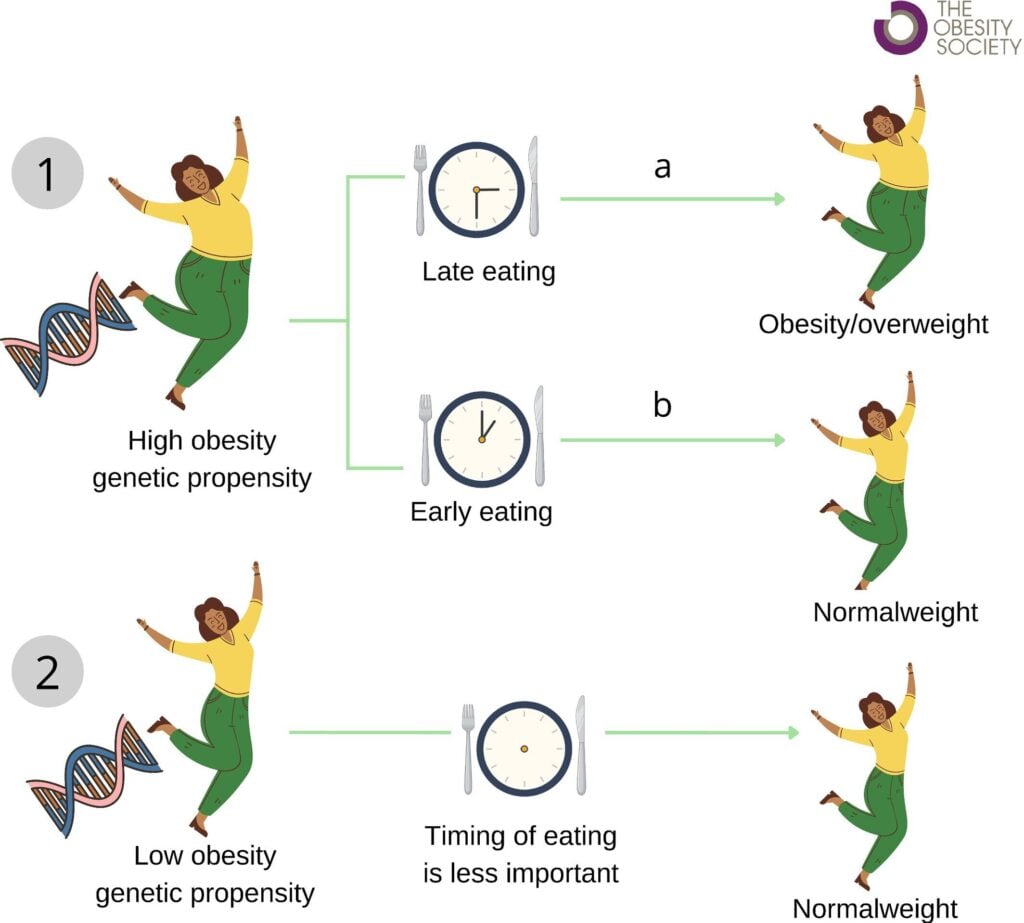 © Graphic Summary. Credit: Obesity (2025). DOI: 10.1002/OBY.24319
Obesity and genetics, meal time that changes everything
Eat early, key advice for those who have a hereditary risk
The study goes further: for individuals at low or intermediate genetic risk, no net correlation appears. In other words, Eating early seems above all beneficial to those who have inherited a terrain favorable to obesity.
“”Eating earlier could alleviate the high genetic risk of obesity, by reducing the impact of genes on body weight “conclude the authors.
This discovery, resulting from a rare follow -up by its duration, opens the way to personalized nutrition recommendations. For some, advancing your dinner would no longer be a simple common sense advice, but a real therapeutic lever.