
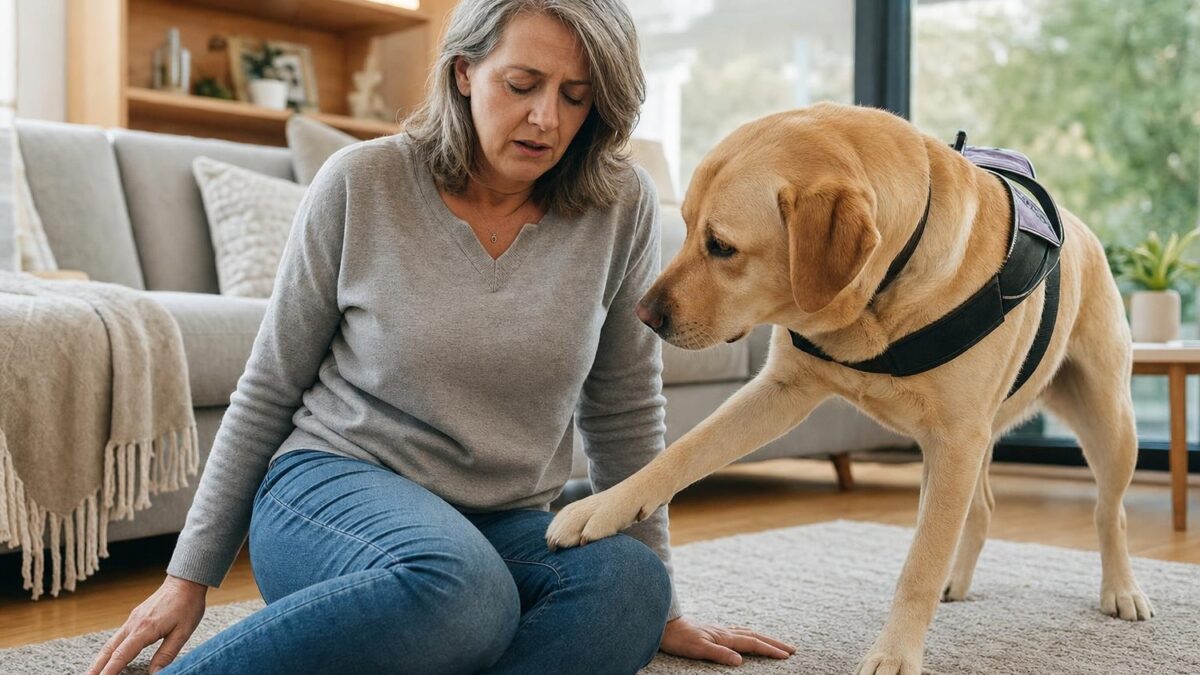
In Lot-et-Garonne, an assistance labrador sometimes pushes its mistress to lie down on the ground, long before she feels ill. A few hours later, an epileptic seizure shook her, just as the dog had predicted. The animal warned her by lightly nudging her thigh, sneezing, suddenly looking dark, says the daily The Dispatch. For people with epilepsy, this type of epileptic seizure detection dog changes everything: falls avoided, treatment anticipated, anxiety reduced.
This “sixth sense” is not magical. It is based on a very concrete reaction of the human body: before and during the crisis, sweat and breathing release particular molecules, which make up a real crisis smell. Trained assistance dogs learn to recognize this smell and associate it with the alert. They also rely on micro-changes in posture, breathing rate or mood of their human, which they constantly observe.
Dog scent and epileptic seizure
The dog’s nose is an extremely precise instrument, equipped with more than 200 million olfactory receptors. It is also capable of detecting pheromones through the Jacobson’s organ, located in the palate, which allows it to obtain a detailed chemical picture of a person’s internal state. Before an attack, the human body emits specific chemical compounds through sweat or breathing, and the dog is able to identify this scent signature.
Assistance dogs for people with epilepsy are capable of making the difference, of identifying the smell of an epileptic patient in seizure, as opposed to all the other smells that can be sampled at all times, whether sleep, activity, sport, calm, work.
Teaching an epilepsy detection dog
This ability is not just innate. It is reinforced by long training, often carried out in France by the Handi’Chiens association. “The training is based on olfaction and odor discrimination. In France, it is in particular the Handi’Chiens association which is responsible for this“, describes Le Mag du Chien. Educators associate the smell of crisis with specific alert behavior, such as “To do this, he will use a specific bark and a gesture, such as a unique snout call called a “poke” or a special way of pulling on his clothing.“.
We met Stéphanie Martins who told us how her dog Oggy helps her on a daily basis. Discover his video testimony at the end of the article.
Electronic noses for epilepsy
Discoveries made with dogs are now of interest to engineers. Knowing that this odor is already present more than four hours before the attack, it becomes a real predictor of the attack, offering several hours in advance to get to safety or adapt treatment. Several research teams are already working on a wearable device, in the form of a brooch, collar or watch, intended to imitate a dog’s scent and alert patients automatically.