
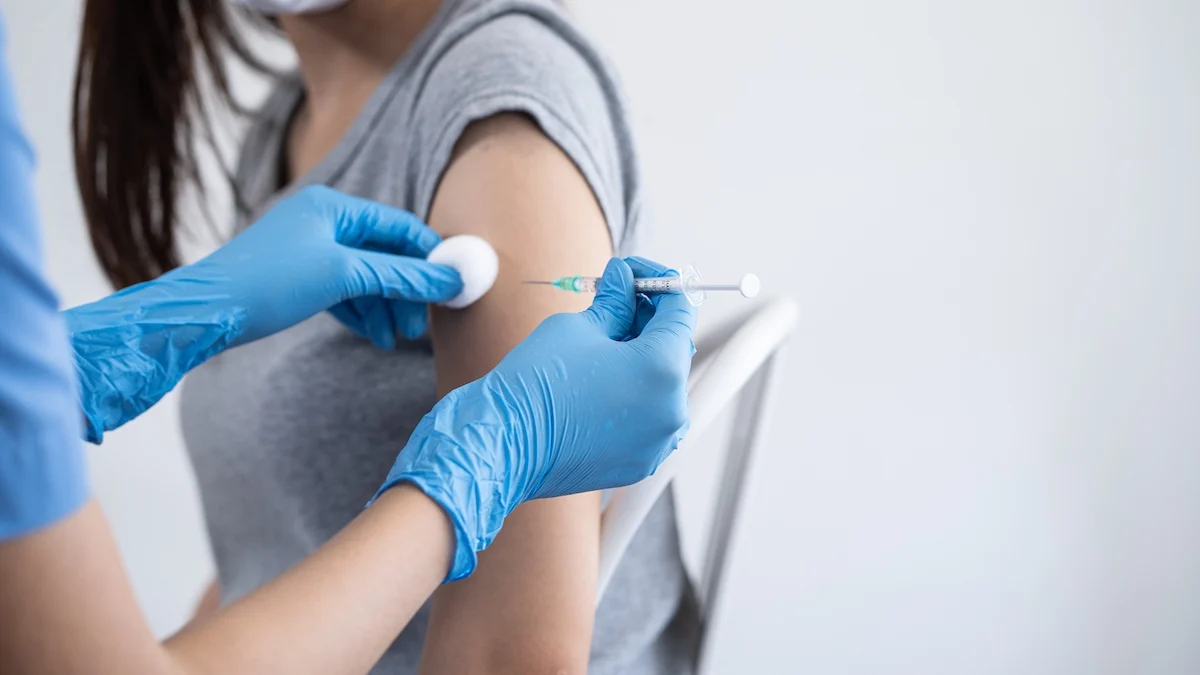
Our immune system does not react the same way in everyone. Researchers from the Max-Planck Institute, the Pasteur Institute and Inserm show that intestinal bacteria participate in this initial state. A discovery which opens up avenues of research, without demonstrating that a dietary change would already make it possible to limit fever after a vaccine.
Why do some people have a fever after a vaccine?
An injection, then a few hours later a rising temperature, aches or a feeling of fatigue. For some people, the effects of vaccination are more pronounced than for others. Until now, the reasons for these differences remained partly mysterious.
To see more clearly, an international team led by Ruth Ley, from the Max Planck Institute of Biology in Tübingen, studied young adults vaccinated against SARS-CoV-2 in 2021 and 2022. Participants provided stool and blood samples, while regularly measuring their temperature before and after the injection.
The researchers found that people who were going to develop a higher fever already showed, before vaccination, differences in their intestinal microbiome and certain markers of inflammation.
“Vaccination provides a controlled way to understand why individuals may respond so differently to the same immune stimulus“, explains Ruth Ley, director of the department of microbiome science at the Max Planck Institute of Biology.
In the intestine, a bacterial protein attracts attention
At the heart of this discovery: flagellin, a protein which is part of the composition of the flagellum, the filament allowing certain bacteria to move.
The immune system can recognize this protein as a danger signal and trigger an inflammatory response. However, the microbiomes of participants who subsequently experienced a high fever expressed more genes associated with bacterial motility, particularly the production of flagella.
To verify that the microbiome could play a causal role, the scientists transferred that of participants to mice lacking intestinal microorganisms. After vaccination, animals that received the microbiome of people who had developed a high fever showed more intense inflammation than others. The effect depended in part on the ability of their immune systems to detect flagellin.
These experimental results reinforce the hypothesis that the microbiome helps shape the immune state before vaccination and can influence the intensity of the response that follows.
Could diet change the vaccine response?
The researchers also observed that participants whose diets were rich in fruits and vegetables generally had less severe fever reactions. They also found that certain food additives could increase the production of flagellins by certain intestinal bacteria.
In mice, a high-fat Western diet also exacerbated inflammatory responses to vaccines.
“We found that a high-fat Western diet exacerbated inflammatory responses to vaccines in mice.”underlines Hirohito Abo, of the University of Georgia.
However, should you change your diet before an injection to avoid fever? Not at this stage. The researchers specify that they have not directly demonstrated in humans that diet determines the vaccine response. Interventional studies will be needed to determine whether dietary changes can effectively modify flagellin production and, therefore, responses after vaccination.
Towards new avenues to better understand vaccine reactions
This work, published in the journal Science on October 8, 2026, shed light on the permanent dialogue between intestinal bacteria and the immune system. They suggest that our microbiome could contribute not only to reactions after vaccination, but also to how the body responds to other immune stimulations.
“Vaccination provides a controlled means of understanding why individuals may respond so differently to the same immune stimulus.”says Ruth Ley, director of the department of microbiome science at the Max Planck Institute for Biology in Tübingen. “Our findings show that microbial flagellins are one of the players in this basic immune state, and this indicates a potential link between variations in the gut microbiome and variability in immune responses.”
Ultimately, researchers hope to determine whether interventions targeting the microbiome can help better predict, prevent or manage certain inflammatory reactions. But this perspective remains to be explored: the study does not yet provide a validated method for reducing fever after a vaccine.
“HAS“As such, this work joins growing evidence that the gut microbiome plays a central role in human immune health.”adds Kelsey Huus, assistant professor at the University of Ottawa (Canada). “Understanding these interactions could open new avenues to improve the prediction, prevention and management of individual variations in immune reactions.”.
The issue is therefore less about promising vaccinations without side effects than about understanding why, when faced with the same injection, organisms do not all react in the same way.