
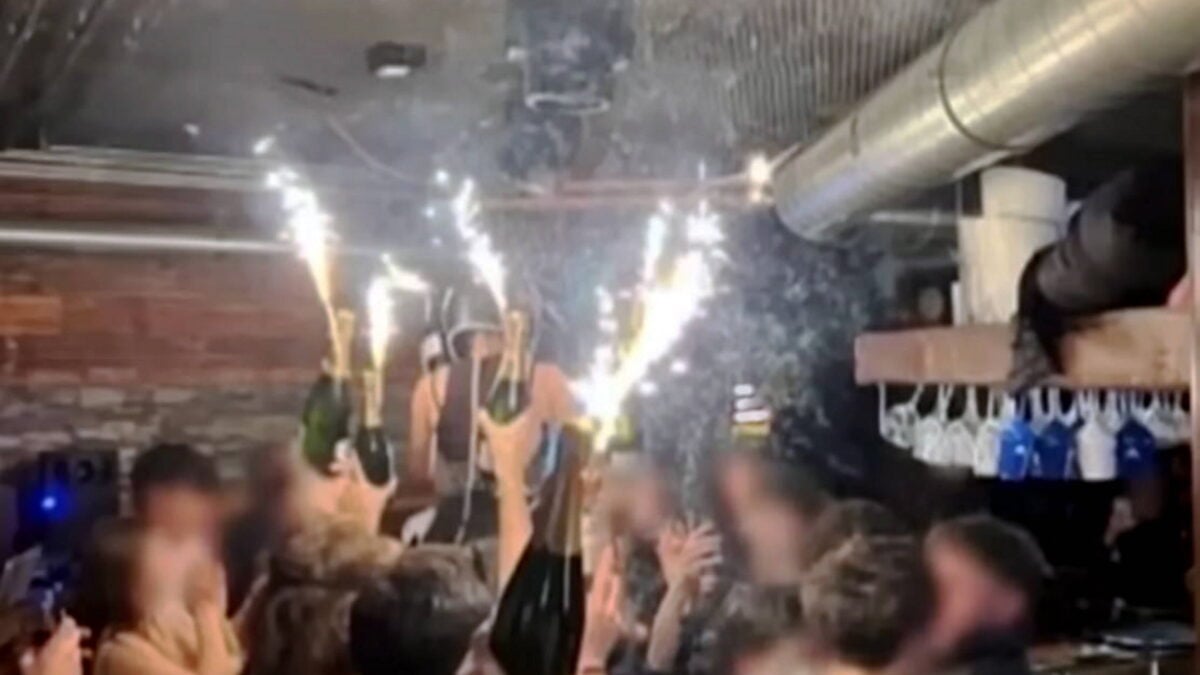
“They prefer to film and laugh rather than act.” Mixed with emotion and amazement, faced with the tragedy of Crans-Montana (which left 40 victims), criticism targeting young people quickly appeared on the networks. “Unconscious”, “glued to their smartphone”, “immature”, when it would have been necessary to act, and act quickly… Judgments are easy, after the fact. But is this a reality? Did the young victims prioritize their presence on the networks over their survival? The reality seems all other.
Our brain first seeks continuity
The videos broadcast afterwards in fact give the feeling of an unreal scene: a ceiling burning, visible flames, and below, a crowd continuing to sing, film, sometimes laugh… before everything changes. A collective incomprehension… which says much less about a so-called “unconscious generation” than about the universal functioning of our brain in the face of danger.
Today, several specialists point out: in extreme situations, our brain is not programmed to react instantly and rationally.
Contacted, psychologist Johanna Rozenblum calls for the greatest caution: “We must approach this subject with great caution and not overwhelm anyone. These situations are dramatic, traumatic. It is always very difficult to immediately assess the dangerousness” she begins.
The normality bias: minimizing the alert to stay within the known
Faced with an unprecedented event, our brain first seeks to maintain a form of normality. Imagining that the party is going to be abruptly interrupted, that the danger is immediate and deadly, requires a violent mental break… that few people are capable of making at the moment.
Among the most powerful mechanisms at work is something called normality bias. This refers to the very human tendency to interpret a worrying signal as not urgent as long as it can be linked to something familiar.
Concretely, the fire is visible, the smoke is perceived, but the situation is mentally reclassified as manageable,
temporary Or not so serious.
As Johanna Rozenblum recalls, “in reality, no one is prepared to imagine for a single second the proportions that such a catastrophe could take. Even the firefighters, although experienced in emergencies, admitted to having never been exposed to a scene of such magnitude.”
A festive atmosphere that blurs all the signals
Context also plays a determining role. A New Year’s Eve party, the music, the alcohol, the crowds, the lights: everything combines to make the danger signals ambiguous.
When the music doesn’t stop, when no siren sounds, when no authority speaks up to say “evacuate immediately”the brain struggles to understand that it is necessary to break away from the current situation. “There was no visible evacuation plan, no clear external signal.”underlines the psychologist. Under these conditions, the alert remains vague… while precious time passes.
The bystander effect: waiting for someone else to act
Another key mechanism: the bystander effect. In a group, individual responsibility is diluted. Everyone observes the others to assess the seriousness of the situation.
Implicit reasoning is almost automatic: “If it was really serious, someone would intervene”, “The staff will handle it”… This phenomenon can lead to collective immobility, even in the face of objectively visible danger.
An effect doubled by the screen
Today, the act of filming acts as a psychological filter. It transforms the exposed individual into a spectator of the scene. Which puts the urgency to react all the more at bay. In this context, filming is not necessarily a conscious or cynical choice, but sometimes an attempt to regain grip on a reality that is escaping.
The pre-movement phase: those seconds that cost a lot
Finally, these young victims or injured or almost all experienced a pre-movement phase, slowed down by the biases mentioned above. Between the moment when danger is perceived and when we actually act, there is a critical phase. This is where the normality bias, the spectator effect, the search for waiting for an authority signal add up. And in the case of a fire, seconds or minutes are crucial. Especially since under stress, our brain slows down. But this delay is not exceptional: it is profoundly human.
Understand rather than judge
Accusing after the fact is tempting. Understanding is more difficult, but essential. As Johanna Rozenblum recalls, “It’s a mix of factors – festive, cognitive, social, organizational – that leads to this type of drama.”
These images do not tell a story of frivolity or generational unconsciousness. Above all, they reveal the limits of our brain when faced with the unthinkable, and the crucial importance of clear warning systems, training, and prevention.
Because in an emergency, it is not morality that is lacking. It’s time, clarity… and sometimes, the human ability to imagine the worst before it’s too late.