

Taken to protect the heart, a simple tablet can sometimes transform the body. In the United States, a 76-year-old man treated for
heart failure saw his chest expand to the point of resembling a woman’s, while he was undergoing his usual treatment.
This coronary patient, suffering from heart failure with reduced ejection fraction, was taking
spironolactone for about four years. Over the past eight months, her breasts had been gradually growing and becoming sensitive to the touch. The diagnosis was made: a
gynecomastia induced by spironolactone, described in a clinical case published on November 26, 2025 in the journal The New England Journal of Medicine. A spectacular side effect that raises a lot of questions.
Spironolactone, a heart medication with hormonal effects
Spironolactone belongs to the family of “potassium-sparing” diuretics, used in cardiology to treat heart failure and sometimes high blood pressure. In the United States, this drug is the subject of more than 12 million prescriptions per year. It is also used to correct certain hormonal disorders, which already shows its action on sexual hormones.
This treatment may disrupt hormonal balance by reducing testosterone production and partially mimicking female hormones. French notices mention gynecomastia and breast pain as side effects “common”, in a range of 1 to 10%. According to the published case, this phenomenon occurs more readily in men receiving more than 100 mg per day, and would affect approximately 10% of male patients. Other sources suggest a rate of 10 to 30% depending on the dose and duration of treatment. For this specific case, the medication was stopped and replaced: “After 3 months of follow-up, the patient’s breast sensitivity had decreased, but gynecomastia persisted.“, reports The New England Journal of Medicine.
Gynecomastia, a side effect often experienced poorly
Gynecomastia corresponds to a real enlargement of the mammary gland in men, different from a simple excess fat in the torso. Taking spironolactone may be the cause, with swelling, chest tension, nipple pain and possible reduced libido or erectile dysfunction. This side effect affects around 10% of men taking this treatment. Other effects such as dehydration, dizziness, headache or fatigue are reported more often.
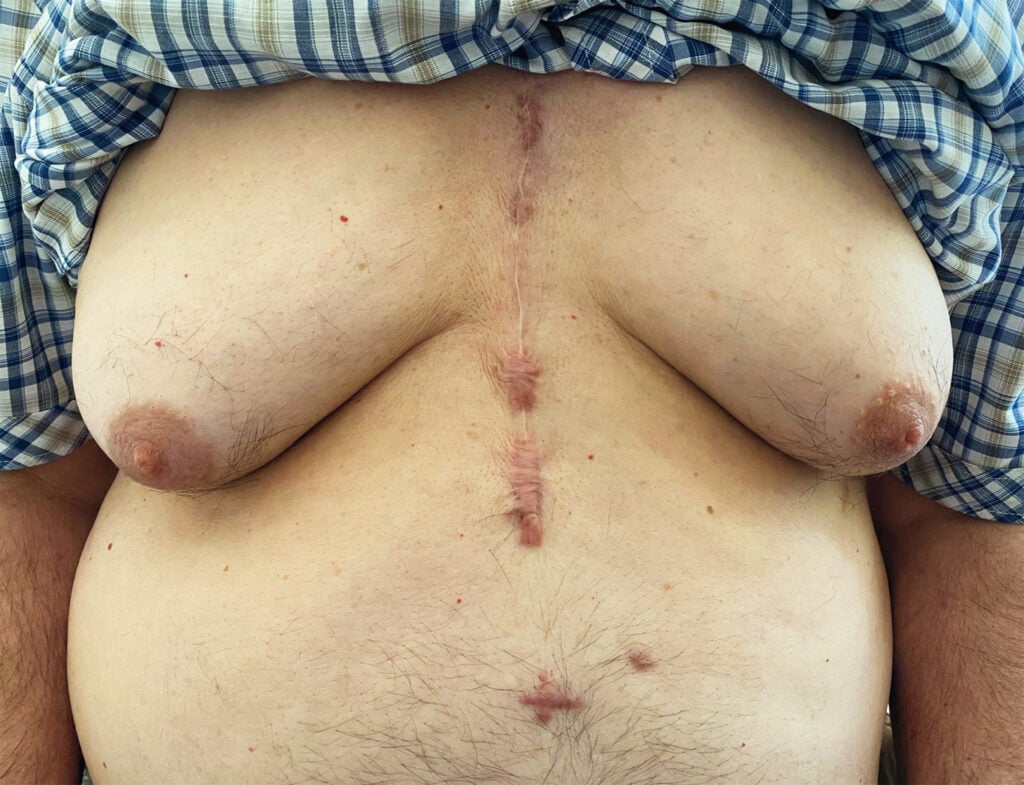 © NEJM
A 76-year-old man consulted for a gradual increase in breast volume over the past 8 months.
It is estimated that at least 50% of men worldwide will experience breast enlargement at some point in their lives. In situations where this phenomenon persists or is not caused by medication, many men opt in large numbers for cosmetic surgery because these changes remain very difficult to cope with. The American Society of Plastic Surgeons lists 20,955 male breast reductions in 2019, compared to 26,430 in 2024, making this operation the most commonly performed plastic surgery on men in the United States.
Chest swelling under spironolactone: when to react
Specialists point out that you should never stop heart treatment alone, even in the event of a surprising side effect. On the other hand, a man treated with spironolactone who notices progressive swelling of the chest or unusual sensitivity should speak quickly to his doctor or cardiologist. The signs to describe are for example:
- Increase in breast volume over several weeks;
- Daily breast pain or tenderness;
- Significant aesthetic or functional discomfort.
If spironolactone remains a key treatment for heart failure, this case reminds us that its hormonal effects are very real and sometimes visible. Gynecomastia induced by this medication is generally benign, but it can be a source of embarrassment, worry or psychological suffering. Any progressive change in the chest in a treated man must therefore be reported immediately, not to interrupt the treatment alone, but to allow supervised medical adaptation and avoid lasting consequences.