
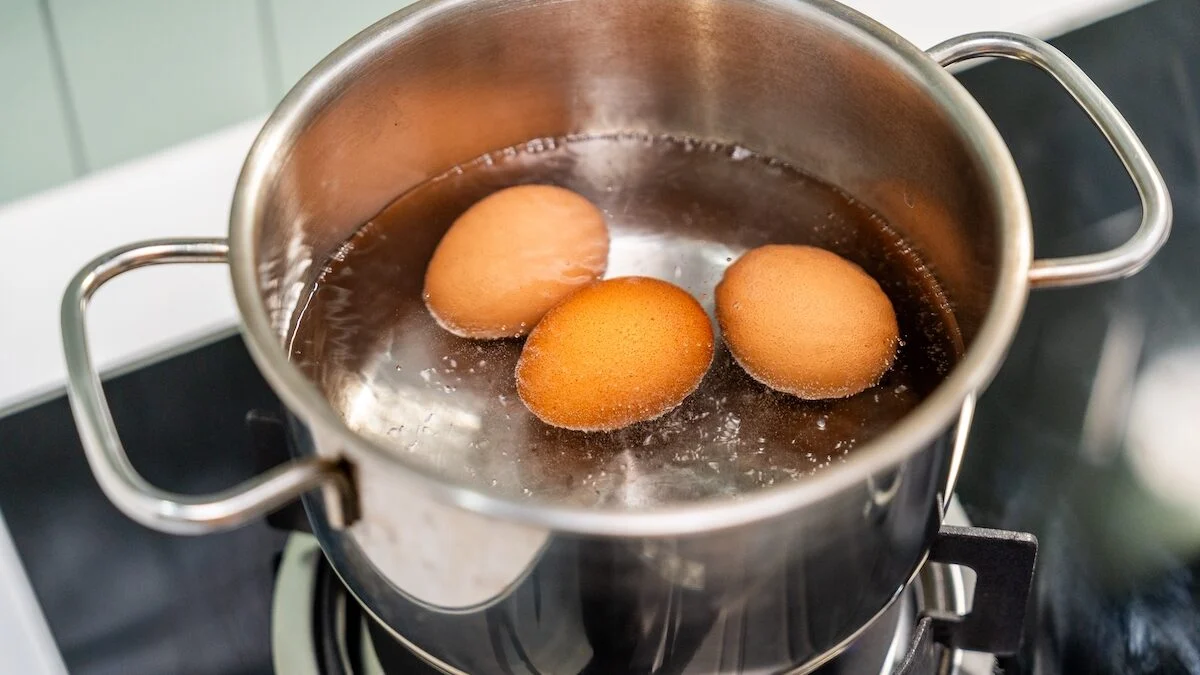
An egg bursting in the pan, filaments of white floating everywhere, and the mixed salad suddenly losing a little of its charm. This little accident often happens when we prepare
hard boiled eggs starting from eggs taken out of the refrigerator immersed in already boiling water. The thermal shock creates microcracks, the pressure increases inside and the shell gives way. The good news is that a simple pantry ingredient really does limit the damage.
This ingredient is quite simply the saltor more precisely sodium chloride, which several sites recommend adding to the cooking water for hard-boiled eggs. Food science explains that salt helps the white to coagulate faster at a crack, which forms a natural blockage. The goal is not to prevent any bursting, but to prevent the white from escaping entirely, and to keep eggs presentable.
Why hard-boiled eggs burst and what salt really changes
According to Marmiton, the main enemy remains the thermal shock between boiling water and a very cold egg. Invisible microcracks may already be present on the shell, especially if the eggs have been handled or banged. When the internal pressure increases suddenly, these weaknesses open and the albumin begins to leak, hence those famous filaments of white in the pan.
The Cookinette site reminds us that salt becomes especially useful at this moment, when the shell splits. In salt water, albumin is surrounded by a more ionic environment and coagulates more quickly in contact with hot water. The white thickens almost instantly at the crack and forms a sort of plug which limits the leak. We then avoid losing half of the egg in the cooking water.
How to Add Salt to Boiled Egg Cooking Water, According to Science
A precise dosage makes all the difference: it is therefore recommended to add “a teaspoon of salt per liter of water”, which corresponds to a good pinch for a small saucepan. The salt is poured into cold or lukewarm water, before the eggs, then everything is brought to a simmer. Fine or coarse salt works, as long as they have time to dissolve.
One point is also often misunderstood: salt does not make flaking easier. Peeling depends mainly on the age of the egg, a bath ofice water right after cooking and sometimes from starting the eggs in boiling water. It is recommended to immerse the cooked eggs in a large bowl of very cold water, which creates a controlled thermal shock which helps the shell to come off.
Salt, white vinegar and small gestures for impeccable hard-boiled eggs
Marmiton suggests adding a spoonful of
white vinegar in the water. Acidity also promotes rapid coagulation of proteins if a crack appears, a bit like a bandage that forms around the leak. This salt plus vinegar duo reassures those who dread repeated split eggs.
Finally, remember that eating eggs does not increase your risk of high cholesterol. The analysis by Pauline Pied, dietitian nutritionist in our articles, allows us to put these recommendations into perspective. According to her, the current data is clear: “It is entirely possible to consume eggs daily, without any particular risk, including in people with moderately high cholesterol.”
She specifies that the current benchmarks allow us to go
up to two eggs per day as part of a balanced diet, rich in fruits, vegetables and fiber.