
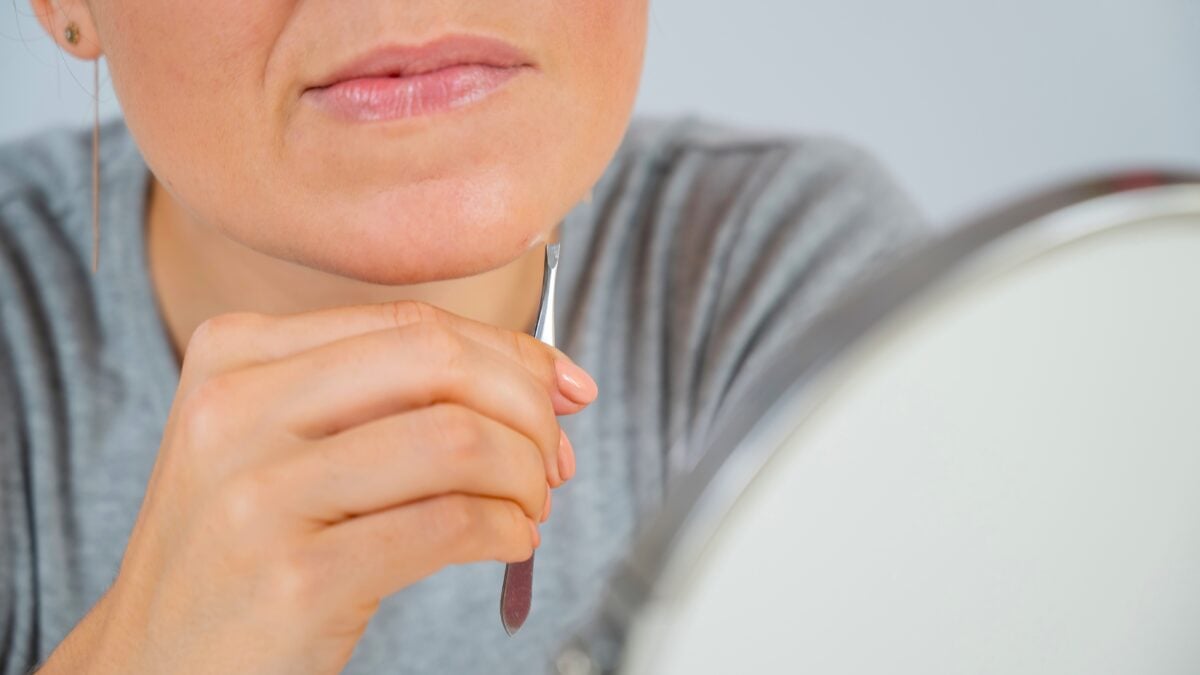
Many women feel deeply embarrassed at the idea of discussing these few stubborn hairs, even with their doctor. The reason: their location, located on the face and more particularly on the chin.
However, this hairiness is often indicative of physiological changes or underlying pathologies which require special attention. Understanding the difference between physiological hair loss and abnormal hair growth is the first step to appropriate treatment.
Here’s how to tell the difference, according to Dr. Odile Bagot, gynecologist.
Facial hair, a genetic inheritance but also a hormonal balance
First of all, it is crucial to remember that some hair growth on the chin can be completely normal. It all depends on the profile of each woman. “The presence of hair around the mouth and chin is physiological, in all women” confirms our expert. And therefore does not require any specific hormonal treatment.
Moreover, as Dr. Bagot also points out, “hair growth is more or less important depending on ethnicity in women“. Mediterranean or Middle Eastern populations can thus naturally have a little more hair without this reflecting a pathology.
The turning point of menopause: when hormones become unbalanced
Approaching menopause is a pivotal period when facial hair can increase noticeably. This phenomenon is explained by a profound change in the female hormonal climate. Dr Odile Bagot specifies that after menopause, there is a decrease in the quantity of estrogen. “As a result, adrenal testosterone is no longer counterbalanced by ovarian estrogen” which promotes the appearance of hair on typically male areas.
If this slight growth is expected during the menopausal transition, it should remain isolated. If it is accompanied by a change in the voice or a change in muscle mass, a medical consultation becomes imperative to rule out rarer causes, such as adrenal conditions.
Polycystic ovary syndrome (PCOS) in young women
In younger women, excessive hair growth, or hirsutism, can be a warning sign of Polycystic Ovary Syndrome (PCOS). According to Dr. Bagot, this disorder causes hyperandrogenism and therefore hirsutism. “This manifests itself as hyperhair in the upper lip, thorax and limbs. and often rises towards the midline above the pubis.
The diagnosis of PCOS is generally based on three pillars: long and irregular cycles, hyperandrogenism – whether clinical with acne and hair or biological with an increase in testosterone in the blood – and the presence of at least twenty micro-cysts per ovary.
“Faced with these symptoms, a hormonal assessment is recommended because PCOS is not just an aesthetic problem; it increases metabolic risks such as diabetes or obesity.”
What solutions to find clear skin?
If the cause is purely physiological or age-related, effective aesthetic solutions exist. To get rid of these hairs considered unsightly, Dr Bagot indicates that laser can be used. Other sustainable options like electrolysis are also recommended, preferably under the guidance of a dermatologist.
For more regular maintenance, waxing or threading is preferable to razor, which tends to irritate sensitive facial skin. The main thing is not to be alone with your complex.