
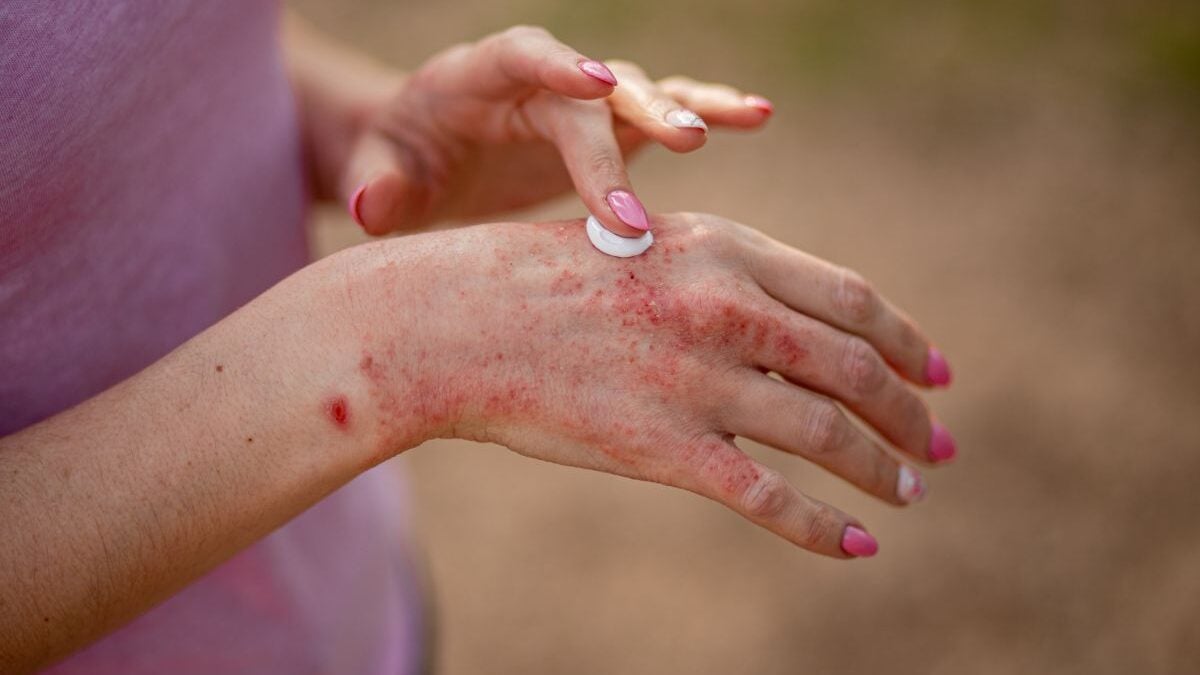
This is a well-known disease among people with atopic conditions (predisposed to allergies), which is mainly encountered in spring and summer in adults. As soon as the thermometer rises, the hands and feet are sometimes covered with small bubbles that itch intensely.
This phenomenon has a name: dyshidrosis, also called bullous eczema or pompholyx. Often triggered by heat and sweating, this skin condition spoils the daily lives of many patients as soon as the sunny days arrive.
What is dyshidrosis, this “pearl” eczema?
Dyshidrosis is a very specific skin disease that exclusively targets the extremities: the palms of the hands, the spaces between the fingers and their edges, as well as the soles of the feet and between the toes.
“This is a particular form of chronic eczema characterized by the formation of blisters (bubbles or vesicles) on the hands and feet.” first explains Dr Gérald Kierzek, emergency doctor and medical director of True Medical.
The doctor specifies that it is a “vesiculobullous dermatosis where the bubbles look like tapioca pearls, usually measuring 1 to 2 millimeters.”
These flare-ups usually last 2 to 3 weeks. Small blisters filled with clear fluid can grow and coalesce to form larger, painful blisters.
Over time, they end up drying out, forming a crust that tends to itch intensely. Depending on the severity, dyshidrosis can be simple (small isolated vesicles), bullous (large blisters) or hemorrhagic (blood-tinged fluid).
Heat, stress, allergens: what are the causes?
If the exact mechanisms of this pathology remain mysterious, several triggering and aggravating factors are clearly identified. Dr. Gérald Kierzek recalls that the exact cause remains poorly understood.
“Dyshidrosis is a reaction of eczema probably in response to various triggering factors that are not always obvious, and there are sometimes cases where no cause is found.”
Skin inflammation can thus be promoted by:
- A fungal infection: notably a reaction to fungi (dermatophytes) which parasitize the plantar interdigital spaces;
- Allergic contact eczema: in particular a sensitivity to metals such as nickel or cobalt;
- An atopic terrain: dyshidrosis can be seen in atopic eczema but is not characteristic;
- Lifestyle and psychological factors: tobacco, alcohol, coffee, but also stress and anxiety which stimulate inflammation and itching;
- Some treatments: such as injections of multivalent immunoglobulins or anti-IL-17 monoclonal antibodies.
Finally, the “seasonal outbreaks” in spring and summer strongly suspect the role of heat and excessive sweating. Indeed, sweat irritates the dry and fragile skin of atopic people, allowing allergens to penetrate the skin barrier more easily.
How to treat and relieve crises on a daily basis?
Mild dyshidrosis may go away on its own within a few weeks. On the other hand, more severe forms require medical treatment. The standard treatment is based on the application of a cortisone ointment (topical corticosteroids) or based on an immunosuppressant to stop the inflammation.
To immediately relieve tension and itching, some doctors recommend gently piercing the largest bubbles in order to accelerate their drying, provided that rigorous disinfection is carried out with antiseptics to avoid any secondary infection.
On a daily basis, the application of emollient creams is essential to restore the skin barrier. In the medium term, other options are particularly beneficial.
“The spa treatment is a complementary treatment from which the patient can benefit. Baths, thermal water sprays or wet wraps are good for relieving itching and fighting inflammation” confirms our expert. These thermal treatments make it possible to significantly space out crises.
When should you consult a doctor urgently?
Although benign, dyshidrosis requires a consultation with a general practitioner or dermatologist as soon as symptoms appear in order to confirm the diagnosis. We must not lock ourselves in the vicious circle of scratching.
Certain situations should also prompt you to consult quickly:
- If the blisters become particularly numerous or very painful;
- In case of signs of secondary infection (presence of pus, suspicious discharge, appearance of fever);
- If the lesions persist after several weeks of local care;
- When itching ruins your nights or strongly impacts your quality of life.
In short, dyshidrosis is a true summer paradox: while we aspire to enjoy the sun, heat and sweating awaken this fierce eczema of the extremities. Fortunately, by combining good skin hydration, appropriate local treatments during crises and basic solutions such as thermal treatments, it is entirely possible to tame these “tapioca pearls” to find soothed hands and feet.