
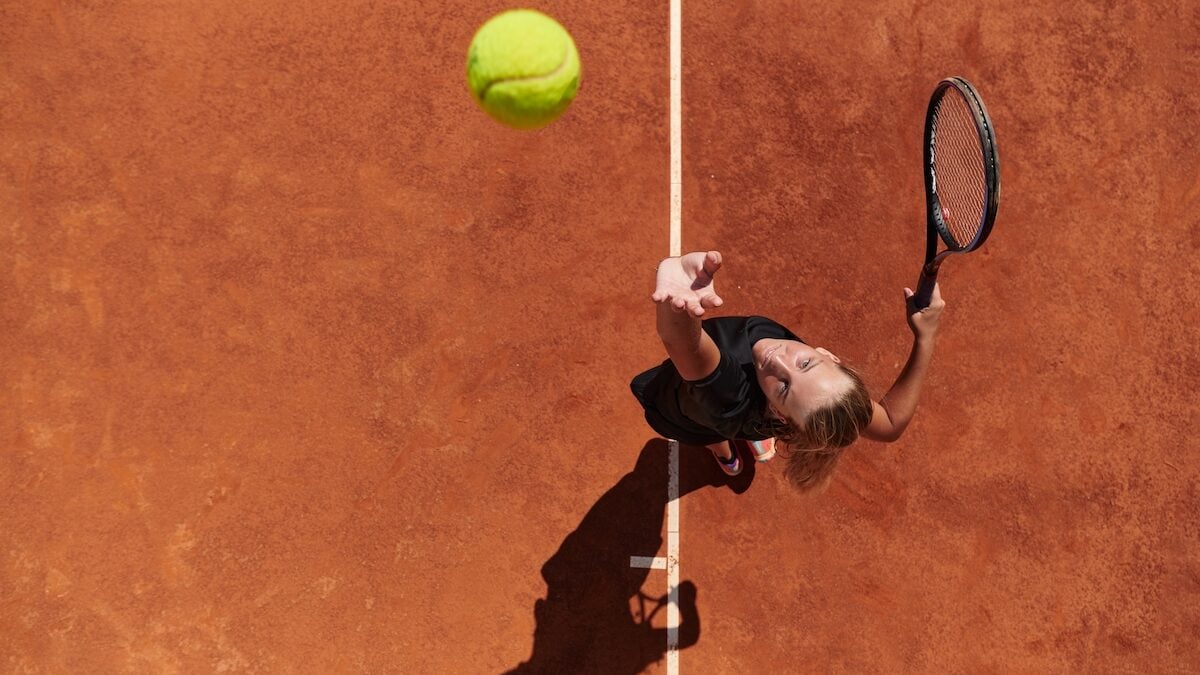
We knew their meticulous physical preparation, their steely mentality and their recovery routines. But among professional tennis players, another training is increasingly important: that of the eyes.
At Roland-Garros, where the exchanges are rapid and the trajectories are sometimes difficult to anticipate, certain athletes work on their vision with specialized orthoptists. One of the best-known exercises in this area has an intriguing name: Brock’s rope.
A simple rope… to train the brain
No futuristic technology or high-tech headphones here. Brock’s rope consists simply of a string on which several colored beads are attached at different distances.
The player holds one end of the rope near his nose and successively fixes the beads. Behind this apparent simplicity lies real neurological and visual work.
“It is neither illusory nor a gimmick, it has existed for a very, very long time”explains Sylvain Milstayn, orthoptist, to True Medical in this second week of Roland Garros. “The Brock cord is based on what is called physiological diplopia.”
In other words, with two eyes, our brain constantly receives two different images, one from each eye. Normally, these two images merge to form a single clear vision at the precise point where the eyes converge.
“The only way to have an image with our two eyes is for the two visual axes to meet in one place. At this place, we see simply”explains the specialist.
Why do we see double without realizing it?
In reality, anything before or after the fixation point is naturally seen twice.
“But the brain does its work of neutralization so that it is not too bothersome”explains Sylvain Milstayn.
Brock’s rope allows us to become aware of this mechanism. When the player stares at a bead, he can observe that the elements located in front and behind appear double.“It brings this physiological diplopia back to consciousness”specifies the orthoptist.
Valuable training for tennis players
In a sport like tennis, where the ball moves at very high speed, this ability becomes crucial.
“Players must always have both visual axes perfectly positioned on the ball so as not to see it double”explains Sylvain Milstayn.
During a rally, the brain must be able to concentrate only on the important object – the ball – while “forgetting” the rest: the public, the net, the opponent or even the doubles partner.
“They have to forget that behind the player in the back of the court the audience is double, and that everything in front is too.”
The Brock rope therefore helps to improve:
- Visual concentration;
- Eye coordination;
- Fixing a moving target;
- Rapid changes in distance;
- Management of peripheral vision.
Another string to the bow of certain champions
The exercise is particularly mentioned in the visual training of certain high-level athletes.
Sylvain Milstayn cites in particular the French player Loïs Boisson, who works on this type of technique with vision specialists.
“Working on visual concentration, fixation and gaze control can clearly improve sports performance,” underlines the orthoptist.
Not just useful in tennis
Moreover, if the Brock rope is particularly interesting for ball sports, its applications go well beyond tennis.
According to Sylvain Milstayn, this training can also be beneficial in:
- Sport shooting;
- Golf;
- Throwing sports;
- Or even certain team sports requiring excellent hand-eye coordination.
All these sports have one thing in common: they require you to follow a moving object with extreme precision. And sometimes, to gain a few decisive milliseconds on a Roland-Garros court, a simple rope can make all the difference.