
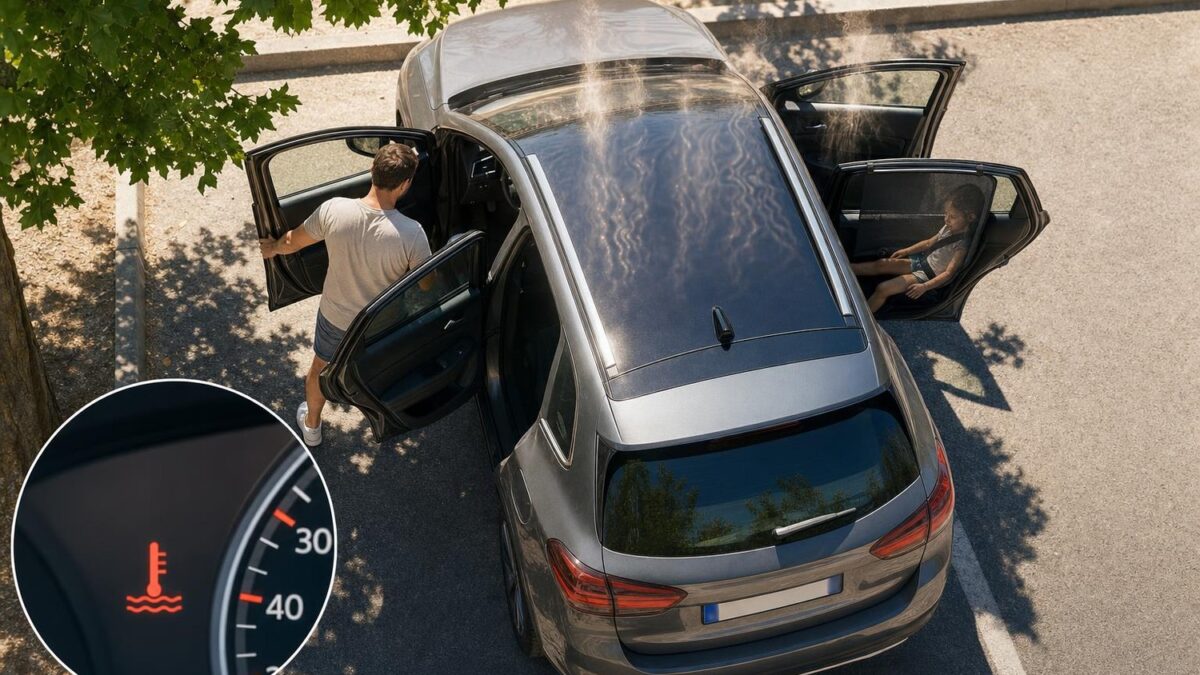
In full heat wavea car parked in the sun turns into an oven in just a few minutes. With only 15 to 20°C outside, the passenger compartment can exceed 45°C in less than thirty minutes. For a child, with 26°C outside, heatstroke can become fatal within ten minutes. The danger also concerns the driver, with fatigue, dehydration and loss of vigilance.
To limit the overheated in a car, the challenge is twofold: keeping the cabin breathable and preventing the engine, battery or tires from failing in the heat. Discover 5 simple and effective reflexes even with modest or tired air conditioning.
Heatwave in the car: ventilate well and control the air conditioning
- First reflex: expel the burning air before riding. To do this, it is recommended to open all the doors for a few moments, or even gently swing a door on the opposite side to create a draft. Parking in the shade and installing a reflective sunshade can lower the interior temperature by around 10°C, insurers point out. A light bodywork also heats up a little less than a dark color.
- Second reflex: use the air conditioning without excess. According to Ademe, it increases fuel consumption by 5 to 35%, especially in town. Experts recommend limiting the indoor/outdoor difference to 5 to 7°C and ventilating for a few minutes with the windows open before turning on the air conditioning. At low speeds, opening the windows is often more efficient and less costly.
Heat in the car: protect children, seniors and animals
- Third reflex: think first of the most fragile. A child should never be left alone in the car, even for a few moments, and especially when it is hot. Light cotton clothing, hat, side sun visors, mister and damp cloth on the back of the neck help the body to hold on. For little ones, offering a drink at least every thirty minutes limits the risk of heatstroke.
“Leaving your child alone in a car, even with the windows open, makes no sense, it’s criminal. You should never leave a child unsupervised. The car is an oven and in the heat, a child becomes dehydrated very quickly” recalls Dr. Gérald Kierzek, emergency physician and medical director of True Medical.
- Fourth reflex: don’t forget the animals. Dogs and cats don’t tolerate heat very well because they don’t sweat much. The advice from insurers converges: windows slightly ajar while driving, damp towel passed regularly over the body, breaks in the shade every two hours with fresh water. Here too, no animal should be left alone in the passenger compartment, even for a few minutes.
Avoid overheating the engine and tires during the heatwave
- Fifth reflex: monitor the mechanics. Check the oil level and coolant (cold engine), the condition of the battery and the pressure of the tires before a long journey. If the temperature gauge rises, white smoke appears or there is a burning smell, you should park safely, turn off the engine and wait before opening the hood. In traffic jam, full air conditioning and prolonged idling seriously fatigue the engine: it is better to reduce the air conditioning, open the windows slightly and accept a few degrees warmer than to stop the car on the side of the road.
Faced with increasingly frequent episodes of heat, the car becomes a place where vigilance must never be reduced. A sun visor, good hydration, a few mechanical checks and a little anticipation can make all the difference. Because in the middle of a heatwave, the danger is not just the outside temperature: it is the speed at which the heat transforms an ordinary passenger compartment into a risky environment.