
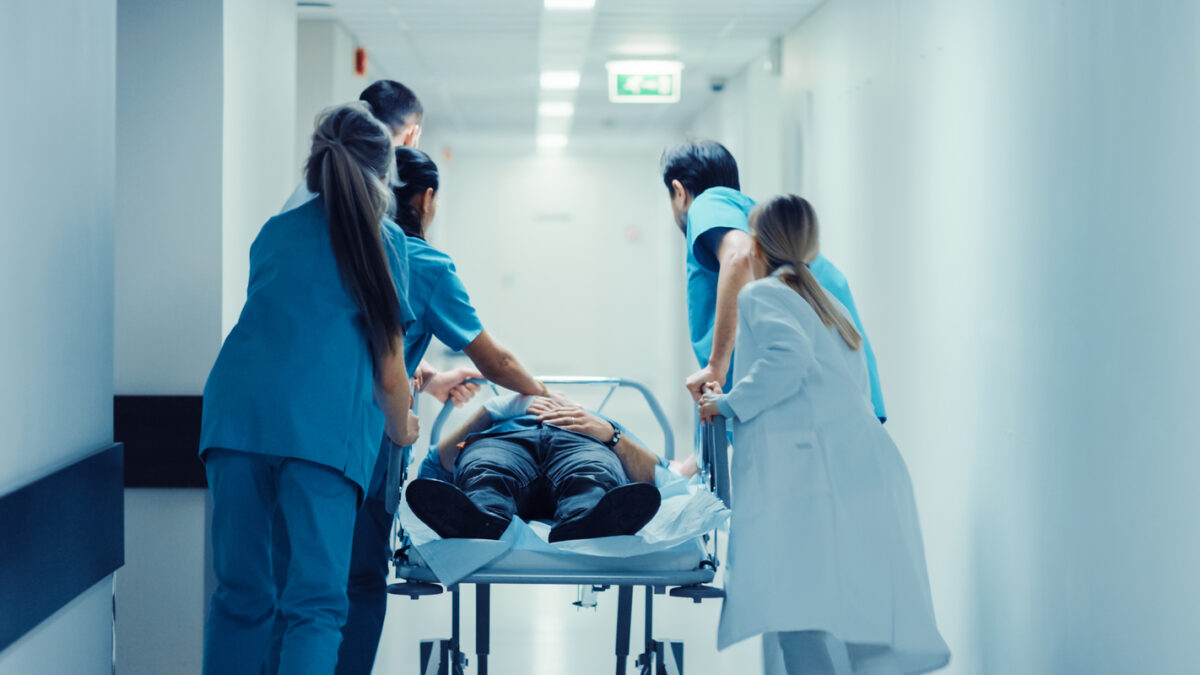
Three hours. This is now the time spent by at least half of the patients who go to the emergency room. Ten years ago, this delay was 2 hours 15 minutes. Worse still: 15% of patients now stay more than eight hours in the department, compared to 9% in 2013. This is the alarming observation carried out by the Drees, which investigated nearly 719 departments.
But behind these figures, there emerges a reality that caregivers have been denouncing for years: that of a hospital system under permanent tension, where emergencies absorb the dysfunctions of the entire care pathway.
Increasingly congested emergencies
Crowded waiting rooms, patients sleeping on stretchers while patiently waiting for their turn… In emergency departments, these images have become familiar. And for good reason: in ten years, the number of visits to emergency rooms has increased by 13%. But this is not enough to explain the explosion in delays.
For Christophe Prudhomme, emergency doctor and former AMUF spokesperson, the problem is above all structural:
“we have concentrated emergencies on a limited number of sites. Result: activity increases and resources decrease.”
According to him, the gradual closure of certain local hospitals and the concentration of activities on large hospital centers would have contributed to saturating reference services.
“At the emergency level, it’s mechanical: when we close the local sites, we overload the reference sites. We saw it with the hospitals of Saint-Lô and Cherbourg: all the activity was concentrated in Cherbourg, and the emergency department exploded,” he laments.
In several territories, the closure or restructuring of hospitals leads doctors to direct patients to the same emergency services,
Yet already powered on.
Some doctors can no longer keep up this infernal pace
Added to this pressure is another phenomenon: the increasing difficulty in recruiting and retaining caregivers. Many emergency physicians leave the hospital to join unscheduled care centers, EHPADs or structures offering schedules more compatible with their personal lives.
“For a long time, the profession has been becoming more feminized. But how can you work five, six or seven shifts per month when you are a doctor and a mother? It’s not sustainable,” regrets the doctor.
“In the end, all these professionals who cannot control their schedules end up leaving or working less.”
A glaring lack of beds
When a patient must be hospitalized after going to the emergency room, a place must be found for them. And these places are becoming rare. In ten years, tens of thousands of beds have been eliminated in France. Result: patients sometimes stay for hours, or even an entire night, on a stretcher while waiting for a transfer.
A situation denounced by the French Society of Emergency Medicine (SFMU), which regularly warns about “downstream congestion“, that is to say the difficulties in finding a hospital bed after treatment in the emergency room.
For his part, Christophe Prudhomme points to bed closures linked to recruitment difficulties.
“Beds continue to close due to lack of staff.
We are reducing emergency services while there are always more patients, it’s a disaster.”
This situation lengthens the wait for everyone: patients who need to be hospitalized, but also those who then arrive and can no longer find a place in the department…
According to the Drees, the elderly are those who experience the longest transit times, because their care requires more examinations… and often hospitalization. Conclusion: more than a third of patients aged 75 and over today spend more than eight hours in the emergency room.
Behind the emergency crisis, the entire health system is faltering
If emergency services are currently struggling (so much), they actually reflect all the flaws in the health system. Because today, millions of French people struggle to find a treating doctor or get an appointment quickly. According to the French Hospital Federation (FHF), nearly one in two French people believe they have difficulty “accessing a general practitioner”.
Lacking an alternative, many end up turning to the emergency room.
“Seven to eight million French people do not have a general practitioner. They no longer have follow-up. Unscheduled care centers are developing because community medicine is deteriorating,” confirms Christophe Prudhomme.
And data from the Drees confirms this trend: more and more patients explain having gone to the emergency room because they were unable to obtain a consultation in town. Ultimately, for the emergency doctor, this crisis goes far beyond the walls of the hospital.
“The provision of care no longer meets the needs of the population. Today, even the most advantaged social categories are suffering from the deterioration of the health system. Patients are postponing their appointments, giving up certain care and losing their medical follow-up”, he concludes.
At the end of the chain, it is the emergencies which absorb this growing demand. With a direct consequence for patients: ever longer treatment times, even when every minute counts.