
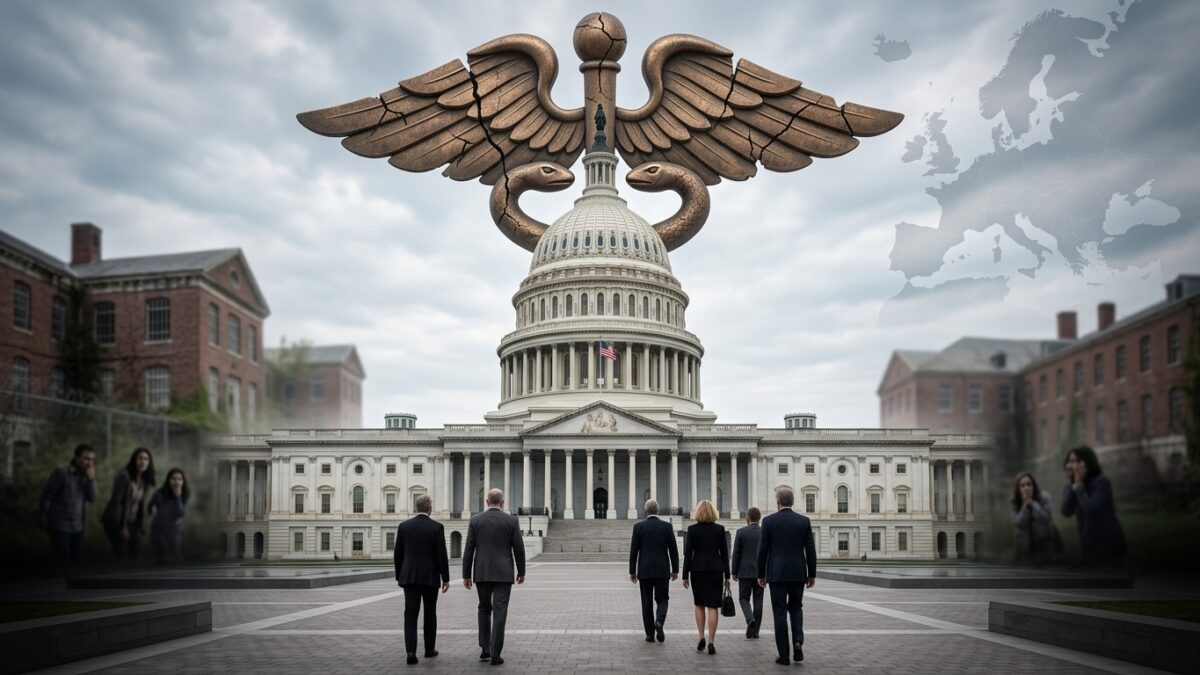
In the United States, mental health is already going through a storm: addiction crisis, increase in depression, diagnoses of autism and ADHD on the rise. It is into this saturated landscape that Trump’s new mental health policy arrives, supported by his Secretary of Health, Robert F. Kennedy Jr., a figure already known for his anti-vax positions.
Between budget cuts, reform of federal agencies and suspicions of pseudoscience, associations and experts fear a real trumpification of mental health. They describe a shift where resources are reduced while attacking psychiatric medications, with a scent of culture war that extends well beyond American borders. A shift that raises a question: will mental health be permanently “trumpified”?
From massive cuts to the dismantling of SAMHSA
According to the think tank KFF, more than 61 million American adults suffered from mental disorders in 2024, while one in two people reporting poor mental health did not get the necessary help at least once in the year. In this context, the Department of Education suspended 1 billion dollars, or approximately 930 million euros, in credits for mental health in schools, although voted after shootings. Twelve organizations warned that this reduction in staff at Federal Health “has the potential to jeopardize years of work and recent progress, like reducing overdose deaths”.
At the same time, the former reference agency, SAMHSA, saw its budget largely cut and its missions integrated into a new superstructure, the Administration for a Healthy America. The 2026 budget proposed by Donald Trump still provides for more than $1 billion in additional cuts, or more than 930 million euros. “Cuts of this magnitude would certainly disrupt crucial research and programs that help people with mental illnesses get and stay better, making many people’s symptoms worse and pushing them into unemployment, the streets, prison, or emergency rooms.” warned Hannah Wesolowski, of the National Alliance on Mental Illness, cited by Axios.
Robert F. Kennedy Jr., autism, vaccines and distrust of psychotropic drugs
The Kennedy Jr. brand looms over this turning point. At the head of Health, he focuses his attention on autism, which he links to “environmental factors” including certain medications. The National Institutes of Health and public insurance have launched extensive data sharing on autistic people to fuel this research. Many specialists see it as a barely disguised attempt to revive the idea, already denied, of a link between vaccines and autism, which has aroused the anger of autistic people themselves.
In terms of treatments, Robert F. Kennedy Jr. is very skeptical of antidepressants and ADHD medications. He pushes the idea of “healing farms”, “healing farms” supposed to respond to addictions through natural approaches. A presidential commission, Make America Healthy Again, must in parallel “assess the prevalence of and threat posed by the prescription of selective serotonin reuptake inhibitors, antipsychotics, mood stabilizers, stimulants, and weight-loss drugs”. Scholarly societies fear that this framing will fuel distrust of psychiatry as a whole.
From a return of asylums to the cultural war, a signal observed from Europe
During the campaign, Donald Trump pleaded for the return of psychiatric institutions closed for decades, while some cities are already experimenting with the forced hospitalization of homeless people suffering from mental disorders. Combined with Kennedy Jr.’s distrust of medications, this approach outlines a model where more surveillance and confinement are carried out, while the means of local care decline.
In France, researchers are already talking about mental health as a new front in the cultural war against science. The Trump-Kennedy Jr. duo, with its cuts, its questioning of psychotropic drugs and the focus on autism, serves as an open-air laboratory closely followed by psychiatrists and French associations, worried to see this story cross the Atlantic in an already weakened system.