

When you follow a diet, after how long can you expect to lose weight? Three days, a week, several months? If the majority of experts tend to say that it is recommended to lose between 0.5 and 1 kilo per week maximum, Julie Boët, dietitian-nutritionist, does not agree.
“Losing weight is not like running 100 meters”
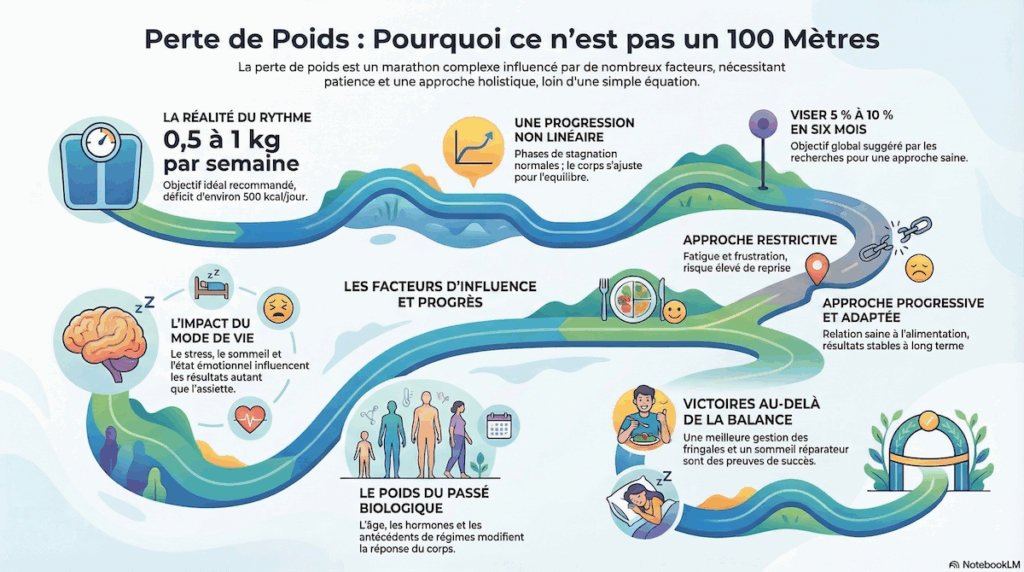
According to the Centers for Disease Control and Prevention in the United States, losing between 0.5 and 1 kilo per week would be a form of “ideal.” This corresponds to a calorie deficit of around 500 kcal per day.
More generally, research suggests aiming for a loss of 5% to 10% of your body weight in the first six months. But in reality: how much can we really hope to lose?
“This is indeed a question that comes up very often in the office. Moreover, many hope for a precise answer, as if weight loss followed a well-defined timetable. However, the reality is much more nuanced. Losing weight is not like running a 100 meter race. It is more of a marathon, a progressive process which requires time, a certain ability to adapt and above all patience”, underlines Julie Boët.
So, if weight loss is often perceived as a simple equation between eating less and moving more, in reality, it is a bit more complicated. Energy balance certainly plays a role, but it does not explain everything.
“Eating behavior, the relationship with food, stress, sleep, the organization of the days or even the emotional state strongly influence the results. Some people eat little but have a very high level of stress, sleep poorly or have developed eating habits linked to emotions. All of these elements can slow down or complicate weight loss”, recalls the expert.
Many individual factors come into play
The speed at which a person loses weight (also) depends on many individual factors. For example, someone who is significantly overweight may lose several pounds quickly at first, while another person will see results come more gradually.
But that’s not all! Personal involvement, regularity in habits, level of physical activity or even medical history can also influence weight development.
Other elements can also come into play, such as hormones, certain treatments, age, or even personal history (in other words, when there have been repeated diets), which can modify the way in which the body reacts to further weight loss.
“We must also keep in mind that weight loss is never linear. It is normal to observe periods of stagnation – these phases are part of the body’s adaptation process. The body naturally seeks to maintain its balance and can temporarily slow down weight loss. This does not mean that efforts are useless, but simply that the body gradually adjusts to changes.” specifies the specialist.
Another element often underestimated: the importance of lasting changes. Because while we would all like to see results arrive very quickly, any (too) rapid weight loss is rarely stable over time. It is also often the cause of very unpleasant mood swings.
“Approaches that are too restrictive can lead to fatigue, frustration and a more complicated relationship with food. In the long term, these methods often increase the risk of weight regain. Conversely, when changes are gradual and adapted to the person’s lifestyle, they are more likely to last over time,” recalls Julie Boët.
 © True Medical
How quickly can you lose weight?
Results that can’t just be seen on the scale
Because progress is not measured solely on the scale, it can be useful to remember that improving the contents of your plates, distinguishing hunger from a simple desire, moving more, sleeping better or reducing your cravings (previously, you necessarily finished the packet of biscuits) already constitute formidable progress.
“These changes often precede visible weight loss and provide a solid foundation for lasting results“, confirms the dietitian. “Finally, if you have been trying to lose weight for a while without success, don’t be left alone with this difficulty. Consulting a dietitian allows you to have personalized and caring support. The objective here is not only to change the contents of your plate, but also to understand your habits and any obstacles that prevent you from moving forward. she concludes.