
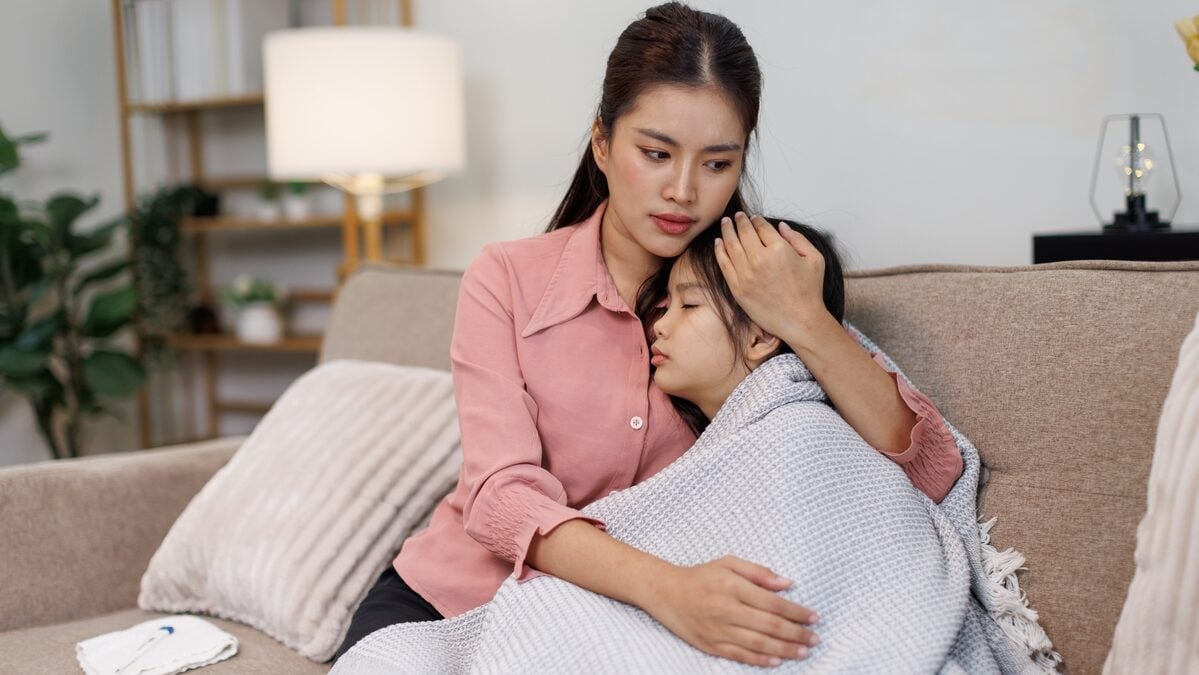
While nearly 160,000 children are victims of sexual violence each year in France, and the volume of children in danger has never seemed so high, the desire to no longer (at all) let your child leave their room is strong.
However, while being vigilant is a good thing, we should not see danger everywhere. So how do we find the right balance? Amélie Boukhobza, clinical psychologist, and Ludovic Gicquel, child psychiatrist, answer us.
Protect your child without transmitting all your fears to them
“I think it’s the question of a lifetime: how can we protect our children without passing on all our fears to them?”sums up Amélie Boukhobza straight away.
Because the reasons to worry do exist. “It’s true that the news around extracurriculars, in general, doesn’t help. So, we worry about it. But also about social networks, journeys, sleepovers, adults we don’t know well, accidents, attacks, bad encounters… In short, everything.”
Faced with these potential dangers, we often oscillate between two extremes: total relaxation or permanent hypervigilance.
However, according to the psychologist, the problem is not protection itself and certain concerns are even legitimate. “But the problem is not protecting your children. The problem is when fear becomes the filter through which we look at the world,” explains the expert.
By anticipating all possible scenarios, multiplying checks or verbalizing our anxieties, we risk transmitting the wrong message: that of a dangerous, threatening world, where life is not good.
Children learn above all from what they see us experience
Is this really a surprise? Children are particularly sensitive to the moods around them. Long before they understand the long speeches, they perceive our attitudes, our reactions and our concerns.
“Because children learn much less from what we tell them than from what they see us experience. So, when a parent checks everything, anticipates everything, worries about everything, the child very quickly understands the implicit message, namely: ‘The world is dangerous,’ explains Amélie Boukhobza.
That being said, reassuring does not mean denying the risks. The challenge is more about transmitting skills rather than anxiety.
“Of course, it is important to teach them to identify certain risky situations, to listen to their discomfort, to know how to say no, to ask for help. To defend yourself too. We no longer teach them to defend themselves. And it’s serious“, regrets the psychologist.
Concretely, this involves regular exchanges (obviously) adapted to his age: teaching him to recognize what makes him uncomfortable, to respect his intuition, to identify trusted adults to whom he can turn or even to understand that he has the right to refuse certain situations.
“Protecting a child does not mean making them believe that nothing can happen”
At a time when information circulates continuously, reality can appear “distorted”, and we are afraid of having our child stolen on every street corner.
“This is one of the paradoxes of our time. We have much more information than before about potential dangers. But this overexposure to news stories, alerts and disaster scenarios makes us lose sight of reality, that is to say that most days go well,” recalls Amélie Boukhobza.
Ultimately, the best way to protect a child is not to make him believe that everything will always be okay, but to teach him that he has the necessary resources to cope.
“A child does not need to know all of his parents’ fears to be careful. Above all, he needs to feel that there are adults capable of managing difficulties when they arise. To feel that the adults around him, in this case his parents, are there, holding their own and are not afraid.” continues the psychologist.
In other words, the objective is not to eliminate all risk-taking, but to allow the child to gradually develop his autonomy in a safe environment.
“Protecting a child does not mean making him believe that nothing can happen. It is also not making him believe that danger lurks everywhere. It is gradually teaching him to live in an imperfect world, with real risks, but also with resources, skills and adults on whom he can count,” indicates the practitioner.
The importance of collective prevention
Although parents have an essential role to play, they cannot bear sole responsibility for protecting children. Prevention must also be collective, recalls Professor Ludovic Gicquel.
“Even if our society tends more and more towards individualism, we must, more than ever, turn towards the collective. Those whose job it is must establish protection systems, and more verifications”insists the child psychiatrist.
And if zero risk does not exist, the specialist points out that prevention tools are progressing. “We are better identifying the risks today… and it is legitimate to seek to reduce them.”
In other words, society must do a better job of preventing the foreseeable dangers that children may face.
Because the protection of children cannot rely solely on the vigilance of parents. It is also a collective issue. The more secure and supervised the structures responsible for welcoming them are, the less families will have to carry the weight of this worry alone.