
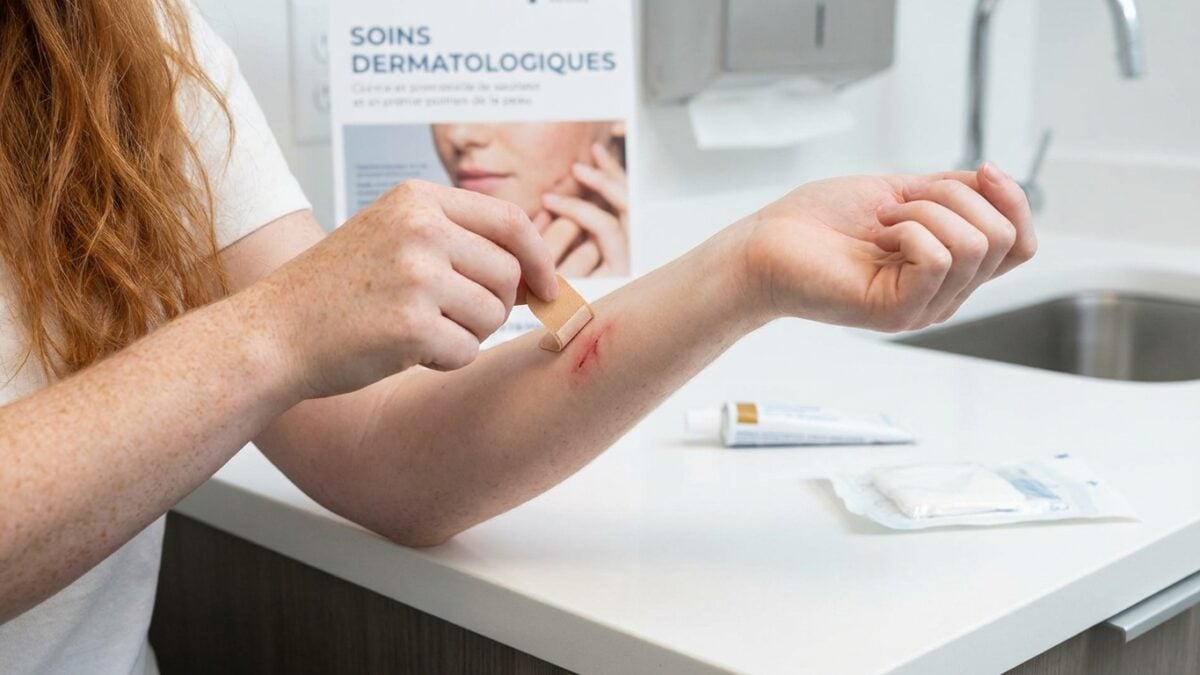
A small cut that stays red for several days, a scar that takes time to blend into the skin: several red-haired people have already asked themselves this question. What if hair color also affected how the skin heals after an injury or an operation? A team from the University of Edinburgh, led by researcher Jenna Cash, has just relaunched the debate by studying the scarring of redheads through an animal model. Their work on mice carrying the genetic variant associated with red hair suggests a somewhat slower healing process, without the researchers yet speaking of danger. Beyond the specific case of redheads, this work could lead to new treatments for chronic wounds.
Slower healing in red mice and the MC1R gene
The color of our hair is largely determined by the
MC1R genewhich encodes a protein controlling the ratio of black-brown and red-yellow pigments in hair follicles. People with brown or black hair carry variants that produce an active protein, while almost all red-haired people have less active or completely inactive forms of MC1R due to mutations. The same protein is also found in the epidermis, where it exerts anti-inflammatory effects, a key point for wound healing.
To test the impact of this feature, the researchers surgically created 4-millimeter-wide circular wounds on the backs of black-haired mice and red-haired mice lacking functional MC1R. A week later, the red mice’s wounds had decreased by an average of 73% compared to 93% in the black mice. As wound healing is quite similar between mice and humans, this difference in speed is intriguing, especially since only 1 to 2% of the world’s population has this red pigmentation.
In humans, a probable but discreet effect
The researchers point out that normal healing requires a short inflammatory phase to eliminate microbes and dead cells, but that too long an inflammation slows down the closure of the wound. Trapped in a cycle of persistent inflammation, chronic wounds (venous leg ulcers, diabetic foot ulcers and pressure sores) do not heal properly and can remain open for months or even years. They often occur in people with other health problems, such as diabetes, obesity or advanced age, and can lead to serious complications such as infections, amputations, sepsis and even death.
Researchers also found that the natural signaling molecule MC1R (called POMC) is less abundant in these types of chronic wounds. As this pathway is important for the regulation of inflammation, the absence of this signaling molecule indicates a defect in receptor activation. Thus, dysregulation of this pathway may be a key feature of these non-healing wounds and actually contribute to repair failure.
A drug targeting MC1R for chronic wounds
Based on this link between MC1R and inflammation, the team tested an experimental topical drug activating the MC1R receptor, with the idea of treating chronic wounds. In black-haired mice, wounds treated with this product decreased by 63% in one week, more than double the reduction observed with a simple saline solution. Analyzes then showed that the drug acts by reducing the number of inflammatory immune cells in the wound.
“This study identifies MC1R as a central regulator of wound healing. Targeting this pathway represents a promising new therapeutic strategy that could benefit millions of patients suffering from chronic wounds” says Dr. Jenna Cash.
Concerning redheads, the team wants to be reassuring: “Redheads don’t have to worry.”specifies Jenna Cash. “We don’t have data in humans yet, and if they heal slightly slower, they might not notice; the effect is probably very small“. But these results show that treatments targeting MCR1 could find real utility for the treatment of chronic wounds. A real hope knowing that such MC1R activating drugs, such as afamelanotide and dersimelagon, have already shown favorable safety profiles during clinical trials carried out for other pathologies.