
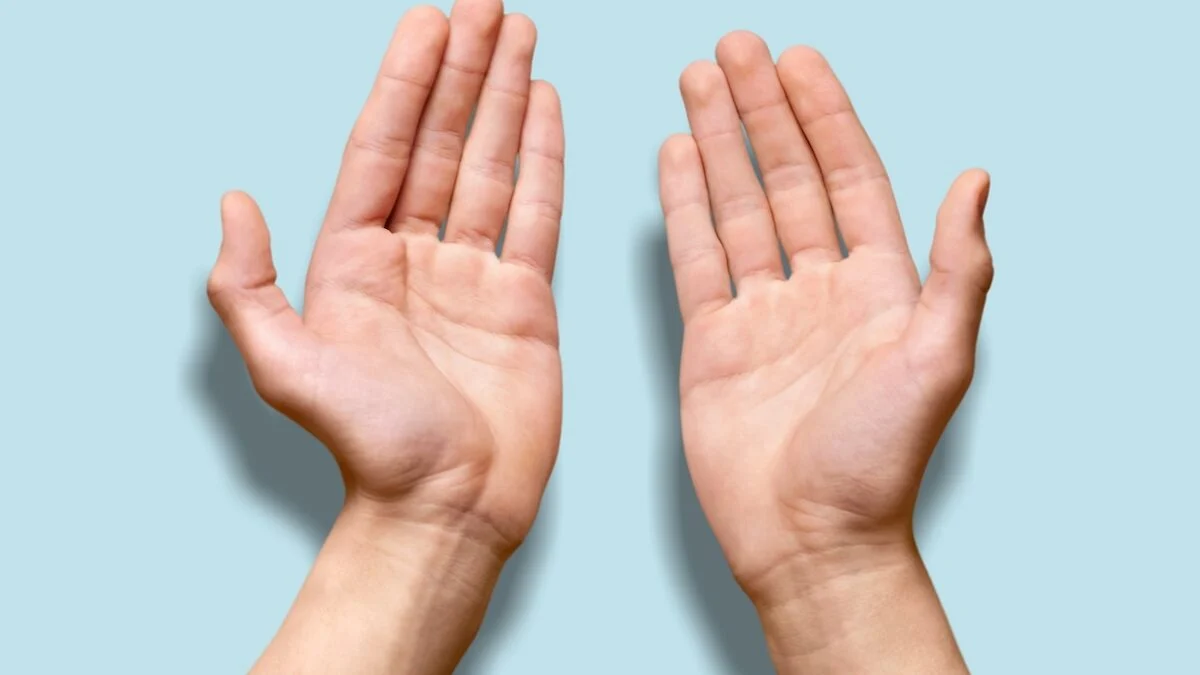
Can your hands really say anything about your health? Yes, sometimes: they can give visible clues. But they cannot predict cancer, diagnose an illness, or read the future. In the show
“It’s much better,” from RTL, Dr Frédéric Saldmann, cardiologist, nutritionist and author of books on health, recalls that the hands are closely observed because they are often uncovered, exposed and poorly protected.
Index finger longer than ring finger: an association, not a prostate test
The most striking example cited by Dr. Saldmann concerns men: according to him, when the index finger is longer than the ring finger, this detail would be associated with a lower risk of prostate cancer. The idea is intriguing, because it is based on an anatomical sign that is simple to observe.
The fact check, however, imposes an essential nuance. The study corresponding to this assertion is not recent: it is a British case-control study published online in 2010 in the British Journal of Cancer. She observed a statistical association between an index finger longer than the ring finger, also called a higher 2D:4D ratio, and lower odds of prostate cancer. All ages combined, the reported odds ratio was 0.67; among men under 60, it was 0.13.
These numbers do not mean that a man can know his personal risk by looking at his fingers. Association does not mean causality, and even less individual prediction. The length of the index and ring fingers does not constitute a screening test and should not modify medical monitoring.
The question of the prostate is discussed with a health professional, depending on age, symptoms, personal and family history.
Hand tremors: a signal to observe without worrying unnecessarily
Dr Frédéric Saldmann talks about hand tremors. He cites in particular the resting tremor, which can lead to the search for Parkinson’s disease, while recalling that other causes exist, such as alcohol or nervousness.
The wording must remain cautious: a tremor is not enough to diagnose Parkinson’s. Above all, it deserves to be understood in context. Medical advice is useful in certain situations:
- A tremor appears recently or persists;
- It occurs at rest, worsens or becomes bothersome;
- It is accompanied by slowness of movement, stiffness or other symptoms.
Spots, sun and hand lines: what your hands can really reveal
The hands also tell a story of exposure. Dr Frédéric Saldmann emphasizes that we often think about protecting the face, but much less the hands. However, UV rays accelerate skin aging and promote certain pigment spots, particularly on the backs of the hands. Protecting this area during repeated exposure to the sun therefore makes sense, just like the face.
Not all stains should be interpreted the same way. Many are linked to age and the sun, but a lesion that changes, bleeds, does not heal or appears different from others warrants medical advice.
There remains the question of the lines of the hand. Dr. Saldmann reports that work has not made it a reliable tool for predicting longevity. This myth above all illustrates the danger of anxiety-provoking predictions: announcing an early death can leave a lasting mark on a person, without medical value. In summary, hand lines do not predict lifespan.
Observing your hands can therefore help spot a change, excessive exposure or persistent tremor. The right reflex is not to self-diagnose, but to consider these signs as elements to be clearly described to a health professional if necessary.